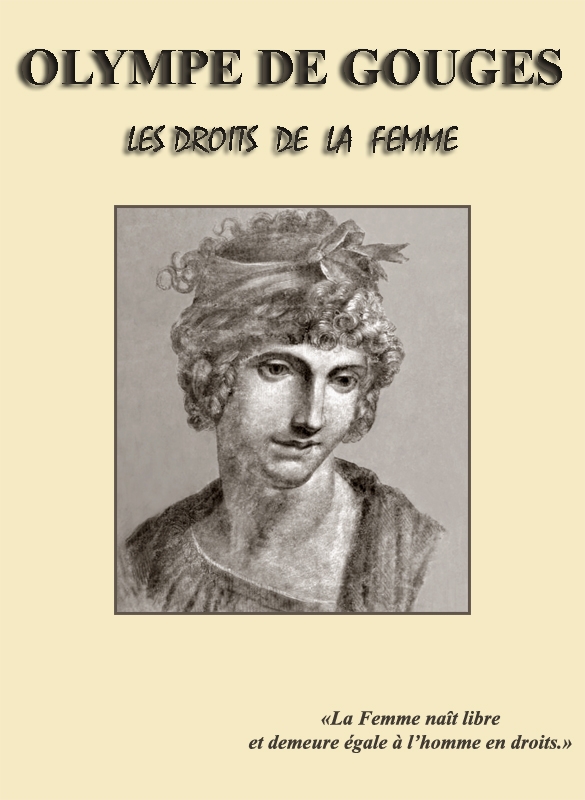
Olympe de Gouges's Declaration of the Rights of Woman and of the Female Citizen is often remembered as a proto-feminist answer to the French Revolution's more famous 1789 declaration. That description is true, but it is too soft for the text itself. Read closely, the pamphlet is not merely asking revolutionary France to be nicer, broader, or more consistent. It is taking the Revolution's own universal language, mirroring it article by article, and forcing that language to answer a harder question: if sovereignty, liberty, and equality are truly general principles, why do they stop at the threshold of female citizenship?[1][2][3][4]
The lead image uses the scanned cover of Les droits de la femme.[1] That choice fits because the pamphlet's force lies in its physical boldness as much as its doctrine. Gouges did not write a private letter or a philosophical aside. In 1791 she published a document that visibly imitates the format of a declaration, places women inside the nation-forming vocabulary of the Revolution, and then pushes that vocabulary into the legal, fiscal, and domestic spaces where exclusion actually lived.[1][2][4]
Timeline anchors: the pamphlet sat inside a narrowing revolutionary definition of citizenship
- August 20-26, 1789: the National Assembly voted through the seventeen articles of the Declaration of the Rights of Man and of the Citizen, which announced natural rights, national sovereignty, and legal equality in a language that claimed universality.[3]
- September 1791: Gouges published Declaration of the Rights of Woman and of the Female Citizen as a direct response, reworking the 1789 structure while the Revolution was still defining who counted as a political subject.[2][4][5]
- 1791: the pamphlet appeared as one part of Les droits de la femme, not as an isolated slogan but as a broader printed intervention with a dedication, preamble, articles, and a model social contract.[1][5]
- November 3, 1793: after siding with the Girondins and defending positions out of step with the Jacobin turn, Gouges was executed in Paris.[5][6]
Those dates matter because they prevent a common flattening. Gouges was not writing from outside the revolutionary moment, nor from the safe distance of later commemoration. She was intervening while the Revolution was still congratulating itself for discovering universal rights and while women remained excluded from the political machinery that supposedly expressed the general will.[3][4][5]
First layer: the pamphlet works by copying the declaration form and turning it against itself
The opening move is visible immediately in both the French text and the English translation. Gouges does not invent an entirely new genre. She rewrites the revolutionary genre already carrying legal prestige.[1][2] The preamble restages the 1789 declaration's logic of public misfortune and governmental corruption, but shifts the missing subject into view: the injuries now flow from ignorance, neglect, or contempt for the rights of woman.[1][2] Instead of letting "man" continue to operate as an allegedly universal container, Gouges names mothers, daughters, and sisters as representatives of the nation.[2][4]
That structure matters more than any one slogan. The pamphlet is strongest when treated as a hostile mirror. It keeps saying, in effect: you have already declared the governing principles; now watch what happens when those principles are read literally enough to include the people your institutions are excluding. The point is not simply to add women to a finished constitutional order. The point is to expose how unfinished that order looks once its own language is applied without the old gender exemptions.[2][3][5]
The famous first article announces the method in compressed form: "Woman is born free and remains equal to man in rights."[2] That line matters not because it is abstractly inspiring, but because it is almost mechanically close to the 1789 original.[2][3] Gouges is not leaving the revolutionary canon; she is forcing it to hear its own sentence again with a blocked subject restored.
Second layer: sovereignty and lawmaking are where the universal claim begins to bite
The text becomes sharper once it reaches the articles on sovereignty and law. Here Gouges moves beyond symbolic inclusion and starts touching the actual machinery of political authority. In Article III, the nation is described as the union of woman and man; in Article VI, female and male citizens should concur in making the law and should be equally admissible to dignities, offices, and public employments according to talent and virtue.[1][2]
This is where the declaration stops sounding like ornamental equality and starts sounding constitutionally dangerous. The 1789 declaration had already attached legitimacy to national sovereignty and general will.[3] Gouges accepts that grammar, then asks what follows if women are truly part of the nation rather than dependents housed inside male-headed citizenship. Once that question is asked, exclusion from office, legislation, and representation can no longer be treated as a local custom. It becomes a contradiction inside the Revolution's own first principles.[2][3][5]
My inference from the text's structure is that Gouges understood something deeper than "representation matters." She saw that universality fails first at the point where law is made and administered. That is why the pamphlet keeps returning to participation, office-holding, and public accountability rather than stopping at moral recognition alone.[1][2][4]
Third layer: the declaration is at its most unsettling when it turns punishment and speech into one sentence
Article X remains the best-known passage for good reason. Gouges writes that woman has the right to mount the scaffold and should equally have the right to mount the tribune.[1][2][5] The line is memorable because it is epigrammatic. It is historically important because it identifies an asymmetry the revolutionary order could not easily defend. Women were fully visible to punishment, sacrifice, and public discipline, yet still denied full standing in public speech and political authorship.[2][5]
That sentence is not merely witty. It is diagnostic. It says the state already knows how to treat women as subjects when coercion is involved. The missing equality lies not in exposure to power, but in access to voice, deliberation, and legitimacy. In one stroke, Gouges converts a complaint about women's status into a question about the integrity of republican publicity itself.[2][5]
The same pattern appears in Article XI, which Britannica rightly flags as one of the pamphlet's most radical sections.[4] There Gouges links free communication of thoughts and opinions to a woman's right to name the father of her child.[2][4] That move can look strange if the text is read as a generic rights manifesto. It becomes perfectly coherent once the pamphlet is read as an attack on the places where public ideals break down in private arrangements. Speech is not only a parliamentary freedom here. It is tied to filiation, legitimacy, inheritance, and the legal invisibility that made women bear social cost while men escaped acknowledgment.[2][4]
Fourth layer: taxation, property, and marriage show that the real target is the household constitution
The pamphlet keeps descending from large principles into embarrassingly practical questions. Articles XIII through XV insist that if women share the burdens of taxation and labor, they should also share in the distribution of positions and in the right to demand an account from public agents.[1][2][4] This is one of the text's most revealing choices. Gouges does not let revolutionary citizenship remain a theater of noble abstractions. She drags it toward taxes, offices, and public accounts.
That emphasis matters because taxation was one of the Revolution's core legitimating themes. If public contribution helps authorize political voice, and women are already folded into fiscal obligation, then the exclusion of women from public authority looks less like a philosophical oversight than like a managed asymmetry.[2][4] Gouges presses exactly there.
The postscript and model social contract push the argument one step further. As the IEP summary notes, the pamphlet was not just a preamble plus seventeen articles; it also included a critique of marriage and a contract form that imagined a more equal civil union.[5] Britannica emphasizes the same point: property, inheritance, separation, widows, and children born outside marriage all enter the pamphlet's reform horizon.[4] That is why the strongest reading of the declaration is broader than "women deserve the same rights as men." Gouges is testing whether revolutionary universality can survive contact with the family order that allocates property, names fathers, and makes women legally dependent in the first place.[4][5]
Two readings still compete
Reading one: the text is mainly an early universal-rights manifesto
This reading treats the pamphlet as important because it says plainly what the Revolution refused to say plainly: women are equal bearers of natural rights and should therefore enjoy the same citizenship guarantees.[2][4] That is correct as far as it goes.
Reading two: the text is mainly a stress test for the Revolution's weak points
This reading treats the pamphlet as a document that takes the Revolution's official principles and runs them through the practical sites where they begin to fail: representation, punishment, paternity, taxation, inheritance, office-holding, and marriage.[1][2][4][5] On this reading, Gouges is not merely seeking admission into an existing system. She is demonstrating that the system's universality is unstable because it depends on exclusions it will not name.
Why the second reading is stronger
The second reading better matches the architecture of the text. Gouges does not stop at asserting equal dignity. She rewrites sovereignty, lawmaking, speech, public finance, and domestic contract in sequence.[1][2][4][5] That sequence is the argument. It shows that rights language remains evasive unless it reaches the institutions that sort dependence from citizenship.
That is why the pamphlet still feels alive. The 1789 declaration had already said that men are born free and equal in rights and that law expresses the general will.[3] Gouges answered in 1791 by asking the question that such language could not avoid forever: universal for whom, and under what household and legal conditions?[1][2][3] The document endures not because it offered a decorative supplement to the Revolution, but because it made universal citizenship answerable to the people it had left just outside the frame.
Sources
- Project Gutenberg, Les droits de la femme by Olympe de Gouges - French text of the 1791 pamphlet and the scanned cover image used here, digitized from Bibliotheque nationale de France holdings.
- Columbia College, "The Rights of Woman (1791)" - English translation of the declaration and related pamphlet sections.
- Assemblee nationale, "La Declaration des droits de l'homme et du citoyen" - official historical background on the 1789 declaration adopted by the National Assembly.
- Encyclopaedia Britannica, "Declaration of the Rights of Woman and of the (Female) Citizen" - overview of the pamphlet's structure, articles, and social-contract section.
- Internet Encyclopedia of Philosophy, "Olympe de Gouges (1748-1793)" - biography and analysis of the pamphlet's five-part structure, political context, and legacy.
- Encyclopaedia Britannica, "Olympe de Gouges" - biographical context on Gouges's 1791 publication, Girondin alignment, and execution in 1793.