
The first object that commands attention in Everest Heroes Home is not the summit photograph. It is an ice axe carrying a Union Jack. Colonel John Hunt lifts it as the British Everest expedition steps from a BOAC airliner at London Airport on July 3, 1953. A government minister waits on the tarmac, police hold a public behind barriers, and cameras turn an arrival into a ceremony.[1][4]
Only five weeks earlier, on May 29, Tenzing Norgay and Edmund Hillary had become the first people confirmed to stand on the summit of Mount Everest. Hillary was a New Zealander; Tenzing was the expedition's most experienced Sherpa climber. They reached the summit by the southeast ridge as the final pair in a large, coordinated British expedition led by Hunt.[2][3] The ascent depended on far more people than the two who reached the top, a fact Hunt and Hillary repeatedly stressed afterward.[3]
That is what makes the newsreel's title worth pausing over. Whose “home” had the heroes reached? Hunt was returning to Britain. Hillary and Tenzing were arriving in a capital eager to claim their achievement as British and Commonwealth history. The two-minute, thirty-nine-second film does not settle that tension. It preserves the process by which a multinational climbing effort was fitted into the familiar shapes of flag, state welcome, family reunion, and direct-to-camera testimony.[1][4]
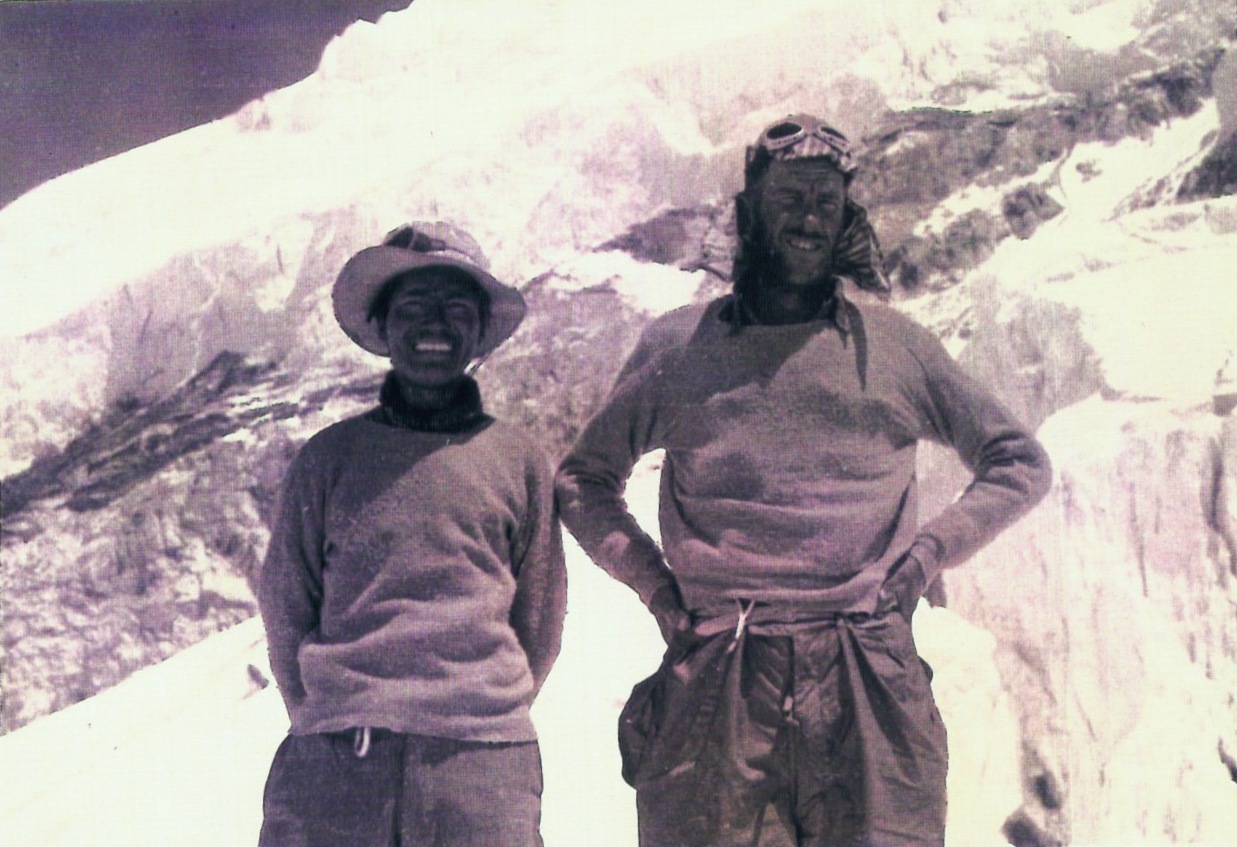
Image context: the cover is a genuine archival photograph from the John Henderson collection, not a video frame. It shows Tenzing and Hillary together in expedition clothes against ice and snow. The surviving scan has visible grain and wear, preserving the physical character of the source. Wikimedia Commons records that it was uploaded by Henderson's grandson and identifies Henderson as a Darjeeling tea planter whose family was involved with the mountain club, Sherpas, and expedition provisioning.[6]
Before the airport, an ascent built by a team
The summit story can become misleadingly small: two men, one ridge, one final step. The expedition was an organized chain. Hunt coordinated climbers, Sherpas, porters, oxygen equipment, food, communications, route preparation, and a sequence of camps that carried the attempt upward. The Royal Scottish Geographical Society calls the success the result of a “long, complex and highly co-ordinated campaign,” and its account follows Hillary and Tenzing descending through the South Col to exhausted teammates who still had to dismantle and withdraw the camps safely.[3]
The distinction between summit pair and expedition matters because the later public story repeatedly tested it. At a 1953 lecture, Hillary insisted that if the others had done anything less, he and Tenzing would never have reached the top.[3] In the Pathé interview, he again describes himself and Tenzing as a unit rather than answering the achievement as an individual possession.[1][4] This was more than modesty. It resisted the pressure to convert shared labor into a single national hero.
Even “British expedition” contained several geographies. The organization and Hunt's command were British; Hillary came from New Zealand; Tenzing's life joined Himalayan communities in Nepal and India; the high-altitude labor force and the long porter column made the mountain possible as a logistical undertaking. Historian Peter H. Hansen shows how receptions in Nepal, India, Britain, and New Zealand each tried to make the ascent express a different national story. Those celebrations did not simply follow one another. Claims made in one place changed what the climbers were asked to represent in the next.[4]
The cover photograph offers a useful counterweight to that competition. Tenzing and Hillary occupy one frame, smiling in the same hard landscape. It does not prove that every role in the expedition was equal, and it does not show the enormous support system below them. It does preserve the partnership that the post-ascent argument over who “owned” Everest kept trying to separate.[3][4][6]
How the summit reached Britain
The ascent became Coronation news before it became a newsreel homecoming. Jan Morris—then reporting as James Morris—was the only newspaper correspondent attached to the expedition because The Times was a principal financial backer. Morris later recalled that there was no radio transmitter capable of sending the story directly from the mountain and that Kathmandu's cable office lay roughly 300 miles away by difficult tracks.[5]
To protect the scoop, Morris used runners, relays, and a code that made success sound like a discouraging weather report. The dispatch began “SNOW CONDITIONS BAD” and decoded to the news that the summit had been reached on May 29 by Hillary and Tenzing. It traveled quickly enough for The Times to publish the result on June 2, the morning of Queen Elizabeth II's coronation.[5] Morris was emphatic decades later that the news had not been held back to manufacture the coincidence; getting it out that fast had required an urgent race down the mountain and through the communications chain.[5]
Yet coincidence acquired political force. Morris remembered the paired events being welcomed as an omen of a “New Elizabethan Age,” a fantasy that a war-worn Britain might recover grandeur through a young monarch and the world's highest summit.[5] By the time the expedition reached London a month later, the ascent already possessed a royal frame. The airport ceremony did not invent that association. It gave it bodies, gestures, and newsreel images.
The surviving newsreel
The embed below is British Pathé's official YouTube publication of Everest Heroes Home (1953). Hansen cites the underlying Pathé item by its archive reference, 53/50, while the YouTube copy runs 2:39 and is published by the verified British Pathé channel.[1][4] The public upload does not identify the camera operator, sound crew, digitization date, or restoration method, so the provenance should not be made more precise than the record allows. What can be said securely is that this is Pathé news footage of the expedition's London arrival, preserved and republished by the archive that holds the item.
Watch first for the relation between state ceremony and domestic reunion. Hunt's flag-bearing ice axe gives the arrival an official emblem. Secretary of State for War Anthony Head receives the party and speaks of Army and Commonwealth pride. Around that formal center, relatives meet climbers and Charles Wylie's daughter breaks through the police barrier to embrace her father. Hansen notes that about five hundred people formed a lively but orderly welcome.[1][4]
The newsreel can therefore call the scene “home” without explaining the word. The flag supplies nation; the minister supplies state recognition; the aircraft supplies imperial-era distance collapsed by modern transport; the embraces supply emotional belonging. None of those elements alone claims Everest for Britain. Edited together, they make Britain look like the natural destination at which the achievement becomes public and complete.
This is not evidence of a hidden propaganda instruction. The film's politics are more ordinary and more visible than that. The event was staged through institutions already present on the tarmac: a British airline, a military-linked expedition leader, a cabinet minister, police barriers, press cameras, and a public ready to welcome the party.[1][4] The newsreel only has to select and sequence them. Ceremony does the interpretive work.
Three voices, unequal microphones
The interviews complicate the flag. Hunt pays tribute to earlier Everest expeditions rather than presenting 1953 as a feat without predecessors. Hillary says he and Tenzing climbed as one unit. Tenzing, speaking through an off-camera translator, says he was very happy on the summit.[1][4] The statements share a refusal of solitary conquest: predecessors matter, partnership matters, and the summit is recalled as an experience rather than a possession.
But the microphone is not neutral. Hunt and Hillary can address the newsreel audience directly in English. Tenzing's words arrive mediated and shortened through translation. The film lets all three speak while making their speech differently available. That asymmetry is historical evidence. It shows how easily a climber can be visually central yet verbally dependent on another voice in the finished public record.[1][4]
The title creates a related imbalance. Hillary, as a white New Zealander, could be absorbed into a story of Commonwealth kinship even while his accent marked him as not quite metropolitan British. Tenzing could be celebrated as part of the same team while remaining more visibly and linguistically outside the category of British homecoming. Hansen argues that “Commonwealth” language helped contain precisely these ambiguities, gathering different people into a larger British story without making their positions identical.[4]
That framing was not the only one available. In Nepal and India, Tenzing became the focus of competing national claims and popular celebration; in New Zealand, Hillary's return helped consolidate a distinct national hero rather than merely an overseas British one.[4] The London newsreel is thus one stop in a traveling contest over meaning. It should be read as a British reception, not as the complete public history of the ascent.
What the homecoming preserves
The film's lasting value lies in the distance between what it says and what it shows. Its spoken language is restrained: predecessors, teamwork, happiness. Its visual setting is crowded with ownership: flag, minister, airline, barrier, waiting nation. The climbers do not need to proclaim a British triumph for the ceremony to make one available.
At the same time, the footage preserves resistance inside the frame. Hillary returns to the unit of two. Hunt returns to the longer chain of effort. Tenzing's translated sentence keeps the summit attached to his own feeling. Family members interrupt the official line of reception. The people being turned into symbols do not vanish entirely into the symbols.[1][4]
That is why Everest Heroes Home belongs in an archival spotlight rather than serving as decorative proof that the climb happened. It records a second achievement being assembled after the physical one: the transformation of a Himalayan expedition into usable public memory. The summit had been reached on May 29. The news reached Coronation London on June 2. On July 3, the cameras watched Britain decide what kind of arrival that success would become.[1][2][4][5]
The strongest reading does not replace the climb with media criticism. Hillary and Tenzing's ascent was real, difficult, and dependent on an exceptional team.[2][3] The newsreel reveals something that a summit chronicle alone cannot: achievement does not enter history untouched. It travels through runners, codes, newspapers, aircraft, ceremonies, translations, and national desires. Everest came down the mountain in stages. By London Airport, it had become a Commonwealth story—but never only one.
Sources
- British Pathé, “Everest Heroes Home (1953)” — official YouTube publication of the 2:39 London-airport newsreel.
- PBS NOVA, “First to Summit” — historical account of the 1953 expedition sequence, southeast-ridge ascent, Tom Stobart's filming, and the coded news dispatch.
- Royal Scottish Geographical Society, Jo Woolf, “The First Ascent of Everest” — expedition teamwork, descent, reception, and the climbers' own emphasis on collective effort.
- Peter H. Hansen, “Confetti of Empire: The Conquest of Everest in Nepal, India, Britain, and New Zealand,” Comparative Studies in Society and History 42, no. 2 (2000) — analysis of competing national receptions and the Pathé item Everest Heroes Home.
- Jan Morris, “The Effect of Everest,” Alpine Journal 98 (1993) — first-person account of the coded dispatch, runner network, Coronation coincidence, and its later mythology.
- Wikimedia Commons, “Tenzing and Hillary” — archival photograph from the John Henderson collection used as the cover image, with source and file metadata.