On 10 May 1857, Indian cavalrymen and infantrymen at Meerut broke open a jail, released comrades imprisoned for refusing rifle cartridges, and turned against their East India Company officers. Mutiny describes that act precisely: soldiers disobeyed a military command and attacked the authority under which they served.[1]
Within twenty-four hours, however, the rebels had traveled roughly thirty-six miles to Delhi, drawn in more regiments, taken the former Mughal capital, and proclaimed the elderly Bahadur Shah Zafar the emblematic leader of the uprising. Peasants, artisans, laborers, dispossessed rulers, landlords, and townspeople entered conflicts that did not all begin in a barracks. Mutiny was already becoming too small.[2]
Half a century later, V. D. Savarkar offered an influential opposite framing. His 1909 history presented 1857 as an Indian war of independence: a national, anti-colonial beginning rather than a breakdown inside a colonial army. The book was banned in India almost until independence and helped make “mutiny or war” a central twentieth-century argument. Savarkar’s account restored political purpose to people whom colonial narratives had reduced to disloyal troops or a violent crowd. It also risked giving many local wars a unity they did not yet possess.[2]
The naming dispute is not a vocabulary exercise with one correct answer hidden at the end. Each term selects a scale, a cast, and a direction of travel. “Sepoy Mutiny” begins with the Company’s army and looks outward. “First War of Independence” begins with the later Indian nation and looks backward. “Rebellion” or “uprising” keeps the middle open, but can become so broad that it explains nothing.
The most defensible account therefore uses more than one name—and asks where each one stops working.
The mutiny interpretation has the clearest beginning
Months of unease preceded Meerut. On 29 March 1857, Mangal Pandey attacked British officers at Barrackpore; fellow soldiers refused to restrain him but did not then join a general revolt. The immediate crisis centered on the Pattern 1853 Enfield rifle cartridge, which soldiers had to bite open. Rumors that its grease contained cow and pig fat made many soldiers understand the drill as an assault on Hindu and Muslim religious practice. Yet the cartridge mattered because it landed inside older grievances over pay, promotion, service conditions, annexation, and increasingly racialized command.[1]
The Bengal Army’s structure made a military cascade possible. Its 1857 establishment included about 135,000 Indian soldiers and 24,000 Europeans. After Meerut and Delhi, all ten of its light-cavalry regiments and most of its seventy-four Indian infantry regiments were affected, though participation ranged from armed revolt to desertion or simply going home.[1] Those facts give the mutiny interpretation real weight. Trained soldiers supplied weapons, routes, organization, and an initial network along which defiance could travel.
The same evidence limits the label. The Company’s Bombay and Madras armies remained relatively quiet. Sikh, Punjabi Muslim, and Gurkha units supported the British, as did many Indian rulers and officials.[1] This was not an all-India army turning in one direction. Calling it a mutiny correctly identifies the ignition mechanism and the uneven military map.
But an ignition is not the whole fire. Once rebels entered Delhi and invoked Mughal sovereignty, they made a political claim beyond regimental discipline. Once the conflict entered Awadh’s villages, courts, estates, and bazaars, a word confined to soldiers concealed more than it revealed.
The national-war interpretation recovers the politics
The strongest case for “war of independence” does not depend on pretending that a modern national command existed in May 1857. It begins with what the rebels opposed. Company conquest and annexation had displaced rulers, altered revenue systems, threatened landed interests, and made military and religious grievances parts of a larger crisis of foreign rule. The rebellion threatened Company rule across much of northern India; one institutional consequence was the Government of India Act, passed on 2 August 1858, which transferred the Company’s territories and governing powers to the Crown.[1][2][6]
Awadh is the hardest region for a mutiny-only account to absorb. The Company had annexed the kingdom in 1856. Rudrangshu Mukherjee’s study of the subsequent revolt follows joint action by peasants and taluqdars, the region’s landed magnates.[4] Its subject is popular resistance, not merely sepoys carrying a barracks grievance into the countryside. Here military rebellion connected with agrarian power, local legitimacy, and opposition to annexation.[1][4]
Delhi also supplied a language of restored authority. Bahadur Shah Zafar had little capacity to command the whole conflict, but recognizing him mattered. It gave scattered rebels a sovereign name under which Company rule could be rejected.[2] A coalition does not cease to be political because its members want different futures.
Nationalist histories such as Savarkar’s made that anti-colonial content visible. They refused the moral geometry of “mutiny,” in which the Company appears as the natural government and resistance begins as betrayal. The phrase “war of independence” reverses the presumption: foreign rule, not military disobedience, becomes the problem to explain.[2]
Its weakness is not that independence was absent as a desire. Its weakness is scale. The uprising remained concentrated in north and central India. The evidence surveyed here does not establish one command, one program, or one imagined constitutional successor. Some fought for Mughal restoration, others for local dynasties, landed rights, religion, livelihood, or authority in a particular district. Communities could join, wait, negotiate, or support British suppression. A later national narrative cannot by itself prove a unified national intention in 1857.[1][2][3]
Local records break the two-name contest
The choice between “mere mutiny” and “single national war” looks less complete once the archive is read region by region. Tapti Roy argues that early imperial and nationalist histories often fitted Bundelkhand’s rebels into longer stories—either the improvement of British rule after a military rupture or the beginning of inevitable national liberation—whose questions were not necessarily those of the participants themselves.[3]
The primary record is correspondingly untidy. The National Archives of India describes eight volumes of “Mutiny Papers” from Bhopal covering 16 May 1857 to 6 December 1868. The collection includes sepoy activity, open rebellion by discontented jagirdars—holders of revenue assignments and local landed authority—measures taken against them, and Persian correspondence among court and district officials. It also documents Sikandar Begum of Bhopal remaining loyal to the British.[5]
One archive therefore contains mutiny, aristocratic rebellion, local administration, and Indian support for Company power. It does not offer a miniature version of one national script. It shows political actors making different calculations inside the same imperial crisis.
This is why “uprising” and “rebellion” have become useful scholarly umbrellas. They acknowledge that soldiers initiated a decisive rupture and that civilian struggles widened it, without declaring in advance that every participant belonged to one movement. The terms are not neutral; “rebellion” still implies an authority rebelled against. But they leave room to specify whether a paragraph concerns the Bengal Army, the Mughal court, Awadh’s countryside, Bundelkhand, Bhopal, or the British imperial response.
The gain is precision, not politeness. “The uprising” should never become a fog that erases who acted, against whom, and for what.
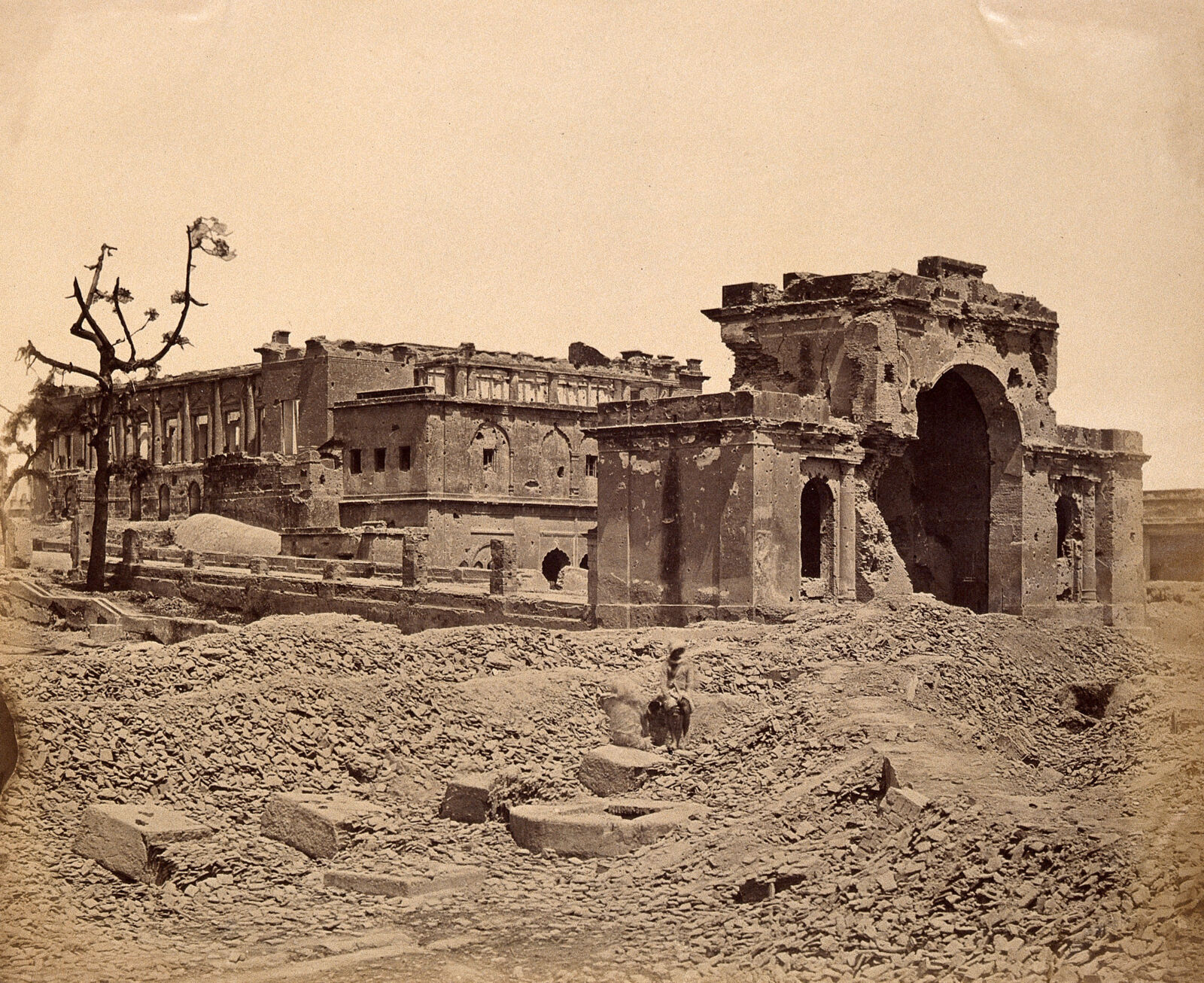
The photograph belongs to the naming problem
Felice Beato’s 1858 albumen photograph holds a damaged gateway, a roofless banqueting room used as a hospital, broken masonry, and the physical afterlife of siege.[7] It is powerful evidence that the conflict was more than an abstract argument over labels.
It is also evidence with a position. Beato arrived in India in February 1858 to record the conflict’s aftermath. Guided by military officers, he photographed, sequenced, and captioned Delhi, Kanpur, and Lucknow for an audience already following the rebellion through imperial news.[8] The photograph cannot show why an Awadh peasant joined the revolt, what a rebel proclamation meant to its readers, or how a loyal court in Bhopal understood the same crisis.
That does not make the picture false. It makes provenance part of its meaning. Colonial military records are indispensable for reconstructing units, dates, movements, and casualties; they also organize experience around what colonial officials could see and needed to govern. Later nationalist narratives recovered heroes, coordination, and anti-colonial purpose; they could smooth regional fractures into a founding epic. Local revenue files, court papers, petitions, vernacular texts, and correspondence change the cast again.[2][3][5]
Historiography advances when these archives correct one another rather than when one is declared innocent.
What would move the debate
The narrowest mutiny interpretation would gain strength if civilian mobilization consistently tracked the presence of rebel regiments, faded when those regiments moved on, and left little evidence of prior local grievances or independent organization. Existing research in places such as Awadh and Bundelkhand makes that conclusion difficult to sustain, but it remains necessary to distinguish voluntary mobilization from survival under armed power.[3][4]
The strongest national-war interpretation would gain strength if a shared anti-Company program can be shown circulating broadly across regions and social groups—and if participants used it to connect their local aims to a wider political community. A centralized command is not required for a war of independence, but evidence of common hostility to Company rule is not by itself evidence that participants understood themselves to be fighting the same national war.
S. N. Sen’s government-commissioned centenary history offered a durable bridge in 1957: the conflict began as a mutiny and widened into a political revolt.[2] The formula is valuable because it allows an event to change category. Its remaining limitation is that “widened” can sound like one center expanding uniformly. The local record suggests branching instead: military revolt opened political space, and different groups entered it with grievances, alliances, and futures of their own.
So what should the event be called? “The Indian uprising” or “the rebellion of 1857–1858” is the least misleading umbrella, provided the next sentence names the place and actors. At Meerut, begin with mutiny. In Awadh, write about popular and landed rebellion as well as soldiers. In the history of Indian anti-colonial nationalism, explain why the first war of independence became a powerful inheritance without treating inheritance as proof of original unity.
1857 refuses one name because it was not one kind of event. The refusal is not a failure of historical judgment. It is the judgment: scale changes the answer, archives carry viewpoints, and a conflict can begin in an army, become many regional rebellions, and later enter national memory as a war.
Sources
- National Army Museum, “Why did the Indian Rebellion happen?” — institutional overview of Bengal Army composition, military grievances, the Barrackpore and Meerut sequence, the spread among regiments, and uneven participation across Company armies.
- Jill C. Bender, “Introduction,” in The 1857 Indian Uprising and the British Empire. Cambridge University Press, 2016 — chronology, the Delhi transition, civilian participation, and a historiographical survey from early British accounts through Savarkar, S. N. Sen, and later archive-centered scholarship.
- Tapti Roy, “Visions of the Rebels: A Study of 1857 in Bundelkhand,” Modern Asian Studies 27, no. 1 (1993) — critique of imperial and nationalist master narratives and source-grounded study of regional rebel aims.
- Rudrangshu Mukherjee, Awadh in Revolt, 1857–1858: A Study of Popular Resistance, 2002 edition with a new introduction. Permanent Black/Orient BlackSwan — publisher record for the regional study of peasant and taluqdar action.
- National Archives of India, “Reference Tools” — official catalogue description of eight volumes of Bhopal Mutiny Papers, including sepoy revolt, jagirdar rebellion, Sikandar Begum’s loyalism, and Persian administrative correspondence.
- UK Public General Act, Government of India Act 1858, 21 & 22 Victoria c. 106 (2 August 1858) — primary text transferring the East India Company’s territories and governing powers to the Crown.
- Wellcome Collection, “Lucknow Residency in ruins: gateway and banqueting room” — catalogue record and digitized image for Felice Beato’s 1858 albumen photograph, reference 569479i.
- J. Paul Getty Museum, “Felice Beato: A Photographer on the Eastern Road” — institutional exhibition history of Beato’s February 1858 arrival in India, work with military guides, and sequencing of Delhi, Kanpur, and Lucknow photographs to reconstruct the uprising for viewers.