Absence is difficult to film. A camera can record a crowd in a square, but not a meal left uncooked, a child-care shift not performed, a telephone exchange short of staff, or the cumulative force of thousands of people declining their ordinary work. That problem sits inside a one-minute Associated Press news item from October 24, 1975, when women across Iceland left workplaces and stopped housework to demonstrate how much of the country depended on their paid and unpaid labor.[1][2]
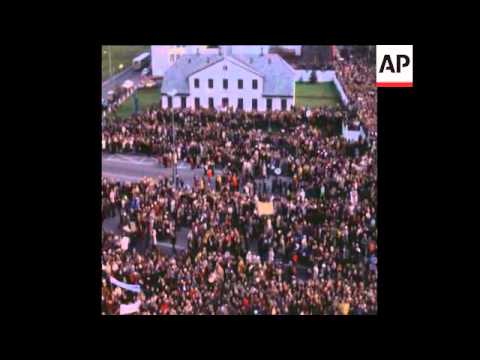
The footage solves the visual problem by showing presence: Lækjartorg in central Reykjavík filled with people. Seen from above, the gathering becomes a measure of scale. Seen closer, women sing and look toward one another, restoring faces and voices to what might otherwise read as an anonymous mass.[1] Yet the action’s real instrument remains largely outside the frame. The full square mattered because so many other places had been made conspicuously empty.
That tension makes this short film more than an illustration of a famous protest. It is an archival lesson about visibility. News film can make solidarity legible in seconds; it can also encourage viewers to mistake the most filmable part of an event for the whole event. Read beside organizing papers, later recollections, and a photographer’s wider record, the minute reveals both the power and the limit of the public image.
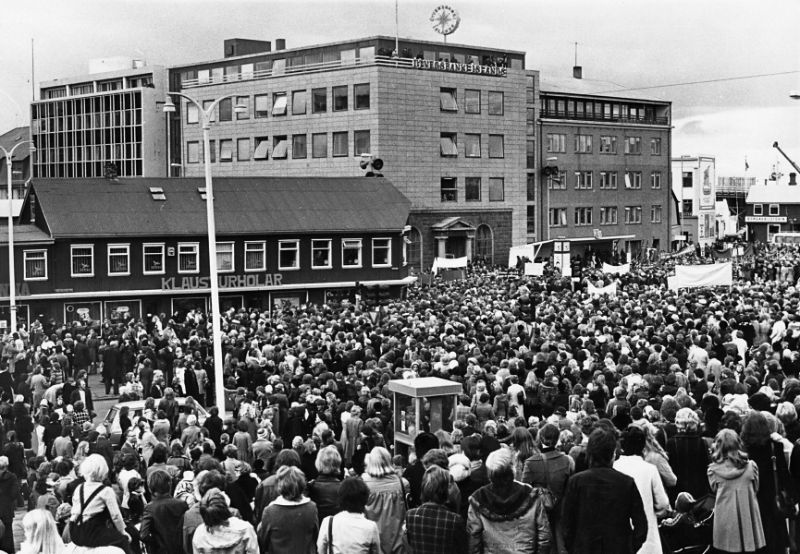
Image context: the cover is a genuine archival photograph from the KSS 1 collection at the Women’s History Archives at the National and University Library of Iceland, not a frame extracted from the embedded video. Its wide view documents the rally’s density while retaining the buildings around Lækjartorg. The gallery does not identify a photographer for this image; it makes the KSS 1 photographs available for informational use and requests attribution and a link to the archive.[3]
A strike designed to include people wary of strikes
The day did not appear spontaneously. Iceland’s Redstocking movement had discussed a women’s strike by 1970 and raised the idea again with women from low-income groups in January 1975.[3][5] The immediate organizing structure widened during the United Nations’ International Women’s Year. More than two hundred delegates met at a Women’s Congress in Reykjavík on June 20–21, 1975, where a motion urged women to stop work on October 24—United Nations Day—to demonstrate the importance of their labor.[3]
Organizers then built a coalition across trade unions, political positions, women’s associations, and other groups. Representatives of more than fifty organizations and interests met on September 11 and created an executive committee and working groups for publicity, media, finance, programming, and activity outside Reykjavík.[3] That infrastructure matters. The later image of a nation moving as one can hide the months of letters, meetings, arguments, leaflets, and volunteer coordination required to make collective refusal possible.
Even the event’s name was strategy. Organizers debated whether to call it a verkfall, a strike, or kvennafrí, a women’s day off. A 1977 account by two women involved in the day says “strike” seemed unpopular to many potential participants and legally difficult, while “day off” could invite a broader coalition.[3] Historian Valgerður Pálmadóttir likewise describes the softer name as a way to secure participation across political lines, even though it left the action’s political meaning open to competing interpretations.[5]
The phrase therefore should not be taken literally. This was not leisure granted by an employer. It was labor deliberately withdrawn for an entire day. The naming lowered an entry barrier without changing the demonstration’s basic mechanism. That ambiguity also gave reporters a choice: frame the action as a holiday, an interruption, a curiosity, or a strike. A 2024 study of Nordic print coverage shows that newsrooms filtered its significance through local ideas about feminism, gender equality, and newsworthiness.[6] The archive did not merely record the action after the fact; media framing helped determine what kind of action distant audiences believed they had seen.
The archival minute
AP Archive titles the item “SYND 25 10 75 WOMEN OF ICELAND ON STRIKE.” Its public description dates the scene to October 24 and identifies the withdrawal of women’s work in factories, stores, communications, and kitchens.[1] The “SYND” title and following day’s date locate the clip within news distribution, but the public YouTube record does not name a camera operator, an original broadcaster, or a restoration process. Those absences are important: the footage can be credited to AP Archive as published, but it should not be assigned a more specific production history without further documentation.
The clip’s brevity produces a striking visual grammar. High views compress the gathering into a dense field around the buildings of Lækjartorg. Individual signs are hard to read at that distance, but occupation itself becomes the message: ordinary circulation has been replaced by assembly. The camera’s elevated position makes the crowd countable in principle while refusing any exact count in practice. It offers magnitude, not measurement.[1]
The closer view changes the political scale. Women singing are no longer units inside a pattern; mouths open, expressions differ, and collective action becomes something performed together rather than simply observed from above.[1] The cut between mass and face answers two different questions. How large was the action? Large enough to transform the square. Who made it? Particular people, not an abstract social force.
But even this shift cannot show the action’s full geography. The anniversary account maintained by the Women’s History Archives says organizers estimated that 90 percent of Icelandic women stopped work and that approximately 25,000 people gathered at Lækjartorg, with demonstrations elsewhere in the country.[2] Those are organizer estimates, not a census, and a 1977 participant account gives the Reykjavík crowd as 30,000.[3] The discrepancy is a reason to use “about 25,000,” not to turn an aerial shot into proof of a precise total.
The sources agree on the broader disruption. Schools, shops, fish-processing factories, theaters, and other workplaces closed or slowed; housework and child care were withdrawn as well.[3][4] The distributed stoppage is what gave the visible rally its force. AP’s camera can show the consequence—a square made extraordinary—but a viewer needs the written record to understand the negative space: all the routine labor no longer occurring elsewhere.
What the famous crowd can obscure
The most repeated statistic, 90 percent, can make solidarity sound automatic. The organizing record shows the opposite. Participation was constructed across differences, and the flexible name allowed women to attach different political meanings to the same act.[3][5] Pálmadóttir argues that the broad consensus made the event ideologically open, even vague, while also making mass participation possible.[5] Unity here was an achievement of coalition, not evidence that class, party, occupation, and ideas about feminism had disappeared.
There is another risk in stories about the day: the comic tale of fathers bringing children to work or struggling to prepare food. Such episodes make dependence vivid, but they can recenter men’s inconvenience as the event’s main drama. The stronger historical point is structural. When child care and cooking suddenly traveled into offices and other workplaces, labor usually kept inside the household crossed into public view. The disruption exposed not an amusing lack of domestic competence, but the extent to which the formal economy had relied on care work remaining available and largely unseen.[3][7]
The film’s crowd scenes perform a similar conversion. They turn withdrawal into a positive image that a news service can transmit. That conversion was necessary for publicity, yet incomplete as evidence. The camera records that a large rally occurred. The archival papers explain how it was organized. Accounts of closures connect the rally to a national stoppage. Later scholarship shows how journalists selected meanings for audiences abroad.[2][3][6] No one source does all four jobs.
A turning point, not a single cause
The chronology after 1975 invites a triumphant ending. Iceland adopted its first Gender Equality Act in 1976. In 1980, Vigdís Finnbogadóttir became the world’s first woman democratically elected as a national head of state, and she later described the Women’s Day Off as important to the possibility of her election.[4][5][7] These are genuine landmarks. They do not prove that one day mechanically caused every later advance.
That distinction matters because “Iceland solved equality” is itself a powerful media frame. Pálmadóttir’s research explicitly places the day’s legacy against a dominant triumphal story and examines the continuing tension over its political meaning.[5] The action demonstrated capacity, altered public expectations, and supplied later movements with a usable symbol. Laws and elections still emerged through separate institutions, campaigns, compromises, and decisions. Historical significance can be enormous without being monocausal.
The event’s repetition is better evidence of an unfinished legacy than any victory narrative. Women’s stoppages returned in 1985, 2005, 2010, 2016, 2018, 2023, and 2025, and the Women’s History Archives preserves papers from their organizing committees.[2] Each return treats 1975 not as a completed solution but as a method: withdraw work, reveal dependence, and make inequality public again.
The AP minute endures because it makes the method memorable. A crowd fills the screen; singing gives the crowd a voice; the square offers news cameras a concentrated symbol. Its most consequential subject, however, is what remains beyond its edges. The film shows women making themselves visible. The history explains why they first had to make their labor absent.
Sources
- AP Archive, “SYND 25 10 75 WOMEN OF ICELAND ON STRIKE” (archival footage filmed October 24, 1975).
- Women’s History Archives, “The Women’s Day Off” (50th-anniversary overview, participation estimates, later actions, and archival holdings).
- Women’s History Archives at the National and University Library of Iceland, “Women’s Day Off 1975” (organizing papers, 1977 participant account, and Snorri Zóphóníasson photograph collection).
- Government of Iceland and Centre for Gender Equality, “Gender Equality in Iceland” (historical timeline and legal context).
- University of Iceland, “Legacy and international impact of the 1975 Icelandic Women’s Day Off” (interview with historian Valgerður Pálmadóttir, January 9, 2023).
- Heidi Kurvinen and Valgerður Pálmadóttir, “The 1975 Icelandic ‘Women’s day off’ in Nordic print media,” Scandinavian Journal of History 49, no. 5 (2024), University of Iceland research record.
- Library of Congress, In Custodia Legis, “Kvennafridagurinn – The Day Icelandic Women Went on Strike” (March 8, 2022).