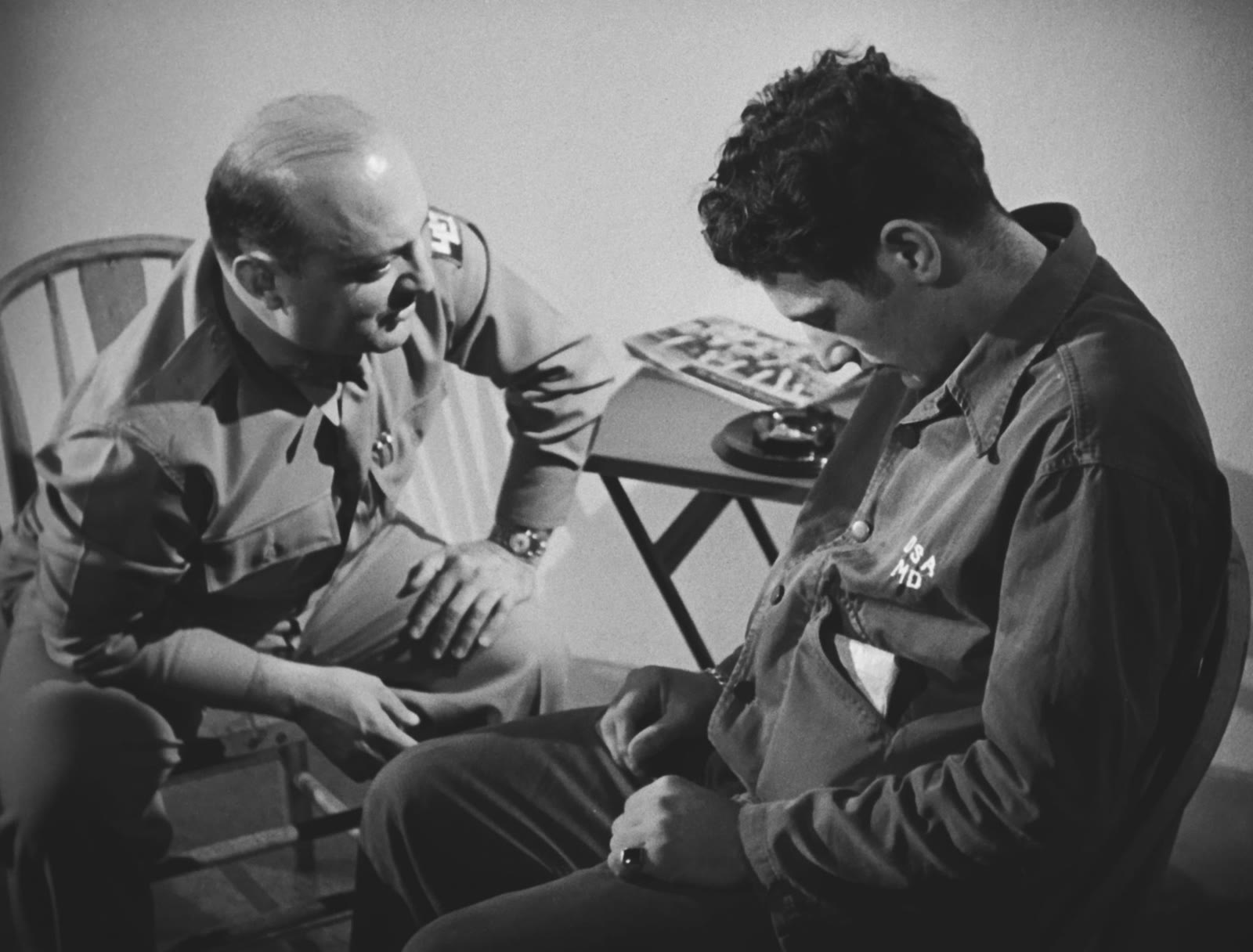

The first thing to notice in Let There Be Light is not a diagnosis or a treatment. It is volume. Men who have survived combat speak softly, sometimes with long pauses, while Army psychiatrists lean toward them and wait. In a wartime information film, where narration usually tells the audience what courage looks like, these uncertain voices are startling evidence. They make psychological injury audible without converting it into cowardice.
John Huston filmed the men in 1945 at Mason General Hospital on Long Island. The U.S. Army Signal Corps had commissioned a film about returning “psychoneurotic” soldiers; Huston instead followed one group from admission through an intensive treatment program and into a carefully staged-looking return to civilian possibility. The finished 58-minute documentary used unscripted interviews, racially integrated group sessions, clinical demonstrations, occupational activity, and recreation. It was completed in 1946, then barred from public circulation by the institution that had paid for it.[2][3][4]
Watch the film with two stories in mind. One is humane and still radical: combat can injure a mind, the injury is not a moral failure, and listening is part of care. The other is more constraining: an Army film still needs an arc from damaged arrival to useful discharge. Huston gives the men unusual room to speak, but editing, narration, music, and the selection of visibly improving patients organize those voices into a promise of recovery. The tension between testimony and reassurance is the film’s real subject.
Image context: the cover is a genuine archival still published by the National Archives, not a YouTube thumbnail or a generated illustration. It shows one of the film’s hypnosis sessions and belongs to the same preserved motion-picture record discussed here.[2]
Before PTSD had its present name
It is tempting to call every man in the film a patient with post-traumatic stress disorder. That shorthand makes the subject legible now, but it also folds several historical categories into a diagnosis that did not enter the American Psychiatric Association’s DSM-III until 1980. During World War II, military language included “combat exhaustion,” “battle fatigue,” “psychoneurosis,” and other terms whose meanings and administrative consequences did not map neatly onto modern PTSD.[3][6]
That distinction changes the viewing. The film is not a modern clinical guide accidentally shot in black and white. It records one institution’s mid-1940s theory of injury and restoration. Mason General had opened as a specialized Army psychiatric center in 1943 and held more than 3,000 patients at its peak. Its program extended beyond the dramatic treatments the camera favored: an official Army medical history describes occupational therapy serving as many as 900 patients a day, along with training for military neuropsychiatry personnel.[5] The movie gives a concentrated narrative, not the hospital’s whole system.
The Veterans Affairs history of PTSD also helps define what was genuinely forward-looking in the film. A major conceptual shift in the later PTSD diagnosis was locating the cause outside the sufferer—in the traumatic event—rather than treating symptoms mainly as proof of an inherent weakness.[6] Let There Be Light does not speak in current diagnostic language, but its moral argument points in that direction. War, not defective character, is allowed to be the wound.
In the first ten minutes, a face becomes a record
The opening movement carries patients from a ship and bus into intake rooms. The institutional route could have reduced them to a flow of cases. Instead, the film repeatedly stops at a face. Around the three-minute mark, a patient sits across from an interviewer as a second camera holds his expression. By roughly six minutes, another young man looks down for so long that the silence becomes part of what he is saying. The camera does not merely illustrate a narrator’s category; it waits for behavior that the category cannot contain.[1]
This effect required an extraordinary amount of filming. Huston’s crew kept multiple cameras running through unpredictable exchanges, exposing roughly 375,000 feet—close to 70 hours—for a final cut of less than one hour.[3] That production fact matters because “unscripted” does not mean unshaped. The men’s words were not written for them, but the surviving hour is a selection from an archive more than seventy times its length. Intimacy and construction coexist.
The portraits also disrupt the Army’s segregation without pretending segregation had vanished. Black and white patients appear in the same therapeutic and recreational spaces, including a group session late in the film. Preservation histories note that this visible integration distinguished Let There Be Light from the replacement film the War Department later commissioned.[3][4] The integrated frame is real evidence of this hospital setting; it is not evidence that the wartime Army as a whole was integrated.
Treatment is shown as encounter—and as spectacle
Between roughly 18 and 42 minutes, the film moves through examinations, psychological testing, narcosynthesis, hypnosis, individual interviews, and group therapy.[1] Some methods now look theatrical. A symptom appears, an Army clinician intervenes, and speech or movement returns before the scene ends. The visual rhythm can make recovery seem as immediate as switching on a lamp.
The fairest reading holds two ideas together. First, the encounters are not simply actors demonstrating a script. Huston’s reliance on continuing cameras captured patients responding in real time, and the restored soundtrack preserves hesitation, strain, and relief that a reenactment would struggle to reproduce.[2][3] Second, a filmed response inside one session is not proof of durable recovery. The documentary provides no control group, no long-term follow-up, and little space for patients who did not improve on its schedule. It should be read as historical testimony and institutional persuasion, not as clinical outcome evidence.
The group scenes widen the frame. Near the half-hour mark, men sit in rows while a clinician speaks; later, discussion lets one patient’s fear become recognizable to others. Here the film’s strongest therapeutic idea is less spectacular than hypnosis. Isolation begins to loosen when experience becomes shareable. The Army medical record places group psychotherapy, reconditioning, and occupational work inside a much larger care program at Mason General.[5] What the movie presents as a sequence of breakthroughs was also daily institutional labor.
The bright ending is both earned and imposed
In its final stretch, Let There Be Light moves toward daylight, visitors, work, and sport. By about 54 minutes, a baseball game replaces the dark ship hull and hospital corridors of the opening. Film scholar Scott Simmon reads this progression from shadow toward open fields as the visual logic of the title itself.[3] The change is pleasurable because the preceding faces have made hope matter.
It is also an argument the camera cannot fully verify. Baseball, occupational confidence, and a discharge interview give the film a legible ending; psychological injury rarely obeys an editing deadline. The closing montage asks civilians—especially prospective employers—to see these veterans as capable people rather than permanent liabilities. That anti-stigma purpose is important. Yet reassurance comes at a cost if it implies that the most acceptable wounded veteran is one who becomes productive quickly and leaves no continuing burden.
The result is more complex than either propaganda or exposé. Huston works inside an Army commission and delivers the desired prospect of rehabilitation. At the same time, the patients’ unscripted presence keeps exceeding that function. Their pauses and involuntary movements do not disappear merely because the score rises. The film’s optimism is strongest when it protects their dignity, and weakest when it makes recovery look complete.
Why the Army kept it dark
The War Department’s stated objection was patient privacy. Huston maintained that releases had been obtained and later argued that officials were defending a “warrior myth”: the image of the American soldier returning strengthened rather than psychologically broken. The archival record does not reduce this dispute to one uncontested motive, so privacy and institutional image should be treated as competing explanations, not collapsed into a single proven cause.[2][3]
What happened next clarifies the stakes even if it does not settle motive. The Army stopped a planned Museum of Modern Art screening in June 1946 and commissioned Shades of Gray as a replacement. National Archives and Library of Congress accounts note two consequential changes: white actors took the speaking roles, and their difficulties were attributed more to upbringing than to war trauma.[2][4][7] The substitute did not merely protect identities. It revised which bodies could represent injury and moved causation away from combat.
Pressure for release grew decades later. The ban was lifted in 1980, the same year PTSD entered the DSM, and public screenings followed around the turn of 1980–1981.[2][4][6] That convergence should not be mistaken for a direct causal chain. It does show that the film reached civilians only after the vocabulary and politics of war trauma had changed around it.
Restoration made listening possible again
Suppression is only half of the film’s archival history. Poor later-generation copies could technically circulate while leaving the quiet interviews difficult to understand. Beginning with preservation work supported in 2006, the National Archives and its partners restored sound from a worn 35mm exhibition print, digitizing it at 24-bit/96 kHz, while the picture was preserved from an acetate fine-grain master with wet-gate printing. NARA then produced a 2K digital restoration that premiered on Veterans Day in 2012.[2][3][4]
Those technical details are not a detour from the human story. In a film whose evidence often arrives as a murmur, removing hiss and repairing level shifts changes what the archive permits an audience to hear. Restoration cannot recover the unused footage, resolve the consent dispute, or turn the movie into a modern clinical study. It can return intelligibility to encounters that institutional suppression and material decay had both placed at risk.
That is why Let There Be Light remains worth a full viewing rather than a summary. Its treatments belong to a specific medical past, and its conclusion is too smooth. But the film recognizes something its sponsor could not comfortably circulate in 1946: a soldier’s mind could be wounded by war without his dignity being destroyed. The restored voices make that claim not as a slogan, but as a roomful of difficult, individual evidence.
Sources
- U.S. National Archives, “Let There Be Light, 1946” (digitally restored U.S. Army documentary; full embedded video).
- Criss Kovac, “The Preservation and Restoration of John Huston’s ‘Let There Be Light,’” U.S. National Archives, The Unwritten Record (November 7, 2013; suppression, release, image, and restoration provenance).
- National Film Preservation Foundation, “Let There Be Light (1946)” (Scott Simmon’s film notes, production history, transfer record, and restoration notes).
- Daniel Eagan, “A Restored Version of Let There Be Light Available Online,” Smithsonian (May 25, 2012; production, institutional framing, replacement film, release, and restoration).
- U.S. Army Medical Department Center of History and Heritage, Neuropsychiatry in World War II, chapter 22 (Mason General Hospital’s scale, occupational therapy, and the film’s institutional setting).
- Matthew J. Friedman, “History of PTSD in Veterans: Civil War to DSM-5,” U.S. Department of Veterans Affairs, National Center for PTSD (historical terminology and the 1980 diagnostic shift).
- U.S. National Archives, “National Archives Leads Restoration of John Huston’s Let There Be Light” (May 24, 2012; original purpose, replacement film, release, and preservation method).