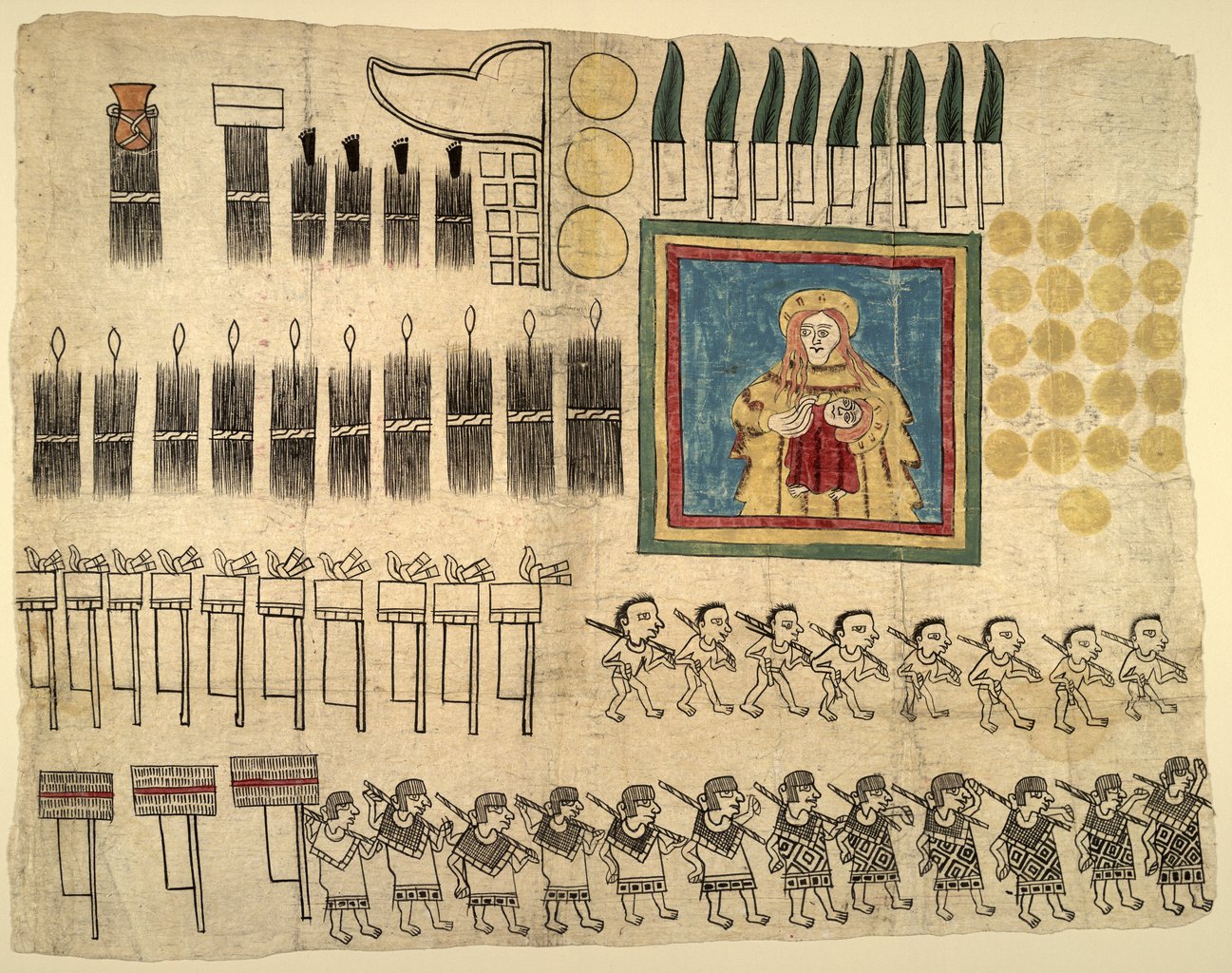
The blue square near the center looks, at first, like the subject. A haloed Virgin holds the infant Christ inside red, gold, and green borders. Then the rest of the sheet asserts itself: long feathers, gold-colored discs, sandals, bundles of darts and reeds, and two files of people walking across the lower edge. The sacred image is not floating above the account. It is one item inside it.[1][2]
This is one of eight pictorial sheets now known as the Huexotzinco Codex, made by Nahua painter-scribes from the altepetl, or polity, whose modern name is Huejotzingo in Puebla, Mexico. The paintings entered a 1531 suit against officials of New Spain's First Audiencia. They recorded tribute extracted while Hernán Cortés was away in Spain: food, textiles, equipment, military service, luxury materials, and people held in slavery. The reproduced sheet makes the cost of a campaign standard visible. Its Madonna and Child were to be executed in gold and featherwork; the surrounding signs record what the community supplied and what it sold to obtain the materials.[1][2][5]
The sheet's historical force lies in its arrangement. It turns coercion into categories and amounts. That made an abuse which could have dissolved into accusation available for inspection, narration, and judgment. Yet this is not a simple story in which an Indigenous community walked into a neutral European court and won its freedom. The images survived because Huexotzinca claims temporarily overlapped with Cortés's claim to the same tribute. To read the codex closely is therefore to watch evidence cross a colonial boundary without mistaking the boundary for justice.[2][3][6]
Before the lawsuit: allies made tributaries
Huexotzinco's position in 1531 grew from an alliance whose terms had changed drastically. In 1519, Huexotzinca forces joined Cortés and many other Indigenous allies against the expansionist Mexica state. After Tenochtitlan fell in 1521, the Spanish Crown granted Cortés the right to receive goods and services from Huexotzinco. The alliance had helped make the conquest possible; the post-conquest settlement made the allies tributaries inside an encomienda.[2][3]
When Cortés went to Spain in 1528, the First Audiencia was intended in part to curb the power he had accumulated. Its president, Nuño de Guzmán, and the judges Juan Ortiz de Matienzo and Diego Delgadillo instead drew heavily on Huexotzinco during 1529–1530. Guzmán was assembling an expedition into western Mexico, the violent campaign that would establish Nueva Galicia. Huexotzinca households were required to supply not only ordinary tribute but the provisions, arms, carriers, clothing, and prestige objects of conquest.[1][2][6]
Cortés returned to find officials consuming tribute he regarded as his lawful due. His case against the three men was therefore a contest among colonizers over authority and revenue. But it also opened a channel for Huexotzinca witnesses to describe the extraction as excessive and to place their own records before a court. Tania García-Piña's study of the accompanying testimony stresses that these witnesses were not merely illustrating Cortés's grievance: through their statements, they articulated political status, community obligations, and the difference between service owed and seizure imposed.[3]
The interests met without becoming identical. Cortés wanted his encomienda restored. The Huexotzinca wanted relief and restitution. The codex matters precisely because it preserves that unstable alignment rather than smoothing it into a modern rights case.
A ledger that refuses to become a table
The reproduced sheet can be read as an invoice, but it does not look like one. There are no ruled columns and no alphabetic labels. Quantity is built through a visual grammar of repetition, grouping, and numerical signs attached to recognizable things. A viewer who knows that grammar can move from the item to its scale: not merely a sandal but a required quantity of sandals, not merely a dart but bundles of weapons, not merely a feather but a costly consignment of long green plumes.[1][2]
That structure does two jobs at once. First, it disaggregates the exaction. “Tribute” becomes cloth, liquid amber, sandals, darts, gold, feathers, a horse, and human lives. The official who might describe all of this as support for an expedition is confronted with the community's itemized burden. Second, it preserves relationships among costs. The standard in the center required gold and feathers; those materials required other payments and sales. The page therefore records not only objects but a chain of conversion—household production into mantles, mantles into provisions or valuable materials, and human captivity into purchasing power.[2][5]
The twenty figures at the bottom make the chain hardest to evade. Recent scholarship identifies them as eight men and twelve women held in slavery and sold so that the community could acquire materials for the standard.[2][5] Their inclusion is not emancipatory. The painters give us no names, and the account itself participates in a world that could render people alienable. But the figures do something a total in Spanish prose might not. They keep the human transaction in the same field of view as the finished holy image. The banner's beauty cannot be detached from its price.
This is why “countable” does not mean coldly numerical. The painters did not convert every cost into one abstract unit. They kept sandals looking like sandals, feathers like feathers, and people like people. The result is exact enough to support testimony while remaining materially specific enough to expose what the total consisted of.
The Madonna is a campaign expense
The central image is among the earliest surviving Indigenous-made depictions of the Madonna and Child in the Americas. Read alone, it might be recruited into a familiar story of rapid Christian conversion after conquest. Read in place, it tells a more difficult story. It represents a luxury featherwork-and-gold standard demanded for Guzmán's western campaign.[2][5]
Its Christian iconography and Nahua facture are not competing explanations. Featherworkers in central Mexico possessed an exacting art of assembling brilliant plumes into shimmering surfaces. The standard brought that knowledge into a European religious image and a Spanish military project. The codex, in turn, brought the standard back into a Nahua record of obligation. At every stage, the object changed function without losing the labor and materials that made it possible.
The placement is the close reading's hinge. The Virgin does not crown a victory scene or bless the marching figures below. She occupies a rectangular block among gold discs and counters. The composition denies the devotional image an innocent frame. Christianity, Indigenous artistry, colonial display, and armed expansion are not successive chapters here; they are simultaneous entries in one account.
Images did not testify by themselves
It is tempting to call pictography a universal language, as though the Spanish judges only had to look. The legal process was more layered. Three Huexotzinca witnesses traveled with the paintings to Mexico City. They were shown the sheets, spoke about them in Nahuatl, and had their statements interpreted and written down in Spanish. The surviving codex joins eight paintings to 79 European-paper documents associated with the case.[2][3][4]
Meaning was therefore produced in a sequence: painter-scribes organized the original record; witnesses identified objects and obligations; an interpreter carried speech between Nahuatl and Spanish; a clerk fixed that speech in legal prose; and Cortés's counsel fitted the whole assemblage to his pleadings. Each step made the claim usable in a Spanish forum. Each step also created an opportunity to redirect it.
The pictorial sheets supplied resistance to that redirection—not immunity, but resistance. A clerk could summarize testimony, while the image continued to display which goods clustered around which demand and how many human figures belonged to the cost. A lawyer could cast the exaction as damage to Cortés, while the painting continued to locate production, loss, and memory in Huexotzinco. The images were powerful not because they needed no translation, but because translation could not wholly replace them.[2][3]
Their materials reinforce the point. Scientific examination identifies four paintings on amate bark paper and four on maguey-fiber paper, made by three Indigenous scribes. The palette includes carbon black, cochineal red, and a regionally distinctive Maya blue, alongside signs of changing colonial practice. The evidence was adapted for a new courtroom audience, but it was not manufactured on neutral paper in a neutral visual language.[4]
A victory inside the system that caused the injury
The litigation succeeded against the Audiencia officials in Mexico and continued in Spain. In 1538, Charles I upheld the judgment and ordered two-thirds of the extracted tribute returned to the Huexotzinca community, according to the ruling later identified in the Library of Congress collections.[1][6]
That outcome was consequential. It shows Indigenous records and testimony altering a royal decision only a decade after the invasion. It also has a clear boundary. The judgment did not abolish encomienda, end tribute, reverse the conquest, or recognize the twenty people pictured at the bottom as having been wronged by their sale. It corrected an excess within colonial government while leaving the structure that made Cortés a claimant largely intact.
Calling the codex evidence of “resistance” is justified if resistance is not confused with autonomy or complete victory. The Huexotzinca used the forum available, joined a case whose sponsor had his own extractive interest, and made their account difficult to exclude. Their agency consisted not in choosing the legal world around them but in making that world answer a record it did not create.[3][6]
The surviving object keeps all sides of that achievement visible. It is an archive of sophisticated Nahua accounting, an early colonial artwork, a file in Cortés's property litigation, and testimony to people financing a conquest expedition under compulsion. No one label is sufficient. The sheet's great accomplishment was to remain several kinds of evidence at once.
That is what made forced tribute contestable. The painters did more than show that goods had changed hands. They preserved the form of the loss: what was taken, how one demand generated another, and where human beings entered the bill. A colonial court could absorb the page into its own procedure. It could not make the page say that the Madonna had cost nothing.
Sources
- Library of Congress, “Huexotzinco Codex, 1531” — digitized primary object, eight-panel catalog record, provenance, subjects, and rights statement.
- Lauren Kilroy-Ewbank, “The Codex Huexotzinco,” Smarthistory — visual reading of the tribute sheets, campaign standard, lawsuit, witness process, and later assembly of the codex.
- Tania Lizeth García-Piña, “‘They no longer belonged to the governor, but to the king’: the politics of being in the Huexotzinco Codex,” Colonial Latin American Review 31, no. 4 (2022) — Indigenous witness testimony, political identity, and colonial legal context.
- Tana Elizabeth Villafana, Mary Elizabeth Haude, and Amanda Satorius, “An analytical study of the Huexotzinco Codex,” Heritage Science 9 (2021) — scribes, paper supports, pigments, production methods, and manuscript provenance.
- Camilla Townsend, “A Girl Walking Forward, 1531,” in After the Broken Spears: The Aztecs in the Wake of Conquest (Oxford University Press, 2025) — close analysis of the twenty enslaved people pictured as the cost of the campaign standard.
- Dan Turello, “A 16th Century Codex Tells a Story of Resistance to Colonial Rule,” Library of Congress (2022) — Cortés's competing interest, Huexotzinca protest, and the 1538 restitution ruling.
- Library of Congress via Wikimedia Commons, “Huexotzinco Codex, 1531 WDL2657” — source page for the archival photograph of the tribute sheet reproduced above.