Imagine an operator on a tower outside Paris in clear morning light. A telescope points toward the previous station. On its roof, three black arms settle into a new shape. The operator does not translate that shape into a place name, an order, or news from an army. He reproduces it with the levers in his own station, checks that the next tower has done the same, and waits for the shape to change.
The message advances, but its meaning does not enter the room.
That separation was the central achievement of the Chappe optical telegraph. Claude Chappe and his brothers did not discover that a visible signal could cross distance; fires, flags, and agreed signs had done that for centuries. They built a system in which arbitrary messages could survive a long chain of human relays because each person had a smaller task than understanding the message. Directors encoded and decoded. Station operators observed and copied. A mechanical alphabet made the copying consistent, while control signals told the line when to begin, stop, correct an error, or yield to a higher-priority dispatch.[1][2][3]
The result, first put into state service between Paris and Lille in 1794, changed the speed of government before electricity carried a single French telegram. Its causal mechanism was not the rooftop machine alone. It was the fit among machine, codebook, sight line, work rule, and administrative hierarchy. Remove any one of them and the famous arms became a sculpture on a roof.
The hard problem began at the third station
Sending one prearranged signal between two visible points is relatively easy. Extending that signal across many points without drift is a different problem. Ignace Chappe's family history of the invention makes the distinction unusually clear. The brothers' first experiments used synchronized pendulums and a sound to identify a number. The arrangement worked between two posts, he wrote, but became difficult with more stations. They moved from sound to visible panels, and on March 2, 1791, publicly demonstrated a link of roughly 15 kilometers between Brûlon and Parcé.[1][2]
The early apparatus was not yet the familiar three-armed semaphore. What mattered was the lesson: distance could be divided into short observable spans, but division created a coordination problem. Every added station was another pair of eyes that might misread, another mechanism that might move late, and another handoff that might lose the boundary between one signal and the next.
By July 1793, Chappe had tested a three-station line from the Paris area through Écouen to Saint-Martin-du-Tertre. The revolutionary government then commissioned a permanent route to Lille. This was more than an order to erect towers. The new service needed sites with uninterrupted views, trained operators, common apparatus, code vocabularies, logs, supervisors, and uniform procedures. Chappe's own account dwells on the construction of the Lille line and on the instructions required to make distant posts act as one service.[1][5]
This is why the invention is best understood as a relay system rather than a very large signaling device. No arm in Paris had to be visible from Lille. It only had to be visible from the next arm.
Turn language into a silhouette
The mature machine made a small set of positions conspicuous at long range. A tall mast held a central crosspiece called the regulator. A shorter indicator pivoted at each end. Cords, pulleys, and levers let an operator inside the station reproduce those angles on the roof. The slatted arms reduced wind resistance; their dark geometry could be read through a telescope from the adjacent post. The Musée des Arts et Métiers describes stations spaced about 15 to 25 kilometers apart, although terrain and visibility determined the actual interval.[2]
Those positions did not ordinarily spell prose one letter at a time. At an endpoint, a director translated a dispatch into numbers drawn from a code vocabulary. Successive arm configurations represented those numbers; at the far endpoint, another director used the corresponding vocabulary to recover the words or phrases. Changing and expanding the vocabulary could improve speed without changing the external machine, because one compact reference could stand for more language.[1][2]
Compression mattered. If a common expression could be represented by a short sequence, fewer physical movements had to pass through every tower. The codebook therefore did two jobs at once: it kept the content obscure to people without the vocabulary, and it reduced the amount of rooftop motion required to carry official language. Secrecy was real, but it was not modern end-to-end encryption. The directors had the key because their job required meaning; ordinary relay operators lacked it because their job required only exact reproduction.[2][3]
That division of labor is the article's hinge. A station operator did not need to remember thousands of words, judge the importance of a military report, or rewrite a sentence accurately. The system converted a semantic task—carry this meaning—to a visual one—copy this stable configuration. It made the human relay more interchangeable by narrowing what each relay had to know.
A message needed traffic rules
Copying shapes still did not make the line reliable. The operators had to distinguish a message from the management of a message. Roy Freedman's technical account describes a second layer of signals for the state of the line: start and end of transmission, an error signal canceling the last transmitted signal, suspension, restricted visibility, minor or major failure, priority, and conflict when dispatches arrived from opposite directions. Logs attached sequence numbers to received signals, and retransmission procedures allowed a mistake to be identified rather than silently propagated.[3]
These were not decorative refinements. Consider a tower receiving traffic from both directions. Its rooftop mechanism could display only one configuration at a time. Without a conflict signal and a priority rule, two valid dispatches could block or overwrite one another. Consider fog descending over one span. Without a suspension signal, the silent tower would be indistinguishable from an absent operator, a broken mechanism, or a message that had ended. Control signals gave the line a limited vocabulary for talking about its own condition.[3]
The relay also contained a local check. After copying the previous tower, an operator watched the next tower reproduce the same position. That made the handoff observable on both sides. An error did not have to wait until a director decoded nonsense hundreds of kilometers away; it could be noticed near the point where one silhouette ceased to match another.[1][3]
At junctions, the hierarchy changed. A director who could read address information selected the onward route, while the intermediate stations continued to move the encoded sequence. The network thus separated three activities that a courier had combined: carrying, reading, and choosing a road. Relay operators carried without traveling; directors read and routed without accompanying the dispatch.[3][4]
Speed came from removing the journey
On August 15, 1794, the Paris–Lille line brought news that French forces had retaken Le Quesnoy. On August 30, the Convention received a dispatch concerning the recapture of Condé and returned a decree over the line; Chappe's letter confirming its receipt at Lille entered the parliamentary record that day. Later retellings sometimes collapse these episodes into one “first message.” The documented sequence is less tidy and more revealing: the line was already carrying decrees and military news as its operators learned to make a new institution work.[1][5][6]
The telegraph did not make human action instantaneous. Arms had to be positioned and recognized at every station; dispatches had to be encoded before transmission and decoded after it. Weather, queues, and mistakes accumulated delay. What the system removed was the need for one physical document or messenger to traverse the full distance. Once a line was ready, the same visible state could be copied successively across it while the paper remained at the endpoint.
That distinction explains the leap. A courier's time grew with every kilometer of road. The optical message's time grew mainly with every human handoff. Adding a station was expensive, but it replaced a stretch of travel with a short act of observation and movement. The telescope enlarged the usable span; the codebook reduced the number of signals; standardized control rules reduced recovery time when the chain faltered. Speed emerged from all three reductions, not from the arms alone.[2][3][5]
It also explains who received the advantage. The French network was built for political and military purposes and became a state telegraph attached to the Ministry of the Interior in 1797. Its lines radiated from Paris toward borders, ports, and armies; they were not a public correspondence service. Faster information tightened the center's ability to issue orders and receive reports, but it did not make communication equally available to the people living beneath the towers.[4]
The same chain that created speed created fragility
Scaling the network multiplied both its reach and its dependencies. By 1840, the Musée des Arts et Métiers counts about 5,000 kilometers of French lines, 534 stations, and 29 major cities served from a Paris-centered network.[2] Each new segment required a site high enough for line of sight, working equipment, and a person present when traffic arrived. A dispatch could cross many provinces only if every short interval remained visible.
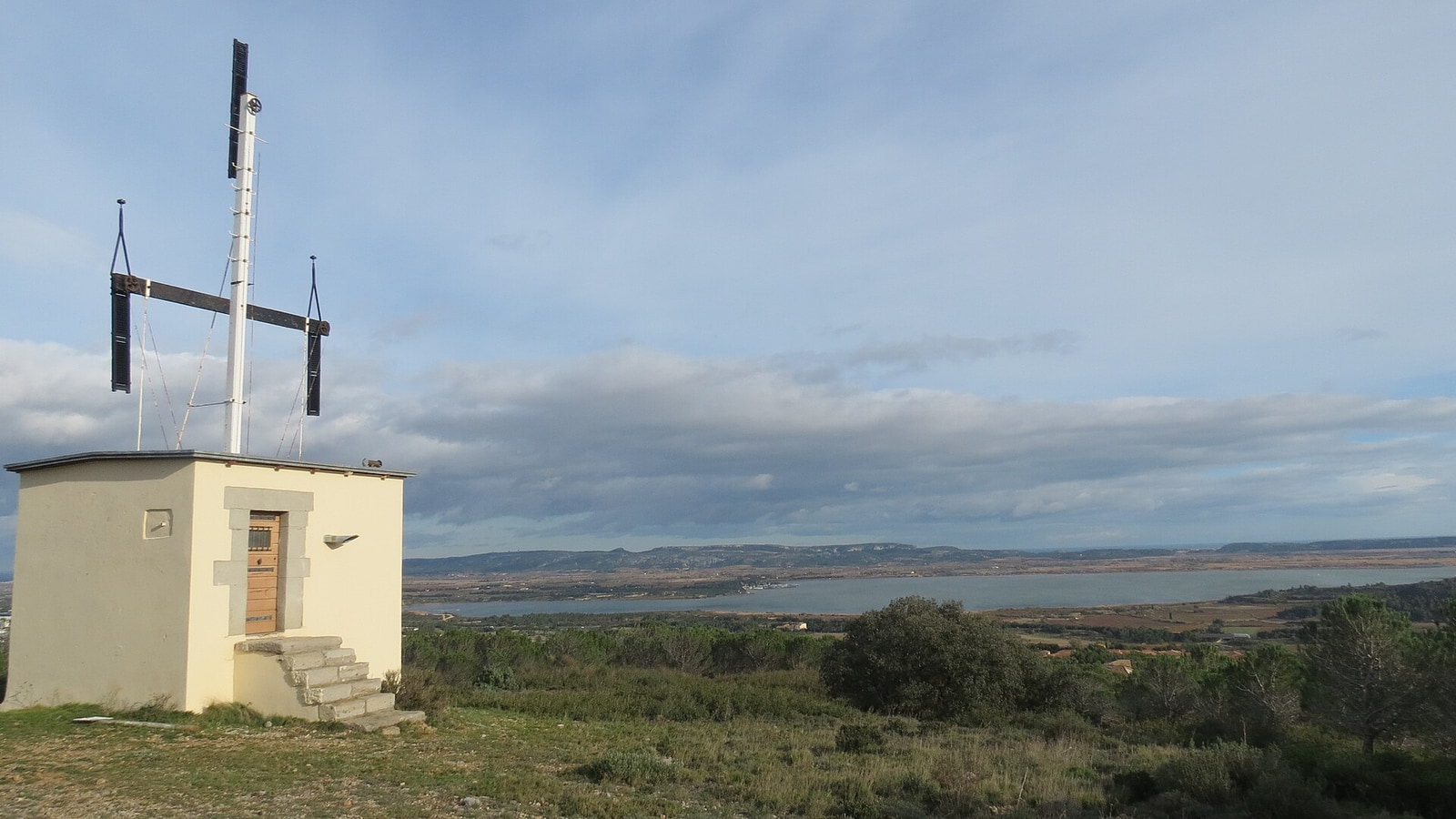
The image above shows that bargain in one restored station. The Jonquières tower near Narbonne places a spare black mechanism against open sky: excellent contrast for a neighboring telescope, but no shelter from the atmosphere between the two posts. Clear daylight completed the circuit. Darkness, rain, fog, smoke, or a failed station could open it.[5][7]
This was not an incidental weakness that a better codebook could solve. It followed from the medium. The network used the landscape as its transmission path and human vision as its receiver. It was also labor-hungry because the signal had to be regenerated by people along the route. A 1965 International Telecommunication Union retrospective counts 556 French semaphore stations over roughly 4,800 kilometers in 1852, during the transition to electricity. Published snapshots differ with their dates and counting methods, but they agree on an infrastructure made of hundreds of staffed points.[2][5]
Electric telegraphy changed that cost structure. Wires introduced new vulnerabilities, but electrical signals did not require a clear view between hilltops, and electromechanical equipment could carry or regenerate them with fewer human rooftop relays. France began replacing the optical network in the 1840s, and the old service disappeared during the 1850s.[2][5] The Chappe system did not fail because its principle had been foolish. It yielded because a new medium could preserve its most valuable abstraction—coded signals moving through a network—while shedding much of its dependence on weather, topography, and continuous manual copying.
What the operators made possible
Calling the Chappe telegraph an ancestor of a modern data network is useful only if the analogy remains bounded. It had standardized signals, repeaters, routing points, control messages, acknowledgments, and error procedures.[3][4] It did not have automatic switching, general public access, or electrical transmission, and its centralized state purpose was far removed from an open communications network.
Its historical insight is simpler. Reliable long-distance communication did not require every person in the chain to possess the message. It required each person to know exactly what transformation to perform and how to signal when that transformation could not be trusted.
The operator in the tower was therefore neither a courier nor a reader. He was a disciplined hinge between two horizons. The codebook kept meaning at the ends; the mechanism made a number visible; the telescope brought the neighboring station close; the operating rules kept one error from becoming a different message. France's first telegraph moved thought quickly by asking hundreds of people to understand less—and to copy better.
Sources
- Ignace Chappe, Histoire de la télégraphie, digitized by the Conservatoire numérique des Arts et Métiers — first-person family account of the experiments, long-line problem, Paris–Lille construction, vocabularies, procedures, and early dispatches.
- Musée des Arts et Métiers, “Télégraphe de Chappe” — official collection dossier on the 1791 demonstration, station spacing, regulator and indicators, relay work, endpoint codebook, network scale, and replacement.
- Roy S. Freedman, “The First Wireless Network,” in Introduction to Financial Technology (Academic Press, 2006) — technical account of Chappe signals, directors, repeaters, routing, logs, error handling, flow control, and acknowledgments.
- Paul Charbon, “Développement et déclin des réseaux télégraphiques: 1840–1940,” Bulletin d'histoire de l'électricité 7 (1986) — scholarly definition of the network's coding and operating rules and its development as a French state telegraph.
- International Telecommunication Union, From Semaphore to Satellite (1965) — institutional history of the Paris–Lille line, the Le Quesnoy and Condé dispatches, network scale, visibility limits, labor costs, and electrical succession.
- French National Convention, “Lettre de Chappe, annonçant la réception à Lille par le télégraphe des décrets concernant Condé,” August 30, 1794, digitized by Persée — parliamentary record of Chappe's return confirmation.
- Wikimedia Commons, “Télégraphe Chappe — tour Jonquières 7” — source and metadata page for the 2012 photograph of the restored optical relay tower reproduced above.