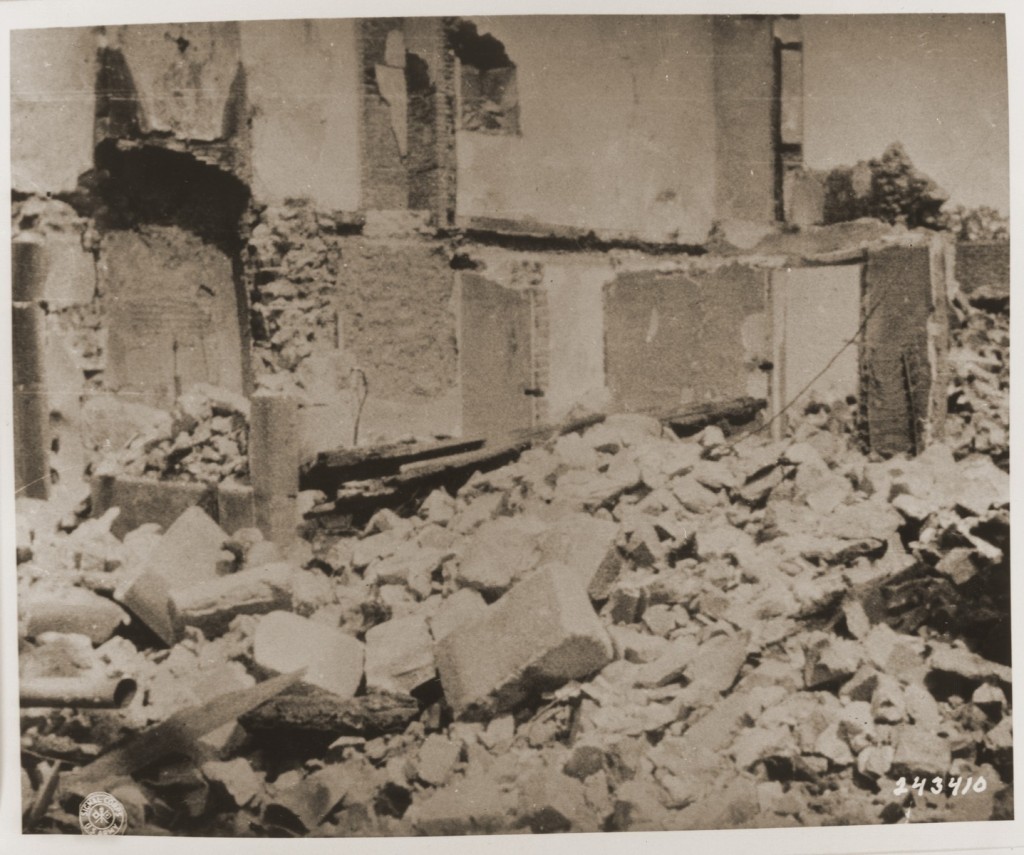
In a photograph taken on 26 September 1944, Oradour-sur-Glane has not yet become a memorial. A roofless building stands behind an undifferentiated field of broken masonry. Rooms have been opened to the weather; the street has disappeared under rubble. The picture records destruction, but it does not tell a visitor where to look or what political meaning to give what remains.[8]
Nine years later, France had made the destroyed village a protected national site but had not turned its visibility into an accepted judicial reckoning. The 1953 Bordeaux trial brought only a fraction of the perpetrators into court, most of the accused from Alsace had been forcibly conscripted, and Parliament answered the verdict with an amnesty less than a week later. What looked from Oradour like justice abandoned looked from Alsace like coerced young men carrying blame for commanders who remained absent.[5][6]
That rupture is the center of Oradour's commemorative history. Preserving the ruins made the crime difficult to deny; it did not identify each perpetrator, resolve the meaning of coercion, or produce a memory that Limousin and Alsace could share. Interpretation, conservation, and later ceremonies would all work inside that gap between visible evidence and unfinished judgment.[3][4][5][6][7]
Image context: The cover is a real archival photograph presented by the United States Holocaust Memorial Museum courtesy of the U.S. National Archives. It was made roughly three months after the massacre, before the French state had converted the destroyed village into a protected national site.[8]
From destroyed village to state-held evidence
On 10 June 1944, four days after the Allied landings in Normandy, troops from the Waffen-SS division Das Reich entered Oradour-sur-Glane. They gathered the population, separated men from women and children, killed them in barns and in the church, looted the village, and burned it.[1] The Centre de la mémoire now records 643 victims, including refugees who were not permanent residents.[3] Only a handful of people survived the killings.[1]
The attack belonged to a wider escalation of German violence against real and presumed resistance activity as units moved north after D-Day. But that context does not supply a settled local cause. Postwar investigations did not conclusively establish why this village was selected or who issued the decisive order. Claims that Oradour held a resistance headquarters, concealed a captured SS officer, or was confused with another village have not been supported by persuasive evidence.[1] A memory site can insist on the certainty of the crime without pretending that every link in its command history is known.
Preservation began turning that certainty into public form. In 1946, France designated the ruins as a national memorial and required their conservation.[1] Law no. 46-986 of 10 May 1946 transferred the grounds and ruins to the state.[2] The key choice was scale: the monument would not be a single statue standing where the village had been. The damaged streets, houses, workshops, tram infrastructure, church, and domestic remnants would collectively occupy the place of a rebuilt town.[3]
That choice made absence spatial. A conventional monument concentrates attention; Oradour disperses it. The distance between the market square, barns, homes, and church prevents the massacre from shrinking into one emblematic object. At the same time, state ownership transformed wreckage into selected evidence. Walls that might otherwise have been cleared became protected surfaces. Ordinary remains acquired a commemorative duty they had never been built to bear.
The trial the stones could not finish
Material survival did not produce a comparable judicial settlement. The 1953 Bordeaux trial placed twenty-one former members of the company in the dock. Fourteen came from Alsace-Lorraine; thirteen of those men had been forcibly conscripted into the German forces. Many German suspects and senior officers were absent. The case therefore joined two genuine but radically unequal histories of victimization: the people murdered at Oradour, and Alsatians subjected to forced incorporation under Nazi annexation.[5][6]
The court convicted twenty defendants. Yet the verdict intensified rather than resolved the conflict between Limousin and Alsace. Less than a week after the judgments of 13 February 1953, Parliament adopted an amnesty on 19 February that freed the forcibly conscripted Alsatians. Later pardons and releases meant that all those convicted were free by 1958.[1][5][6] In Limousin, the amnesty looked like national reconciliation purchased by abandoning the dead. In Alsace, the trial had looked like the state making young conscripts carry a disproportionate share of blame for a German SS crime whose principal commanders remained beyond reach.[5][6]
The strongest historical reading does not need to erase either coercion or responsibility. Forced incorporation changes the circumstances in which individual choices were made; it does not make the victims' demand for an accounting illegitimate. The trial's evidentiary problem was narrower and harsher: with very few survivors, absent senior perpetrators, and uncertain proof of each defendant's acts, a court was asked to assign individual guilt for coordinated mass murder.[5][6]
Here the boundary of the ruins becomes clear. They prove that a village was methodically destroyed and keep the scale of that destruction visible. They cannot show which absent commander gave which order, distinguish one uniformed man's conduct from another's, or decide how coercion should affect culpability. Preserving the crime scene protected truth against denial; it did not turn masonry into a verdict.
Why the ruins needed an interpreter
By the late twentieth century, the site faced a second problem: physical immediacy could be mistaken for historical completeness. The organization that now operates the Centre de la mémoire explains that the ruins were classified in 1946, while a new interpretive project began in 1992 with the agreement of the victims' families and the municipality. The Centre opened in 1999 to place the massacre and its memory in historical context.[3]
That addition quietly revised the original memorial logic. In the immediate postwar years, the ruins themselves had been treated as sufficient national testimony to Nazi barbarism. The Centre acknowledged that a place can be emotionally overwhelming and still require explanation. Who lived here? What was Das Reich doing in the Limousin? What is documented about the selection of Oradour? What happened at Bordeaux? How did the symbol become vulnerable to political appropriation? These questions need archives, testimony, and explicit uncertainty—not only preserved walls.[1][3][5][6]
The interpretive building therefore does not compete with the ruined village. It establishes the terms on which visitors enter it. The ruins provide encounter; historical work disciplines the conclusions drawn from that encounter. Together they prevent two opposite failures: reducing Oradour to an abstract peace symbol, and treating the physical site as if it answers every contested question.
Conserving damage without erasing it
“Preserved” also does not mean untouched. Roofless walls lose mortar, exposed floors shed material, storms accelerate collapse, and objects left in place continue to corrode. In 2024, France's Ministry of Culture described a conservation program extending from 2024 to 2039. Its stated problem is unusually delicate: stabilize the ten-hectare site while retaining bullet strikes, fire damage, missing volumes, and other traces that give the ruins their evidentiary force.[4]
The ministry's formulation—conserve without erasing—reveals the paradox. If authorities do nothing, the material witness disappears. If they rebuild too much, later work can imitate the very damage it is meant to preserve. Conservation must keep the distinction visible between an original trace, a necessary support, and a conjectural reconstruction.[4] Oradour's apparent stillness is therefore an ongoing technical and ethical achievement.
The 1944 photograph helps make that work legible. It is not valuable because today's site must reproduce every heap of rubble exactly as the camera found it. Debris was cleared, and vulnerable structures have since required active management. Its value is as a temporal boundary: this is what destruction looked like before commemoration organized the encounter.[4][7][8] The archive prevents preservation from masquerading as untouched nature.
A changing site is not a forgiven crime
Commemorative meaning changed again on 4 September 2013, when French president François Hollande addressed German president Joachim Gauck inside the ruins. Hollande linked modern Germany's willingness to face Nazi crimes with Franco-German friendship, while also recalling the failed pursuit of SS leaders, the long wait for an interpretive center, and the need to reconcile the memories of Limousin and Alsace. His governing claim was that reconciliation had to rest on truth.[7]
That ceremony did not replace the site's earlier meanings. Oradour remained a grave landscape, a protected record of a massacre, a monument to civilian victims, and a reminder of incomplete justice. The joint presence added another use: the ruins could host reconciliation precisely because responsibility was named rather than blurred. Friendship between states was presented as a response to the crime, not an acquittal of it.[7]
Oradour's force comes from holding two facts together. The crime is materially indisputable; the postwar reckoning remained judicially and politically incomplete. That tension has stayed inside the site's history: the ruins entered public care in 1946, the verdict and amnesty divided memory in 1953, an interpretive threshold opened in 1999, and a Franco-German act of remembrance added reconciliation in 2013 without erasing what justice had failed to settle.[2][3][5][6][7]
Preservation limits what later generations can plausibly deny. It cannot dictate what they must conclude about individual guilt, coercion, nation, or reconciliation. Oradour endures not as an untouched answer but as evidence strong enough to resist denial and incomplete enough to make responsible memory keep working.
Sources
- United States Holocaust Memorial Museum, “Oradour-sur-Glane” — massacre, German anti-partisan context, disputed targeting explanations, postwar trials, and conservation.
- French Ministry of Culture, Mérimée notice PA00100409, “Village martyr d'Oradour-sur-Glane” — official heritage record for the 1946 state transfer and historic-monument classification.
- Centre de la mémoire d'Oradour / Limousin – Nouveaux Horizons, “L'histoire du village martyr d'Oradour-sur-Glane” — 1946 classification and the 1992–1999 development of the interpretive center.
- French Ministry of Culture, “80 ans de mémoire à préserver à Oradour-sur-Glane” (10 June 2024) — conservation principles, material deterioration, and the 2024–2039 preservation program.
- Odile Girardin-Thibeaud, “Oradour ou la sédimentation mémorielle,” Annales du Midi 122, no. 271 (2010) — review of Guillaume Javerliat's study of the trial, verdict, amnesty, and the layered Limousin and Alsatian memories.
- French National Assembly, written question no. 16650 and government response (2024) — 1953 judgments, forced conscription, amnesty dates, and the status of the trial archives.
- Élysée, “Déclaration de M. François Hollande … en hommage aux victimes du massacre d'Oradour-sur-Glane,” 4 September 2013 — remembrance with German president Joachim Gauck and the relationship between truth and reconciliation.
- United States Holocaust Memorial Museum Collections, “The ruins of Oradour-sur Glane” — catalog record, date, rights, and National Archives provenance for photograph 25726.