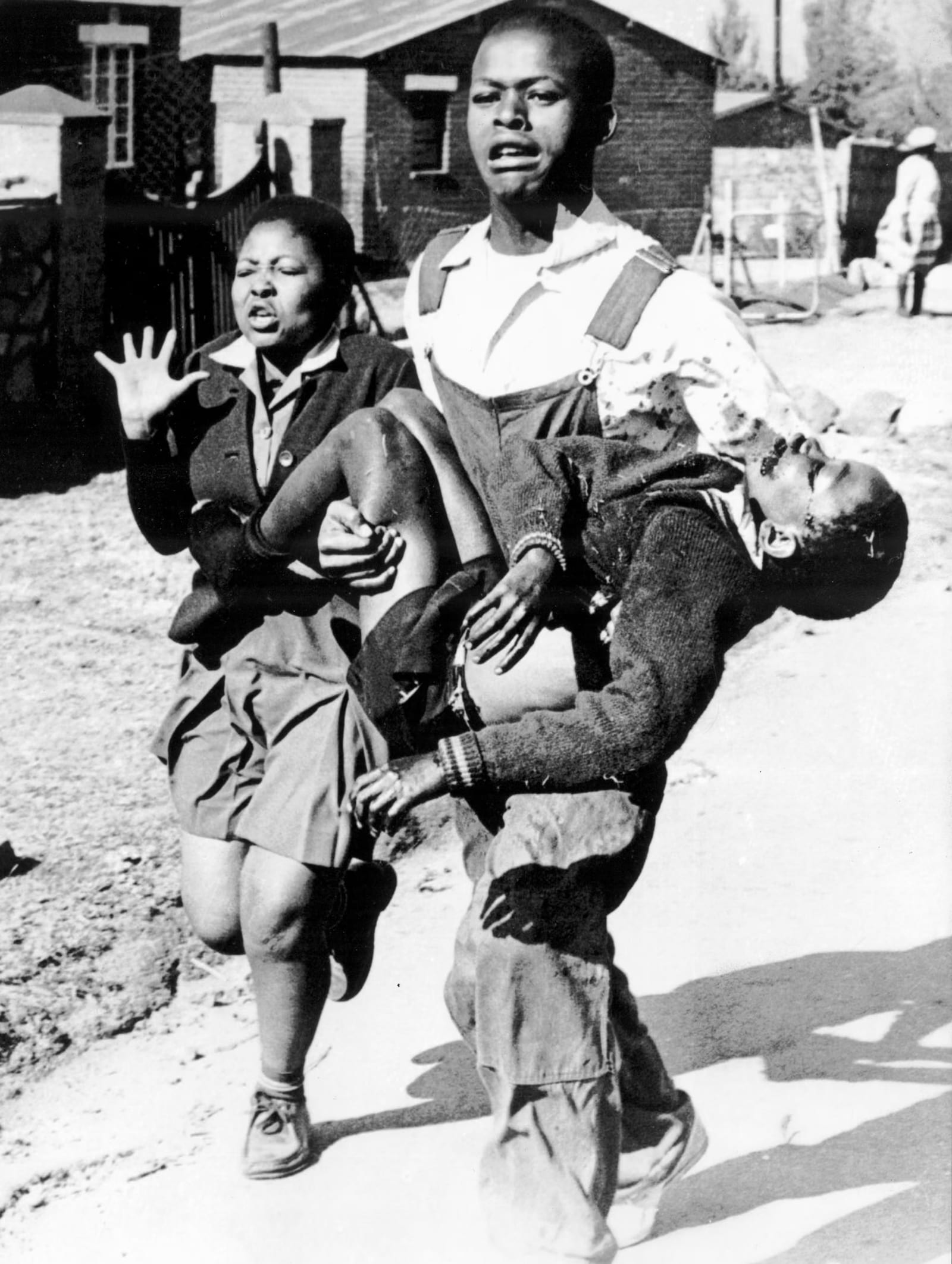
Sam Nzima’s best-known photograph centers three people and a fourth presence. Mbuyisa Makhubo runs with the mortally wounded Hector Pieterson in his arms. Hector’s sister, Antoinette, moves beside them in anguish. Nzima is invisible behind the camera, close enough to turn their flight toward a clinic into a sequence of six frames.[1][4]
The photograph became the visual shorthand for the Soweto uprising of 16 June 1976. That power is deserved: one exposure made the lethal force used against Black schoolchildren immediate and difficult to deny. But shorthand always leaves something out. The image cannot show the thousands of pupils who organized and joined the march, the system of Bantu Education they opposed, the other children killed, or the costs later carried by the three people who survived the instant.[1][2][3]
That is why the history of the Hector Pieterson Memorial and Museum is not simply a story about preserving a famous image. Long before the museum opened on 16 June 2002, the photograph had already become a portable memorial. The museum’s harder task was to open that memorial back up—to put a crowd, a place, many voices, and an unsettled record around the single frame.
Before the photograph, a planned march
The uprising did not begin as the spontaneous “riot” of apartheid-era official language. Resistance to compulsory Afrikaans instruction had been building in Soweto schools during February and May 1976. Pupils staged go-slows and class boycotts; solidarity spread between schools; and on 13 June, student representatives formed an action committee to organize a mass demonstration three days later.[2][3]
Afrikaans was the immediate trigger, not the whole grievance. The state was attempting to enforce Afrikaans and English on a prescribed basis in Black secondary education, compelling pupils to learn difficult subjects through languages chosen by an unequal school system. Students were also rejecting Bantu Education’s larger purpose: preparing Black children for a deliberately subordinate place in apartheid society. Organizers intended the march to be peaceful and student-led.[1][2][3]
On the morning of 16 June, columns of schoolchildren moved toward Orlando Stadium. Police blocked their route in Orlando West. Accounts differ on the exact first exchanges, but the Truth and Reconciliation Commission later found that the march remained peaceful until violent police intervention; students then fought back as the confrontation spread.[2]
Hector was among the first children killed, not securely the first. His sister’s sworn testimony gives his age as 12, though later accounts often call him 13. Police records indicate that 15-year-old Hastings Ndlovu was shot earlier. Even the death toll depends on its boundary: a first-day Soweto count is not the same as the much larger national toll accumulated as revolt and repression continued into 1977.[1][2] Those distinctions matter because an icon can make uncertainty look settled.
Six frames made one death portable
Nzima was covering the march for The World, a Johannesburg newspaper serving Black readers. When gunfire scattered the crowd, he photographed a fallen child and then Makhubo lifting and carrying him. Nzima and Antoinette helped place Hector in a press car bound for a clinic, where he was declared dead. The famous exposure was one image within that hurried sequence, not a composed tableau.[1]
Its structure nevertheless had extraordinary force. A child’s body occupies the center. Makhubo’s forward motion makes rescue visible even as the image records its failure. Antoinette’s gesture carries private recognition into public view. The photograph joins state violence, care, and grief without needing a caption to invent those relationships. Published locally that afternoon and reproduced abroad almost immediately, it gave newspapers an image through which readers far from Soweto could encounter the crackdown.[1][4]
It would be too neat to say one photograph changed international policy or ended apartheid. Images act inside political conditions; they do not replace organization, testimony, diplomacy, sanctions, or years of resistance. The narrower claim is stronger. Nzima made police violence emotionally legible and mechanically reproducible at the moment the state most needed the confrontation to look like disorder caused by dangerous children.
The picture’s circulation also created unequal afterlives. Security police harassed Nzima until he left Johannesburg and photojournalism. He testified in 1996 that the photograph had traveled worldwide while he received no royalties and no longer knew where the negatives were.[1] Makhubo, who had come to help after hearing shots rather than marching as a pupil, drew police attention, left South Africa, and was last heard from by his family in a 1978 letter from Nigeria.[2] Antoinette became the image’s most persistent living witness, repeatedly restoring names, sequence, and family experience to a frame often reproduced without them.[1]
The photograph preserved an instant. For the people within it, the instant did not end.
A famous child without a portrait
When the museum was being prepared, its curators faced an unsettling absence: the family did not possess a conventional portrait of Hector that could simply introduce visitors to the boy before the icon. Photographs loaned to journalists after his death had not been returned. The world knew the shape of Hector’s dying body better than it knew his face in life.[7]
That imbalance is one reason the photograph began functioning as a memorial before there was a dedicated building. Reproduction made Hector publicly present, but only at the threshold between injury and death. Every poster, newspaper page, anniversary display, or march placard carried the moment again. The image held memory in circulation while apartheid still governed the country and while official commemoration remained politically constrained.
Other forms accumulated around it. During the 1980s, the photograph became ubiquitous on T-shirts, posters, and placards, carrying 16 June through anti-apartheid mobilization. Rachel E. Johnson points to a 1990 Soweto photograph of a young woman wearing the image beneath the words “Soweto Massacre”: one historical moment literally worn into another.[5] In the early 1990s, a memorial on Khumalo Street fixed remembrance near the reported shooting site. Democratic South Africa placed 16 June on the public calendar as Youth Day, and on that date in 2002 the museum opened beside the memorial.[6][10]
This sequence changed the scale of remembrance. Portable prints attached memory to a movement. The street memorial attached it to a neighborhood. Youth Day attached it to the national calendar. The museum attached it to a wider testimonial and photographic record. None displaced Nzima’s frame; each gave the frame more history to carry.
The museum restored geography and plurality
A memorial near the reported shooting site preceded the museum, which opened in 2002. Homes occupied the corner itself, so the museum rose roughly two blocks away on Khumalo Street—close enough to keep the uprising’s geography visible without pretending that symbolic ground was empty land.[6][7]
Its red brick answered a community request that the building belong to the material world of surrounding Soweto houses. Inside, photographs share authority with film, documents, a death register, and oral testimony. Windows orient visitors toward local landmarks and the route of events beyond the walls. The building therefore performs a reversal. The famous photograph pulls attention tightly toward three figures; the museum pushes sight outward again—to streets, schools, police positions, march routes, witnesses, and other dead.[7]
Curators described that work as ongoing. Visitors could recognize themselves or others in crowd photographs, offer testimony, and add names to an archive that was not treated as complete at opening.[7] That choice matters. A finished monument can imply that the past has received its final form. An accumulating museum admits that public memory changes when another witness speaks or an unnamed face is identified.
The museum does not escape selection merely because it contains more material. Naming the site after Hector still gives one child unusual representational weight. Photographs still dominate how visitors see the uprising. And a national holiday can fold many political traditions into a smooth liberation story. Scholars have therefore treated commemoration as both a major repair of apartheid erasure and a place where new choices about visibility are made.[5][8]
Put the fourth person back in the picture
A 2026 study by Addamms Songe Mututa and Keyan Gray Tomaselli identifies a particularly sharp gap: a memorial organized around Nzima’s photograph can honor its subject while leaving the photographer insufficiently memorialized. They call this a structured absence—the image is everywhere, while the person who chose the position, pressed the shutter, protected the record, and paid a professional price recedes from public attention.[8]
The same method of reading can restore others. Makhubo was not merely a pair of arms; he made a rescue attempt and then disappeared into an unresolved exile. Antoinette was not simply grief at the edge of the frame; she was a pupil in the protest, Hector’s sister, a sworn witness, and later a guide through the museum’s history. Hastings Ndlovu and the many people whose deaths were not photographed test the dangerous ease with which visibility becomes priority.[1][2]
None of this weakens the photograph. It explains how to use it responsibly. The image is not a complete account of 16 June, and it never claimed to be. Its historical achievement was compression: it gave a vast structure of educational coercion and police violence a human scale that could cross borders. Commemoration’s job is re-expansion.
The Hector Pieterson Museum put the uprising back around one photograph. It returned a crowd to the three central figures, a photographer to the unseen fourth position, and a neighborhood to an image that had traveled far from Soweto. The frame remains the door. History begins when we walk through it.
Sources
- Truth and Reconciliation Commission, testimony of Antoinette Sithole and Sam Nzima, Soweto hearing, 22 July 1996 — primary testimony on Hector’s age, the march, the six-frame sequence, clinic journey, publication, and Nzima’s persecution.
- Truth and Reconciliation Commission, Final Report, vol. 3, ch. 6 — official findings on the Soweto uprising, police violence, casualty boundaries, and the Makhubo family’s testimony about harassment and disappearance.
- Truth and Reconciliation Commission, testimony of Murphy Morobe, Soweto hearing, 22 July 1996 — primary testimony on May–June student organizing, the planned march, and its peaceful intent.
- South African History Archive, “The death of Hector Pieterson,” collection AL2547, item 24.2.6 — catalogue record for Sam Nzima’s photograph and its archival JPEG/TIFF preservation.
- Rachel E. Johnson, “The shadow of a young woman,” in Voice, Silence and Gender in South Africa’s Anti-Apartheid Struggle (University of London Press, 2025) — analysis of the photograph’s circulation on 1980s protest material and the women obscured by iconic memory.
- South African Government News Agency, “SA’s top heritage sites” — official account of the early-1990s Hector Pieterson memorial and the museum’s opening on 16 June 2002.
- City of Johannesburg, “Hector: the famous child whose face is unknown” — pre-opening account of the museum’s site, community-shaped architecture, collections, and continuing oral-history method.
- Addamms Songe Mututa and Keyan Gray Tomaselli, “Curating Remembrance in Post-Apartheid South Africa,” Visual Anthropology 39 (2026) — peer-reviewed study of the photographer-photograph disconnect and Nzima’s structured absence from commemoration.
- Wikimedia Commons, “Mbuyisa Makhubu carries Hector Pieterson at Soweto Uprising” — high-resolution source page for the Sam Nzima archival photograph used as the article image.
- South African Government, “Public holidays in South Africa” — official calendar identifying 16 June as Youth Day.