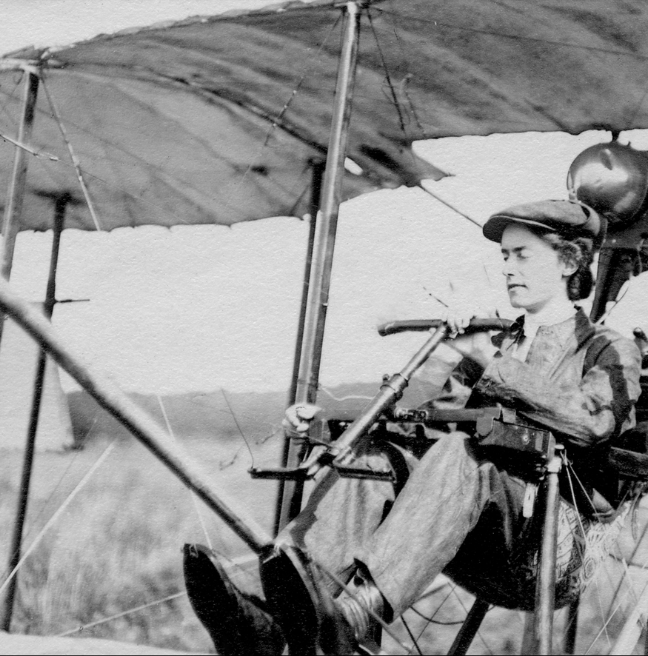
On December 17, 1910, the aviation weekly Flight gave Lilian Bland three pages to explain the Mayfly, the biplane she had designed, built with local assistance, and flown in County Antrim. She did not use them to polish a legend. She listed ash spars, spruce ribs, bamboo outriggers, an elm engine bed, crossed control wires, bent wheel spindles, a broken propeller, and the cost of unbleached calico. By then, she wrote, the machine had been “practically rebuilt” and had gone through two propellers, several pairs of skids, and three tails.[1]
That inventory is more revealing than the familiar claim that Bland was the first woman in the world to design, build, and fly her own aeroplane. Institutions still qualify that priority—“a first for a woman in Ireland and maybe the world,” in the careful language of National Museums NI—because experimental flights and definitions of control were poorly standardized in aviation’s first decade.[4] The narrower achievement needs no superlative. Between 1909 and 1911, Bland took one machine from model to glider to powered prototype, tested its failures, revised its structure, and published enough detail for readers to see her decisions.
The Mayfly itself did not survive. Its second construction did: a paper machine assembled from letters, photographs, drawings, and one extraordinary technical article. That record shows why Bland belongs in engineering history without turning a short flying career into a frictionless triumph.
1909: learning to see an aeroplane
Bland did not begin as a trained engineer or pilot. Born in Kent in 1878 and living by 1909 at Tobercooran House near Carnmoney, she had worked as a sports journalist and photographer. She rode, shot, and studied birds closely enough to write about their flight. A postcard showing Louis Blériot’s monoplane—sent after his July 1909 Channel crossing—gave her dimensions to think with. In October, she attended the aviation meeting at Blackpool and watched working aircraft and pilots at close range.[3]
Her response was not to copy one successful machine at full scale. She built a model first, then enlarged the inquiry into a biplane glider. That sequence matters. Early aircraft combined uncertain aerodynamic theory with highly variable engines, materials, ground conditions, and control systems. A model could expose a bad arrangement cheaply; a glider could test lift and control without adding engine vibration and fuel delivery. Bland later distilled that method into advice: draw every detail to scale, and, for an original design, make a large model to see whether the controls work as intended.[1]
Nor was this a lone-genius build in an empty field. Family property gave her room and a workshop; local helpers made fittings and assisted with construction and trials; her social position gave her time and access to imported parts. The historical point is not diminished by those resources. It becomes more exact. Bland directed a small, improvised development project at a moment when aviation itself was still largely a network of workshops, clubs, wealthy patrons, mechanics, and public meetings rather than a settled profession.[1][3]
The full-size glider used ordinary materials in unusually unforgiving service. Ash carried the main loads. Spruce kept ribs and struts light. Bamboo extended the tail structure. Fabric created the lifting surface, wire held the frame in tension, and skids absorbed rough grass. Bland called it the Mayfly—a joke about whether it may fly, but also an honest name for a prototype whose answer had to come from testing.[1][3][5]
July 1910: the famous bottle was a failed test
The Mayfly story is often reduced to its most combustible props: a whisky bottle and an aunt’s ear trumpet. Bland’s own letter to Flight, published on July 16, 1910, restores their proper scale. Her 20-horsepower A. V. Roe engine had arrived before its fuel tank. Impatient to try it, she used the bottle as a temporary reservoir and the ear trumpet as tubing. Fuel was spilled across the wing, the engine sounded like a magnified catfight, and darkness and rain ended the attempt.[2]
It was funny because Bland wrote it that way. It was not the flight, and it was not proof that reckless improvisation made the aircraft work. It was a ground run that exposed the new system’s violence. The engine shook fasteners loose; wires could snap into the propeller arc; a structure that behaved as a glider now had to survive concentrated vibration and thrust.[1][2]
Bland’s December account records what happened after the anecdote. She recommended solid-headed eyebolts, properly cut threads, castle nuts or locking washers, and double nuts where vibration demanded them. After a broken wire destroyed her first propeller and the replacement had narrow escapes, she tied wires back so a break could not reach the blades. She varnished wood against weather, painted inaccessible wire against rust, and rejected bamboo canes until she found thick, round sections. This is not the language of a lucky hop. It is a failure log converted into construction rules.[1]
Late summer 1910: a flight with uncertain edges
With a proper tank fitted, the powered Mayfly moved to larger parkland at Randalstown. The surviving accounts do not give one clean, instrumented flight record. A biographical account from the Dictionary of Irish Biography places Bland’s declaration “I have flown” in September and reports a height of 30 feet; a later newspaper feature gives August 31 for the inaugural flight. Retellings do not always distinguish that first low hop from subsequent, longer trials.[3][5]
Those differences are a reason to bound the claim, not discard it. By September 1910, Bland was reporting powered takeoffs in calm air in a machine she had designed and helped construct. Her own description was strikingly unheroic: she said she had not known she was airborne until she looked back for the wheel tracks. The first trials were low, irregular, and hard to measure from the pilot’s open seat. They nonetheless crossed the decisive boundary from a towed or wind-borne glider to a machine taking off under its own engine.[3]
The careful version also keeps the Mayfly’s limits visible. Twenty horsepower left little reserve. Rough, ridged grass increased the takeoff burden. Bland was learning on the only aircraft she had ever flown, in a place with no experienced local pilot available to correct her. Her achievement was not that the prototype had become a practical transport. It was that she had kept the design-test-revise loop coherent long enough to achieve powered flight and understand why the machine could not yet do much more.[1]
December 1910: publishing the machine from the inside
Bland’s Flight article is valuable because it does not merely certify that an aeroplane existed. It opens the structure.
The engine and pilot sat on a separate chassis clipped across the main spars. The unit could be removed with or without the engine, which four bolts held in place. That modularity made repair and transport easier—important when the workshop, practice ground, and larger flying field were not the same place. Turning the skids and removing the outriggers allowed the dismantled machine to roll along a road.[1]
The controls reveal a designer working before conventions had hardened. A bicycle handlebar rocked and turned to operate front elevators; crossed wires made left and right surfaces move differentially. Moving tail surfaces were coupled to the forward controls. The pilot’s back pressed against another control for balancing planes between the wings, while pedals worked the rudder. Bland admitted that the arrangement sounded complicated but argued that it was simple in practice and gave her authority over both engine and airframe.[1]
Most persuasive are the discarded answers. Steamed ribs lost their proper curve, so she replaced them with solid-cut ribs bored for lightness. Ball-bearing wheels and spring arrangements bent or broke their spindles, so she rebuilt around larger hubs and let pneumatic tyres provide the spring. Laced fabric allowed alteration and retightening without destroying the covering. Three tails were not embarrassment hidden from customers; they were published evidence that the tail remained an open problem.[1]
Even her budget was an engineering argument. The wood cost only a few pounds and calico ninepence a yard, but the engine dominated a total still below £200. Building cheaply, she concluded, required putting “the best of everything” into fasteners and other failure-critical parts.[1] Economy meant spending selectively against known failure modes, not pretending all components were interchangeable.
1911: a prototype does not become an industry by itself
At the article’s end, Bland tried to turn publication into a market. She invited orders for gliders or full-size machines, provided she could use her own designs. Advertisements priced a glider at £80 and a May-fly biplane at £250 without an engine. Her guarantee came with a boundary: an inefficient engine or propeller would make the whole exercise a waste of time.[1][3]
No aircraft business followed. Bland’s father offered her a Model T Ford if she stopped flying. A retrospective account published in 1965 says she accepted not simply because he disapproved, but because she already knew the Mayfly was underpowered and believed a stronger engine would wreck its superstructure. She shifted to the new machine she could support: she learned to drive and became a Ford agent in Belfast in April 1911. In October, she married Charles Loftus Bland and later left for Canada.[3][6]
It is tempting to force that turn into one of two clean stories. In one, an Edwardian father ends a woman’s career; in the other, a rational inventor abandons an exhausted design. The evidence supports both pressures and does not let either explain everything. Gendered expectations narrowed the life available to her. So did the prototype’s power-to-weight limit, the cost of another development cycle, and the absence of an institution prepared to convert her tests into sustained production.
The physical Mayfly was disposed of rather than preserved intact. What endured was unusually diagnostic: Bland’s published sequence of observation, model, glider, engine trial, powered flight, redesign, costing, and commercial boundary. National Museums NI now holds a Lilian Bland fonds containing correspondence, personal photographs, notes, sketches, and research material, while period photographs preserve the machine’s exposed frame.[3][4][6][7]
That archive changes the meaning of “first.” The broad global superlative may remain contingent on definitions and discoveries. The documented achievement is firmer. A 31-year-old journalist-photographer entered experimental aviation, built and flew a powered biplane in Ireland, and left readers enough evidence to distinguish the work from the legend. Wood made the Mayfly rise. Paper lets us see how.
Sources
- Lilian E. Bland, “The ‘Mayfly’—The First Irish Biplane, and How She Was Built,” Flight (December 17, 1910), pp. 1025–27, transcription and page images—materials, controls, revisions, costs, and design advice.
- Lilian E. Bland, “The ‘Mayfly’ Gets Its Engine,” letter to Flight (July 16, 1910), reproduced on the Lilian Bland archive site—transport of the engine and the improvised fuel-system test.
- Helen Andrews, “Bland, Lilian Emily (1878–1971),” Dictionary of Irish Biography, reproduced in History Ireland 18, no. 1 (2010)—biographical chronology, flight correspondence, proposed aircraft sales, and move into automobiles.
- National Museums NI, Lilian Bland fonds, reference TRA.BLAN—collection description for Bland’s correspondence, photographs, notes, sketches, and the museum’s qualified assessment of her aviation priority.
- Rory Carroll, “The incredible life and times of Lilian Bland, Anglo-Irish ‘flying feminist’,” The Irish Times (August 12, 2021)—modern reassessment, flight-date tradition, and Ulster Transport Museum context.
- “Air Pioneer,” Winnipeg Free Press (March 16, 1965), reproduced by the Lilian Bland archive site—Bland’s retrospective account of the Mayfly’s flight, its power limit, and her decision to accept a motor car.
- National Museums NI, “Photos of Lilian Bland and Mayfly,” item TRA.BLAN/4/6—catalog record for the archival photograph set containing Bland and the aircraft.