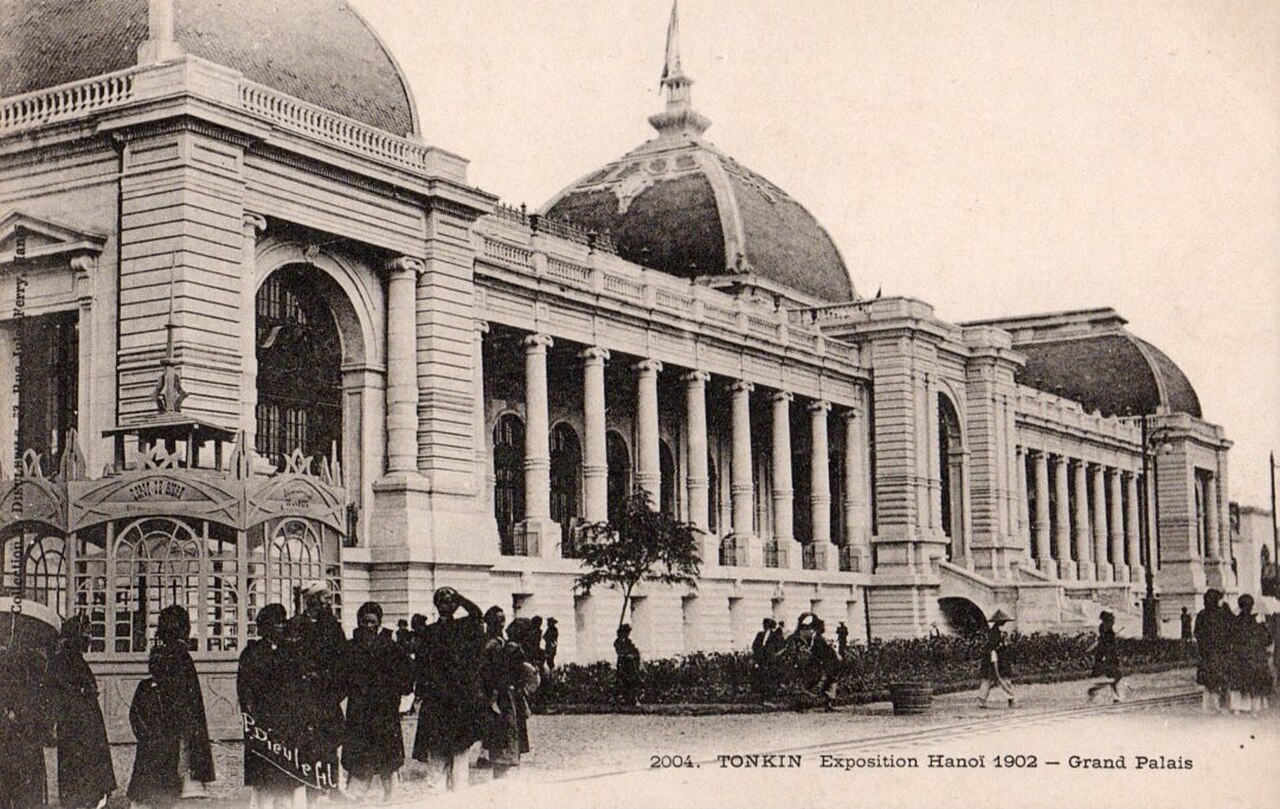
In 1902, French colonial Hanoi produced two records of modern government. One was meant to be seen: the Grand Palais, a long exhibition building crowned by a dome and photographed as the centerpiece of a colonial fair. The other was meant to remain underground: municipal forms counting rats killed in the city's sewers. The palace promised order. The forms recorded a campaign whose rising totals could not show whether Hanoi was becoming safer.[1][3][8]
The familiar ending is almost too perfect. Officials offered money for rat tails; colonial reports then alleged that residents left tailless rats alive, imported rodents, or bred them; the scheme collapsed. Economists now use the episode as a parable about perverse incentives. That lesson is real, but it starts halfway through the mechanism. Before the badly chosen metric came a divided city, an engineered rat habitat, a dangerous labor regime, and an administration more capable of counting claims than verifying outcomes.[1][2][5]
The rat bounty failed because it separated proof of payment from proof of public-health effect. A tail could be counted at a desk. A dead rat, fewer infected fleas, a shrinking sewer population, and lower plague risk were much harder to establish. Once those things ceased to be equivalent, every impressive total became ambiguous.
The sewer solved one city's problem and made another
Governor-General Paul Doumer's administration, from 1897 to 1902, remade Hanoi as the capital and showcase of French Indochina. Broad streets, offices, villas, piped water, and sewers marked the European quarter as a material claim about French rule. The distribution of those improvements was racialized. Historian Michael G. Vann estimates that roughly 90 percent of the city's residents—principally Vietnamese and Chinese—occupied about one-third of its area, while the European and administrative districts used most of the remaining land. French villas received running water and flush toilets; much of the Old Quarter relied on public fountains, gutters, and night-soil collection.[3][5]
That unequal system matters to the rat story. The new sewers removed waste from privileged interiors, but they also gave rats protected routes, shelter, and access to the same houses through pipes. Infrastructure had not simply failed to keep nature out. It had rearranged the urban ecology. The system that made a French villa feel hygienically separate from the crowded city also connected its toilet to an unseen habitat below.[1][3]
The timing sharpened official fear. Alexandre Yersin identified the plague bacillus during the Hong Kong epidemic in 1894, and Paul-Louis Simond advanced the rat-flea transmission mechanism in 1898. Acceptance of every part of that mechanism was not immediate, but by 1902 rats had become a serious object of plague policy across colonial ports.[4][7] Hanoi's officials therefore faced more than an unpleasant infestation. They saw a possible route by which the third plague pandemic could enter the colonial capital.
April to July: output rises, outcome stays unknown
The first campaign used paid Vietnamese crews in the sewers. Vann reconstructed it from a colonial dossier containing roughly one hundred repetitive forms for Hanoi's first and second districts, beginning in April 1902 and ending in July. The numbers climbed astonishingly. The forms recorded 7,985 rats from April 26 through May 1, 15,041 on May 30, and 20,114 on June 12.[1][3]
Those totals document the campaign's claimed scale, not independently verified work or rat abundance. Still less do they demonstrate control. No reliable baseline gave officials the sewer population against which to measure the kills. A higher count might mean that crews were becoming more effective, that rats were reproducing or arriving faster, that hunting expanded into new areas, or that the payment system rewarded larger claims. The forms measured throughput, not prevalence.
Their shape exposes a second problem. After weeks of thousands of recorded kills, Vann found that the dossier's totals fell—from thousands to hundreds, then dozens, then zero—without an explanation in the file.[9] The paper trail ends exactly where interpretation becomes necessary. It cannot tell us whether rats became scarce, crews stopped, money ran out, reporting changed, or the program shifted form. Bureaucratic precision generated a crisp series with a missing denominator and a missing ending.
The work was supposed to remain invisible
Rat catching also pulled Hanoi's social geography into view. Vietnamese workers had to descend through manholes into cramped, filthy passages and handle animals that officials feared might carry infected fleas. They resisted the assignment and demanded better compensation. On June 9, the resident-superior of Tonkin reported that Europeans had complained about encountering foul-smelling crews emerging into their neighborhood with piles of rat bodies.[1][3]
The complaint reveals the bargain behind the European quarter. Sanitation was supposed to arrive as a clean service, detached from the people performing its dirtiest work. The sewer hid waste; racial hierarchy was expected to hide labor. The rat campaign broke both screens at once. Workers surfaced into ceremonial streets carrying the material cost of keeping those streets clean.
The later bounty preserved those labor and disposal problems in a new form. After the sewer campaign failed to end the infestation, the administration widened the hunt: residents could claim payment with a small token instead of delivering a carcass. Operationally, the policy outsourced both the killing and much of the evidence that killing had occurred.[1][2]
A tail became more valuable than a dead rat
The bounty paid for a severed tail rather than a whole carcass. That choice made administrative sense: tails were compact, countable, and easier to dispose of. It also changed the objective. The state wanted fewer live rats. The claimant needed one detachable body part.[1][2][3]
Reports soon described tailless rats alive in the city. Later investigations, as Vann reconstructed them, alleged rat raising outside Hanoi and a trade that brought rodents from elsewhere in Tonkin to the bounty point. Officials canceled the scheme.[2][3] Each tactic exploited the same gap. Releasing a tailless animal preserved its ability to reproduce. Raising rats converted future infestation into inventory. Importing an outside rat earned the same payment as removing one from a Hanoi sewer, even though it did nothing for the targeted habitat.
The episode is often reduced to clever residents defeating foolish officials. The archive supports a more careful conclusion. It contains official tallies and official reports of gaming, not a representative set of testimony from the people who caught, traded, or allegedly raised rats. Aro Velmet's later history of French colonial bacteriology notes that it is difficult to know how widespread the practices were and how much the reports absorbed a municipal rumor culture already shaped by racist assumptions.[6]
That boundary does not make the bounty's failure imaginary. It changes what can be claimed. The evidence strongly supports that officials lost confidence in the tail as proof, believed the program was being manipulated, and abandoned it. It does not let us calculate how many tailless rats survived, how many farms existed, or how much those practices changed Hanoi's rat population. Opportunism, survival, labor resistance, and colonial suspicion may all be present; the documents do not permit one of them to erase the others.
Plague did not turn the parable into an experiment
Bubonic plague struck Hanoi in 1903. Vann connects the outbreak to the movement of people, cargo, rats, and fleas around the colonial exhibition and the transport links joining Hanoi to southern China and other ports. Peter Soppelsa's wider study likewise places the Hanoi campaign inside an imperial system in which railways and shipping moved disease while colonial authorities repeatedly targeted rats and racialized communities.[1][4]
But the later outbreak is not a controlled proof that the bounty caused plague. The route of introduction cannot be reconstructed rat by rat, and the city was already tied into a pandemic transport network. Nor can the 1902 kill totals prove that the hunt prevented a worse outbreak. The responsible conclusion is narrower: the campaign did not produce a trustworthy measure of reduced risk, and the infrastructure and mobility that worried officials remained in place.
That is why “bad incentives” is an accurate but incomplete label. The bounty's metric failed because a tail was easier to verify than an ecological outcome. The policy failed more deeply because the administration treated killing as a substitute for understanding the whole system: sewer design, food and shelter, transport, flea control, waste, worker safety, and the unequal geography of sanitation. Later French campaigns increasingly discussed rat-proofing buildings, ports, pipes, stores, and ships—slower work that attacked habitat and access rather than celebrating body counts alone.[4]
The Grand Palais photograph makes a fitting cover because it restores the two levels of the story. Above ground, the colonial state's exhibition hall stood ready as a monumental display of order by October 1902. Below ground, rats occupied its modern infrastructure, workers contested filthy and dangerous labor, and official forms mistook a stream of tails for knowledge. Hanoi's rat bounty did not merely reward the wrong action. It revealed a government that could build a showcase faster than it could see the city it had made.
Sources
- Michael G. Vann, “Of Rats, Rice, and Race: The Great Hanoi Rat Massacre, an Episode in French Colonial History,” French Colonial History 4 (2003), pp. 191–203 — peer-reviewed reconstruction of the sewer campaign, daily tallies, labor conflict, bounty, and colonial archive.
- Michael G. Vann and Liz Clarke, The Great Hanoi Rat Hunt: Empire, Disease, and Modernity in French Colonial Vietnam (Oxford University Press, 2018) — source-based graphic history with translated primary documents and historical context.
- Marc Jason Gilbert, “Interview with Michael G. Vann,” World History Connected 15, no. 2 (2018) — Vann on the April–July dossier, Hanoi's divided infrastructure, sewer ecology, rat farms, trafficking, and the limits of colonial control.
- Peter Soppelsa, “Losing France's Imperial War on Rats,” Journal of the Western Society for French History 47 (2021) — comparative imperial history of plague mobility, extermination campaigns, racial scapegoating, and the shift toward rat-proofing.
- Michael G. Vann, “Building Colonial Whiteness on the Red River: Race, Power, and Urbanism in Paul Doumer's Hanoi, 1897–1902,” Historical Reflections 33, no. 2 (2007), pp. 277–304 — peer-reviewed study of the racial and spatial logic of colonial Hanoi.
- Aro Velmet, Pasteur's Empire: Bacteriology and Politics in France, Its Colonies, and the World (Oxford University Press, 2020) — history of bacteriology as colonial governance, including Hanoi's deratization campaign and the evidentiary limits of official reports.
- Thomas Butler, “Plague history: Yersin's discovery of the causative bacterium in 1894 enabled, in the subsequent century, scientific progress in understanding the disease,” Clinical Microbiology and Infection 20, no. 3 (2014), pp. 202–209 — chronology of Yersin's 1894 identification and Simond's 1898 rat-flea work.
- Wikimedia Commons, “Exposition Hanoï 1902 — Grand Palais” — public-domain source page for Pierre Dieulefils's archival photograph dated October 10, 1902, used as the article cover.
- Ivan Franceschini and Michael G. Vann, “The Great Hanoi Rat Hunt: A Conversation with Michael G. Vann,” Made in China Journal (August 20, 2020) — Vann on the dossier's abrupt numerical decline and the unreliability of colonial statistics.