An independence ceremony has an irresistible piece of cinema built into it: one flag descends and another rises. The movement is clean, visible, and punctual. It can make sovereignty look as though it changed hands in the length of a shot.
British Pathé used that visual grammar repeatedly as Britain's African empire contracted. Its films of Ghana in March 1957, Kenya in December 1963, and The Gambia in February 1965 differ in length and texture, but they return to the same small repertoire: a royal visitor arrives, dignitaries meet, uniformed ranks hold their places, a crowd cheers, and constitutional change becomes ceremony.[1][2][3][4] These are real events, not staged substitutes. The problem begins when the ceremony is allowed to explain the history that produced it.
Watched together, the three newsreels reveal what a single clip can hide. Ghana's mass nationalism and new government's Pan-African ambitions, Kenya's violent Emergency and contested legal inheritance, and The Gambia's electoral reordering were not versions of one process. Yet the British cinema audience received each ending through a remarkably portable story: Britain appears not simply as the power leaving, but as the master of ceremonies completing an orderly transfer.
That does not make the footage useless. It makes it unusually valuable. Read with the grain, the films preserve clothes, gestures, spatial arrangements, sound, and public ritual. Read against it, their titles and edits disclose who the archive expected to act, who was permitted to symbolize continuity, and how much political struggle could disappear behind a lowering flag.
1. Ghana, 1957: the royal visit becomes the title
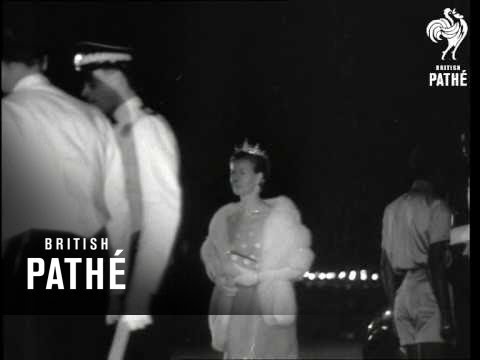
The first film is the longest of the three, and its title makes its point of view explicit: Ghana Independence: Duchess of Kent's Visit. Ghana names the occasion; the Duchess supplies the plot.[1] British Pathé's own current teaching page identifies Ghana's independence on March 6, 1957 as the first in Britain's African colonial sequence considered there.[4]
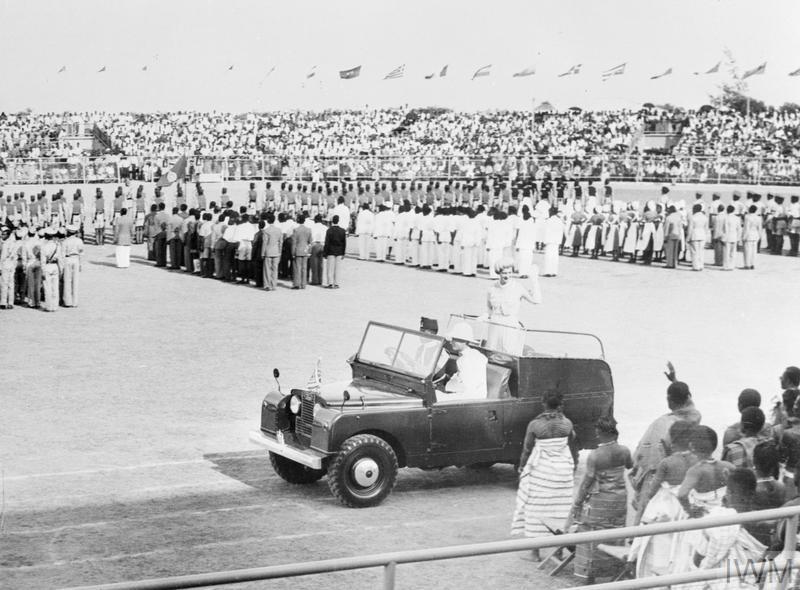
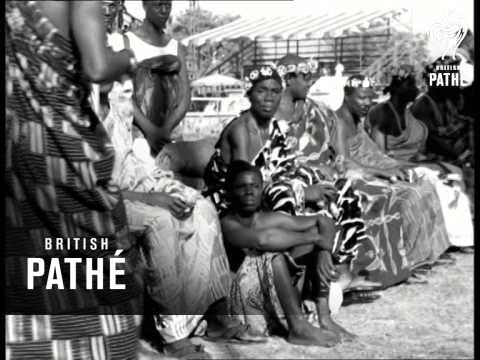
The footage gives Ghanaian presence real visual weight. Chiefs, patterned cloth, massed spectators, parades, and public celebration are not incidental decoration. The crowd is large enough to exceed any single official's control of the frame. The cover photograph, made at Accra Stadium on March 4, carries the same tension: Princess Marina stands in an open jeep, but the packed stands and assembled groups turn the royal progress into a Ghanaian public event.[8]
Still, a visit is a powerful editing device. It supplies arrival, reception, movement through ceremonial spaces, and departure. Kwame Nkrumah can appear as the prime minister of the new state while the visitor's itinerary quietly determines what the viewer sees next. Decolonization becomes hospitality: Ghana receives a representative of the Crown, and Britain recognizes a state whose political agency is easier to see in the cheering present than in the years that made the cheering possible.
Nkrumah's own governmental speech from August 29, 1957, preserved by the Library of Congress, points beyond that frame. Six months into independence, he described a program of non-alignment, economic development, education, social services, and institutional transformation.[5] Those priorities do not invalidate the stadium ceremony; they change its scale. Independence was not only a successful week of pageantry. It was a claim that a new government could set external alignments and reorganize social life on purposes it defined for itself.
The useful question, then, is not whether the newsreel is “British” or “Ghanaian.” It is where agency sits from shot to shot. Ghanaian bodies fill the film, and Ghanaian celebration gives it energy. The title nevertheless teaches the audience to remember a royal visit. The camera records a new nation while the edit retains an old narrator.
2. Kenya, 1963: a peaceful ceremony closes a violent passage
The Kenya film is radically compressed. British Pathé catalogues it as a two-minute, two-second black-and-white cinema newsreel released on December 16, 1963, four days after independence. Prince Philip and Prime Minister Jomo Kenyatta watch the Union flag come down in Nairobi.[2][4] The emblematic action is so strong that almost everything before it can seem like prelude.
Here the distinction between an event and a process matters most. The ceremony could be orderly even though the route to it was saturated with coercion. Britain's colonial government declared the Kenya Emergency in October 1952 and suppressed the Mau Mau rebellion through detention, dispossession, restrictions on assembly, capital punishment, and an expanded administrative security state. The formal Emergency ended in January 1960; negotiations and constitutional transition followed. Recent archival research by Kyle Melles adds a further complication: Kenyatta's incoming government retained important security powers and administrative structures built under colonial rule.[6]
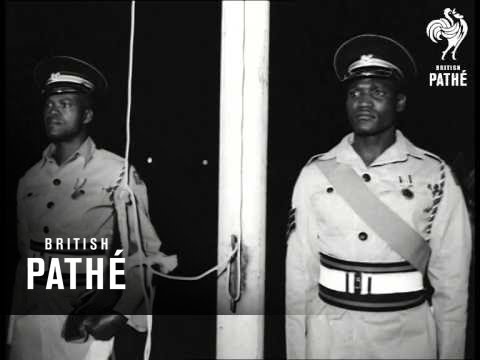
None of that means the flag shot is false. At the instant it records, formal sovereignty really is changing. Kenyatta and Prince Philip really do occupy the same ceremonial space; soldiers really do execute a public sequence; spectators really do witness a state begin. The error would be to treat visual calm as evidence that decolonization itself had been calm—or to assume that the lowering of one flag also removed the institutions formed beneath it.
The clip's brevity makes it a particularly sharp historical object. It shows how a cinema newsreel can turn a long conflict into a punctual settlement without making a single fabricated claim. Selection does the work. The Emergency is offscreen. Land, detention, rival nationalisms, constitutional bargaining, and the inherited security apparatus are offscreen. What remains is the moment Britain can film as a completed obligation.
Read alongside the written record, the ceremony becomes more interesting, not less. It marks both rupture and continuity: a new sovereign government takes office, yet some of the state's coercive tools cross the threshold with it.[6] The flag falls cleanly. Institutions do not.
3. The Gambia, 1965: the same grammar meets a different politics
The Gambia prevents the comparison from collapsing into a single accusation. British Pathé's one-minute, 46-second film shows the Duke and Duchess of Kent meeting Prime Minister Dawda Jawara, a formal handover, marches, and dances on February 18, 1965.[3][4] Its royal-centred grammar resembles the Ghana and Kenya films. The political road behind it does not resemble Kenya's Emergency.
Arnold Hughes and David Perfect's political history describes a comparatively low-conflict constitutional transition, but not a politics without struggle. In the years before independence, party organization expanded beyond colonial Bathurst into the protectorate. The rural-based People's Progressive Party displaced older urban parties, and Jawara's leadership emerged from that electoral reordering.[7] The crucial action was not a guerrilla war hidden just beyond the edge of McCarthy Square. It was the building of a constituency that the square's official choreography could not readily picture.
This difference is essential. If every royal handover film is treated as a cover for the same kind of violence, the viewer merely replaces Pathé's flattening story with another one. The Gambia's ceremony matched a more negotiated passage. What the newsreel still compresses is political agency: organizing, campaigning, constitutional talks, regional imbalance, and the transfer of authority from an old capital-centred elite to a party with a broader rural base.[7]
The film's marches and dances therefore have more than one meaning. In Pathé's edit they complete a reassuring sequence—official recognition followed by popular celebration.[3][4] For Gambian participants, they could also occupy the capital in the name of a public that colonial political structures had represented unevenly. The same image can support both readings. A crowd may validate the newsreel's story of orderly transfer while also exceeding it, carrying local memories and expectations that the narrator never explains.
The repeated presence of a royal guest is not trivial, but neither is it the sole meaning of the day. The archive makes the Duke and Duchess convenient agents of change because arrival and handover are easy to film. Party formation is slow, dispersed, and visually untidy. Cinema privileges the key passing between hands over the years spent deciding who has the authority to receive it.
Watch the handover twice
Across the three films, British Pathé did not invent independence. It arranged it. The recurring sequence—royal presence, official encounter, disciplined ranks, flag, crowd—gave British viewers a legible ending to empire. It also gave the departing power a final active verb. Britain hands over; the new state receives.
That syntax conceals different things in each case. In Ghana, it narrows mass nationalism and a far-reaching governing project into the hospitality of a royal visit.[1][5] In Kenya, it lets ceremonial order stand where a violent Emergency and a complicated institutional inheritance should remain visible.[2][6] In The Gambia, it substitutes a punctual transfer for the slower work of party building and electoral change.[3][7] The similarity belongs to the films; the difference belongs to the histories.
A responsible viewing keeps both. First, watch with the newsreel. Notice who stands where, which uniforms survive the constitutional break, how crowds use ceremonial space, when the old flag disappears, and how the new one is presented. These are details prose cannot fully replace. Then watch against the edit. Ask whose journey supplies the beginning and end, which political actions cannot be turned into spectacle, and whether the narrator confuses a peaceful day with a peaceful process.
The strongest archival reading is not a hunt for proof that the camera lied. It is an inquiry into what truthful images were made to explain. On these three independence days, the flags changed. The newsreel's point of view changed much more slowly.
Sources
- British Pathé, “Ghana Independence: Duchess Of Kent's Visit (1957)” — official archival newsreel upload on YouTube.
- British Pathé, “Kenya Gains Independence (1963)” — official archival newsreel upload on YouTube.
- British Pathé, “Gambia Independent (1965)” — official archival newsreel upload on YouTube.
- British Pathé, “7.3B Independence in Africa” — institutional viewing guide with film durations, ceremony descriptions, and the Kenya newsreel's cinema release date.
- Kwame Nkrumah, Ghana's Policy at Home and Abroad (August 29, 1957), Library of Congress — primary-source statement of the new government's foreign-policy, development, education, and social-service program.
- Kyle J. Melles, “Kenya's Emergency Powers: Legal Continuities in the Post-Colonial State, 1959–1969,” Law and History Review (2025) — archival analysis of the Emergency, independence negotiations, and retained security powers.
- Arnold Hughes and David Perfect, A Political History of The Gambia, 1816–1994. University of Rochester Press, 2006 — political and electoral history of party formation, the People's Progressive Party, independence, and the Jawara era.
- Imperial War Museums, “Ghana Independence Celebrations, 4 March 1957, Accra Stadium,” catalogue no. A 33748 — object record for the archival photograph used as the article image.