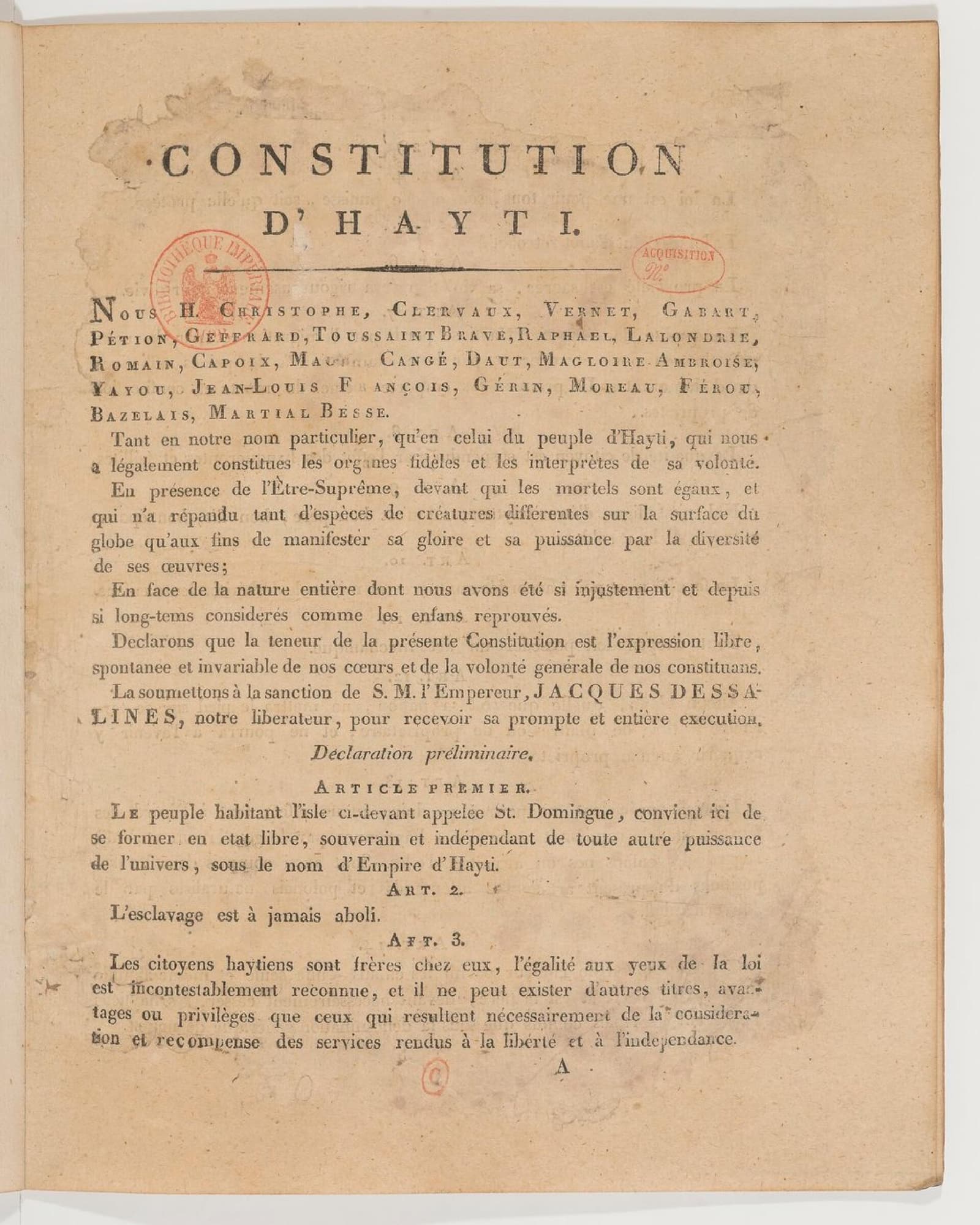
The first page does not open with Jean-Jacques Dessalines. It opens with twenty-two generals. Henri Christophe, Alexandre Pétion, François Capois, and their fellow signatories declare themselves the lawful interpreters of the Haitian people, then place their constitution before the emperor for sanction. Sovereignty speaks in the plural; authority resolves into one man.[1]
That movement—from a people who broke their chains to a ruler who embodies the state—runs through the Imperial Constitution of 20 May 1805. In the text the generals submitted and Dessalines sanctioned at the Imperial Palace that day, Article 14 assigns Haitians the common designation Black.[1][2] Detached from its neighbors, the line can look like a startling racial slogan. Read in sequence, it does more exacting work. It converts a category built to rank people under slavery into a name for political membership, while binding that membership to a guarded territory, revolutionary service, and an emperor figured as the nation’s father.
This is not a contradiction to be solved by choosing whether the document was liberating or authoritarian. It is the document’s architecture. Haiti’s founders used constitutional language to make emancipation irreversible in a world that had just demonstrated its willingness to reverse it. The same language made equality concrete and power vertical.
Image context: the cover reproduces the first page of the constitution from a Gallica scan. Its crowded list of generals matters: Article 14’s national family was announced by named military founders before it was sanctioned by the emperor.[1][7]
A constitution after emancipation had been reversed
The date explains the urgency. France had abolished colonial slavery in 1794, but the revolutionary opening did not hold. In 1802, Napoleon’s government preserved slavery where abolition had not taken effect and reimposed it in Guadeloupe; racial restrictions also returned across the French imperial system. Saint-Domingue’s army continued its war against the French, and Haiti declared independence on 1 January 1804.[5]
By October 1804, Dessalines had taken the imperial title. The constitution published the following May therefore did not organize a republic, despite the label often applied to early Haiti from abroad. It constitutionalized an empire created by people who had defeated a slaveholding empire. Dessalines’s assassination in 1806 was followed by civil war and rival northern and southern governments, making the charter’s institutional life brief.[4]
Brief did not mean slight. The preliminary declaration begins by renaming the place itself: the people of the island “formerly called St. Domingo” form a free, sovereign, independent state called the Empire of Haiti.[1][2] Article 2 then makes the revolution’s survival test constitutional: slavery is abolished forever. Articles 3 and 4 recognize Haitians as brothers at home and place them under one law, whether it punishes or protects.[1][2]
These provisions do not treat freedom as an abstract possession that any state could promise. They locate it in a specific political community made by a successful struggle against enslavement. Tamar Herzog reads the constitution’s method as a refusal to pretend inherited racial categories had ceased to matter: equality was pursued by taking the old classification and naming all Haitian citizens Black.[3] The universal enters through a history, not above it.
Articles 12–14 form one argument
Article 14 becomes clearer when reading starts two clauses earlier. Article 12 bars any white person, regardless of nationality, from entering the territory as a master or proprietor or acquiring property there. Article 13 exempts white women naturalized by the government, their children, and naturalized Germans and Poles. Then Article 14 declares that distinctions of color among one family’s children must cease and gives all Haitians the same generic name: Black.[1][2]
The sequence rules out a merely biological reading. Some members of the nation whom the document explicitly recognizes as white in Article 13 become Black in the political vocabulary of Article 14. Historian Julia Gaffield emphasizes this point through the surviving copies and translations: the clause attempts to make Blackness follow Haitian belonging, not measured complexion.[4] Herzog and the scholars Gaffield surveys read that move as a radical reworking of civic universality: the previously subordinated term is made to carry the whole civic body.[3][4]
But Article 12 prevents the passage from becoming an easy story of color-blindness. The constitution does not announce that race is irrelevant. It remembers precisely what master and proprietor meant in Saint-Domingue and draws a legal barrier against their return. Its exceptions also preserve distinctions of sex, national origin, and naturalization. The text does not state one general test behind those exceptions. What their placement makes visible is a political boundary inside the category white, not a claim that Germans and Poles were biologically different from other Europeans.[1][4]
There are two strong ways to interpret this maneuver. One stresses its expansive force: people whom colonial society had divided through elaborate gradations of color were gathered into a single anti-slavery nationality. The other stresses what Gaffield, drawing on Doris Garraway, describes as a negative universalism: the new collective was defined partly through the exclusion of whiteness as the position of colonial mastery.[4] The text supports both readings because it performs inclusion and exclusion in adjacent clauses. Article 14 widens Blackness into civic membership; Article 12 gives that membership a defended edge.
The family is equal, but it has a father
The family metaphor begins before Article 14. Article 3 calls Haitian citizens brothers at home. Article 9 measures a worthy Haitian through domestic and military roles: a good father, son, husband, and, above all, soldier. Article 14 then describes citizens as the children of one family whose father is the head of state.[1][2]
At first glance, that vocabulary softens government into kinship. In context, it also ranks the household. Siblings may be equal to one another, but the father stands above them. The article that erases color distinctions therefore makes the head of state the organizing figure of equality. Its political grammar is horizontal fraternity under vertical guardianship.
The institutional clauses remove any doubt about the vertical side. Dessalines is named emperor, commander in chief, avenger, and deliverer; the persons of the emperor and empress are declared sacred and inviolable. The crown is called elective, yet Dessalines can designate his successor. He appoints and dismisses ministers, generals, judges, local administrators, and other public officers; directs state finance; controls the armed forces; and alone makes war, peace, and treaties.[1][2] The Council of State is composed by right of division and brigade generals. The military founders listed on page one do not leave the constitutional stage. They become the state’s governing class.
Calling Article 14 democratic in a modern institutional sense would therefore misread it. The provision equalizes the civic name without distributing sovereign power equally. Its “family” joins former colonial subjects against a racial order while naturalizing a father-emperor at the center. Emancipation and command are not separate chapters of the document. They are written into the same metaphor.
Property becomes sacred—for a remade political community
Another apparent contradiction rewards the same close reading. Article 6 declares property sacred. Article 12 denies white foreigners the right to acquire it. In the general provisions, the constitution confiscates former property of white French owners for the state.[1][2]
Those clauses are inconsistent only if “property” is imagined without history. In colonial Saint-Domingue, ownership included land, plantations, and legal property in human beings. Nor was the transfer of land only a legal event: in 1804, Dessalines’s government directed the killing of much of the remaining white French population. Ferrero connects that massacre and wartime flight, followed by confiscation and title reviews, to the passage of most productive land into state hands.[6][8] The new state had emerged by destroying property in people and violently confronting claims to restore the colonial order. Its constitution protects property inside the political community it is building; it does not promise to honor every title produced by the order it defeated.
The result was not a simple transfer from plantations to independent small farmers. Under Dessalines, large estates remained intact and were managed through a heavily directed agricultural system whose export revenue helped finance the defense of independence.[6] That later evidence sets a boundary on what the constitutional words alone can prove. Article 12 blocked the return of white proprietorship, but it did not specify an egalitarian distribution of land or guarantee autonomy for plantation laborers.
The same boundary applies to Article 14. A legal name does not demonstrate that older divisions between people free before general emancipation—whether born free or previously manumitted—and those emancipated during the revolution disappeared in daily life.[4] Nor does the masculine family vocabulary establish equal political standing for women. Raffaella Sarti’s wider study of race, gender, and dependency in the French revolutionary Atlantic warns that formal emancipation and citizenship repeatedly left gendered dependence in place.[5] The charter tells us how the state wanted the nation to be legible. Administrative practice, landholding, labor, family law, and later civil conflict tell us how incomplete that act of naming remained.
What one sentence changed
The 1805 Constitution is most revealing when Article 14 is neither celebrated in isolation nor dismissed because it sat inside an empire. Its radicalism lies in refusing the supposedly neutral solution. A society built through racial slavery could not undo that inheritance merely by omitting race from the page. Haiti’s founders instead seized the name imposed on the enslaved and made it capacious enough to include the citizen—including naturalized Europeans whom the preceding clause still called white.[1][3][4]
Its limit lies in the form of that inclusion. The constitution turns difference into one national family, then gives the family a military father. It makes property secure only after deciding which colonial claims the new state will reject. It declares one law for all while vesting extraordinary control over law, offices, armed force, and succession in Dessalines.[1][2]
That combination is why the document outlived its short institutional career. Article 14 did not claim that skin color had vanished. It changed the question color answered. Under colonial rule, color had organized degrees of status and exposure to enslavement. In the constitution’s founding language, Black named membership in a sovereign polity created to prevent enslavement’s return. The transformation was neither complete nor politically innocent. It was a constitutional attempt to make the revolution survive as a people.
Sources
- Government of Haiti collection via HaitiDocs, Laws and Acts under the Reign of Jean-Jacques Dessalines, 1804–1806 — digitized French primary text of the 20 May 1805 Imperial Constitution and related laws.
- Wikisource, “Constitution of Hayti (1805)” — historical English translation of the charter used here as a reading aid alongside the French text.
- Tamar Herzog, “Independence(s): What Is a Revolutionary Law?” in The Cambridge History of Latin American Law in Global Perspective (2024) — comparative legal history of revolutionary state-making and Haiti’s use of Blackness as a category of equality.
- Julia Gaffield, “Race and the Haitian Constitution of 1805,” University of Pennsylvania Libraries (2015) — analysis of Article 14, its surviving translations, political meaning, and competing scholarly interpretations.
- Raffaella Sarti, “From Slaves and Servants to Citizens? Regulating Dependency, Race, and Gender in Revolutionary France and the French West Indies,” International Review of Social History 67 (2022) — abolition, re-enslavement, citizenship, and gender across the revolutionary Atlantic.
- Mario Ferrero, “Accidental socialism: a natural experiment in Haiti 1796–1820,” Journal of Institutional Economics 17 (2021) — land confiscation, state property, plantation management, and the post-revolutionary economy.
- Bibliothèque nationale de France via Wikimedia Commons, “Constitution d’Haïti (20 mai 1805), page 01” — source page for the Gallica archival scan used as the cover image.
- Carolyn Fick, “Jean-Jacques Dessalines and the Independence of Haiti,” Bibliothèque nationale de France, Shared Heritage: France–Americas — the 1804 independence settlement, Dessalines’s orders against remaining French residents, and the constitutional setting.