Cultural notice: This article and its cover photograph name and depict Aboriginal people who have died.
On 23 August 1966, about 200 Aboriginal stockmen, domestic workers, and family members left Wave Hill cattle station in Australia’s Northern Territory. Vincent Lingiari led the walk-off, but the company did not lose only a crew of men. Gurindji, Mudburra, and Warlpiri people withdrew the households on which station life depended. They left corrugated-iron quarters without floors, sanitation, or reliable clean water, and work that could still be rewarded with rations or wages below those paid to white employees.[1][11]
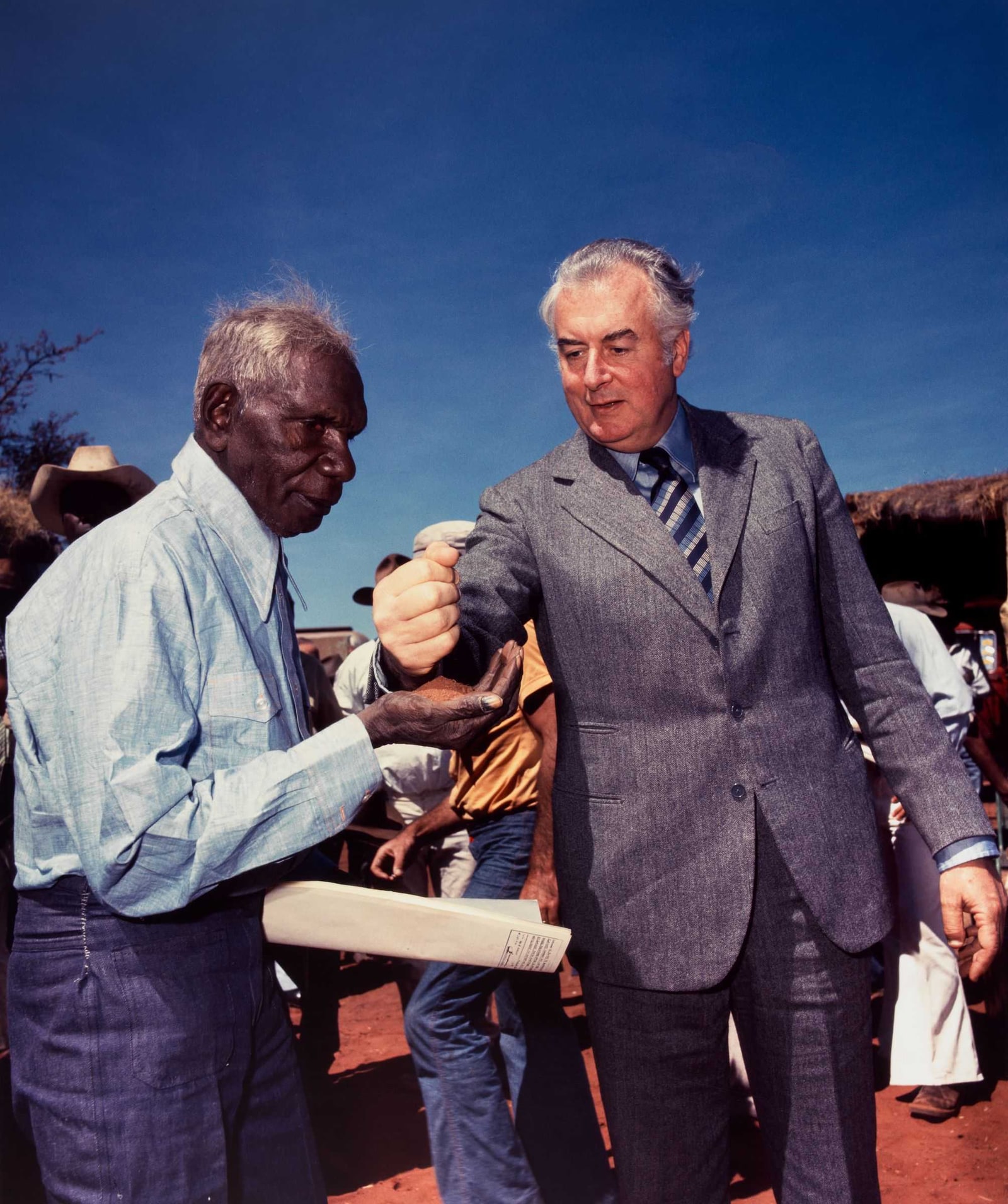
The most familiar version of what followed jumps nine years ahead. On 16 August 1975, Prime Minister Gough Whitlam tipped red earth into Lingiari’s open palm at Daguragu. Mervyn Bishop’s photograph turned the gesture into a national image of restitution. Yet beginning with that picture makes the outcome look almost inevitable, as though a wage strike naturally matured into land rights and the state eventually supplied the correct ending.
The chronology is rougher and more revealing. An industrial judgment extended award coverage to some Aboriginal pastoral workers, but postponed the change and preserved exclusions. The walkers shifted camp twice, rejected inducements to return, and placed their own settlement on Gurindji Country. A petition translated an older claim into the legal language of a lease, a cattle enterprise, and a school; the government refused it. Supporters carried food, letters, publicity, and money, but the Gurindji supplied the campaign’s irreplaceable resource: they stayed. By the time the new award terms took effect for covered male pastoral workers, going back to work could no longer answer the question the walk-off had made physical—who had the authority to decide what life on that land would be?
March 1966: equality, delayed
The walk-off began inside a labor system that had made Aboriginal expertise essential and Aboriginal equality optional. Gurindji stockmen mustered cattle across immense distances, while women’s domestic labor sustained the homestead. Vincent Lingiari had risen to head stockman, yet his Australian Dictionary of Biography entry records that he initially received no cash wage. The inequality was not an accidental practice at one remote property. Government regulation and pastoral awards had helped maintain it.[2][6]
On 7 March 1966, the Commonwealth Conciliation and Arbitration Commission decided to remove the cattle award’s racial exclusion for Aboriginal male pastoral workers—but delayed the change until 1 December 1968. It did not establish universal equal pay: domestic-service workers, many of them women, remained outside the award, and employers could seek permits to pay reduced rates to workers classified as unable to earn the minimum. Legal historian Thalia Anthony argues that the celebrated case carried unequal machinery inside it, while the proceedings treated the removal of Aboriginal families from station camps as part of assimilation. The ruling extended an industrial entitlement on a timetable and in a form shaped partly around the industry that would have to pay for it.[2][12]
At Wave Hill, owned by the British-based Vestey group, waiting meant continuing the same work under the same authority. Poor housing, rations, low pay, and the deeper history of pastoral occupation converged. Oral histories gathered with Gurindji elders place the decision against more than eight decades of land seizure, killings, and family violence, not merely the months since an industrial ruling. That wider memory matters: it explains why a better wage could be necessary without being sufficient.[3]
23 August 1966: leaving the station was the first claim
The walkers first camped in the dry bed of the Victoria River near the Wave Hill Welfare Settlement, then shifted to higher ground nearby during the wet season.[5] From the company’s perspective, a strike could still end conventionally: negotiate, improve terms, bring labor back. Through the rest of 1966, the workers consulted with other Gurindji, the North Australian Workers Union, and the Northern Territory Council for Aboriginal Rights. No agreement with Vestey returned them to the station.[1]
Outside allies were important, but a later story sometimes gave them too much authorship. Journalists and unionists initially read the action chiefly as a wage dispute. Historian Charlie Ward’s account of the Gurindji petition restores a different sequence: leaders including Lupngaiari, Pincher Nyurrmiarri, Donald Nangiari, and Vincent Lingiari explained ambitions broader than the industrial frame to writer Frank Hardy. Assistance could amplify and translate the campaign; it did not invent the connection to Country.[4]
The distinction is visible in where people chose to live. In March 1967, the community moved about 20 kilometres from the welfare settlement to Wattie Creek, or Daguragu, near important Gurindji places.[1] The route now protected on Australia’s National Heritage List preserves that sequence in the ground: the station homestead, the fence line followed by the walkers, a remembered resting place, the camps near the welfare settlement, and the site of the new community at Daguragu.[5]
Moving there changed the strike’s grammar. A picket asks an employer to change the terms of work. A community built on Country asks why the employer and the state possess the power to set those terms at all. The Gurindji did not need every supporter to understand that distinction immediately. They made it harder to miss by refusing to leave.
19 April 1967: Country enters the petition file
The petition sent to Governor-General Lord Casey on 19 April 1967 did not ask for a symbolic acknowledgment. Four senior leaders—Pincher Nyurrmiarri, Gerry Ngalgardji, Long Jonny Kitngiari, and Vincent Lingiari—requested tenure over about 500 square miles in the Wave Hill–Limbunya area. They proposed a cooperatively run cattle and mining lease, a school, and an economy directed by the community. Frank Hardy and welfare officer Bill Jeffrey were identified as the people who transcribed, witnessed, and transmitted the request.[4]
That chain of authorship deserves precision. English legal prose and the lease proposal were a strategic form, not the origin of the claim. The petition said the Gurindji had been dispossessed without compensation and distilled its moral argument into one sentence: “We feel that morally the land is ours and should be returned to us.”[4] The sentence put prior belonging before administrative permission.
The request was rejected later in 1967.[4] This is the point at which a shorter protest might have dissolved. The company still controlled the pastoral lease; the government had declined the proposed enclave; the settlement needed supplies; and remote distance made attention expensive. Instead, rejection turned time itself into leverage. Each season at Daguragu demonstrated that the community was not waiting in a temporary strike camp for an employer’s offer. It was trying to govern a place.
The 27 May 1967 referendum, which expanded Commonwealth power to make laws concerning Aboriginal people, did not itself grant land at Wave Hill. It did, however, alter the federal setting in which the Gurindji claim was heard.[1]
1968–73: staying becomes the action
When the new award terms began for covered male pastoral workers on 1 December 1968, the campaign did not end. That fact is the cleanest evidence against treating land rights as a decorative cause attached to a wage dispute. The award altered employment rules for part of the station workforce. It did not cover domestic service, return land, make Daguragu secure, or transfer decisions about housing, schooling, cattle, and sacred places to Gurindji hands.[1][2][12]
The years between petition and handback were active, not an empty interval. Lingiari and other elders travelled to Sydney and Melbourne to build support. In 1971, Lingiari, Galarrwuy Yunupingu, and Ted Egan recorded Gurindji Blues, carrying the land claim in Lingiari’s own voice beyond the Northern Territory. The community formed the Muramulla Gurindji Company, raised funds for horses and fencing, and prepared for the cattle enterprise it had already described to the governor-general.[6]
This work also set a boundary around the role of solidarity. Unionists, students, writers, Aboriginal activists, and donors helped the settlement survive and made the dispute national. Their networks moved resources and publicity. But the campaign could not have been outsourced: only the people at Daguragu could keep the claim embodied day after day. The walk-off’s mechanism was not one dramatic march. It was the repeated decision not to let distance, refusal, or the eventual wage award pull the community back inside Vestey’s terms.
When Labor returned to government in December 1972, Whitlam had already promised national land-rights legislation. In March 1973, his government reached an agreement for a Gurindji lease over roughly 3,236 square kilometres of Wave Hill station.[5][6]
16 August 1975: one handful of earth
Two years passed between that agreement and the public ceremony at Daguragu. Whitlam’s short speech on 16 August 1975 acknowledged a victory achieved nine years after the walk-off and promised the act would not stand alone. He handed Lingiari the deeds and described them as proof under Australian law that the land belonged to the Gurindji.[7]
The famous photograph is truthful without being candid. The formal presentation occurred under shelter; Bishop, then a photographer for the Department of Aboriginal Affairs, asked Whitlam and Lingiari to repeat the gesture outside in strong light. In the resulting frame, blue sky, red ground, dark suit, and two pairs of hands strip away almost everything except transfer. Lingiari holds the documents in his left hand while Whitlam lets the earth fall into his right.[10]
Knowing that the scene was repeated does not make it false. It shows that restitution had to operate in two registers. The deeds performed a legal transfer; the earth made that transfer intelligible to a public that might never read a lease. Bishop’s composition gave the state a memorable gesture, but Lingiari’s presence kept the image from becoming a gift bestowed on passive recipients. The government was returning a portion of what the Gurindji had asserted was theirs before the station existed.
The photograph nevertheless compresses away the hard middle: the families who walked, the months at the welfare settlement, the move to Daguragu, the rejected petition, fundraising trips, company-building, and years of remaining in place. It also conceals a legal limit. What the Gurindji received in 1975 was leasehold title, not yet the inalienable Aboriginal freehold they sought.[1][6][9][10]
After the photograph: making “forever” harder to revoke
The Whitlam government introduced an Aboriginal land bill later in 1975, but it did not pass before the government’s dismissal that November. Under Malcolm Fraser, Parliament passed land-rights legislation in December 1976.[13] The resulting Aboriginal Land Rights (Northern Territory) Act 1976 received assent on 16 December 1976 and principally commenced on 26 January 1977. It created a process through which traditional Aboriginal owners in the Territory could claim eligible land and hold it through land trusts as inalienable freehold. The law was broader than the Wave Hill settlement, and the Gurindji campaign helped pave the way for it.[1][8]
Even then, the title in Whitlam’s promise did not become fully secure at once. The Central Land Council pursued a claim covering the Daguragu pastoral lease and adjoining land. In May 1986, twenty years after the walk-off, the Gurindji finally received the deed to inalienable Aboriginal freehold title for Daguragu.[1][9]
That longer ending changes the meaning of “nine years.” Nine years measures the road from walk-off to the iconic handback. It does not measure the full struggle to replace a conditional pastoral lease with inalienable Aboriginal freehold.
Nor did every claim to Gurindji Country end in 1986. On 8 September 2020, a consent determination recognised non-exclusive native title rights across approximately 5,492 square kilometres of Wave Hill Station. Those rights coexist with the operating pastoral station—a different tenure and legal route from Daguragu’s Aboriginal freehold.[14]
Today the Gurindji Aboriginal Corporation’s Freedom Day march follows the walkers’ footsteps toward Lipananku on the Victoria River, while ceremony, story, sport, and music keep the event in community time.[11] The protected route and the annual march resist the photograph’s tendency to make history stand still. The handback matters because people first moved away from the station, moved again onto Country, and then refused to move off it.
The Wave Hill walk-off began with a demand an industrial tribunal had deferred. It endured because the Gurindji made that demand inseparable from authority over land and collective life. Wages could change what work was worth. Staying at Daguragu changed who was entitled to decide what the future was for.
Sources
- Museum of Australian Democracy at Old Parliament House, “The 1966 Wave Hill walk-off” — institutional chronology of working conditions, the walk-off, the move to Daguragu, the 1973 leases, the 1975 handback, and later title.
- Thalia Anthony, “Reconciliation and Conciliation: The Irreconcilable Dilemma of the 1965 ‘Equal’ Wage Case for Aboriginal Station Workers,” Labour History 93 (2007), University of Technology Sydney repository — analysis of the award’s wage exceptions and assimilationist premises.
- Felicity Meakins, “The untold story behind the 1966 Wave Hill Walk-Off,” ABC / The Conversation (2016) — Gurindji oral histories placing the action within the longer history of pastoral occupation and violence.
- Charlie Ward, “The Gurindji Petition,” Australian Dictionary of Biography, Australian National University — account of the petition’s authors, transcription, demands, and political language.
- Australian Government, Inclusion of the Wave Hill Walk-Off Route in the National Heritage List, Gazette C2024G00339 (18 June 2024) — official description of the route, sequence of camps, Daguragu settlement, and national significance.
- Ted Egan, “Vincent Lingiari (1919–1988),” Australian Dictionary of Biography, vol. 18 (2012) — biography covering station work, national organizing, the Muramulla Gurindji Company, the 1973 agreement, and the 1986 freehold title.
- Gough Whitlam, “Speech at the Gurindji Land Ceremony,” Daguragu, 16 August 1975 — official contemporary transcript of the handback address.
- Australian Government, Aboriginal Land Rights (Northern Territory) Act 1976 — Federal Register as-made text of the statutory framework, with assent and commencement history.
- Central Land Council, “Daguragu station land claim,” reprinted from Land Rights News (November 1986) — account of the gap between the pastoral lease and the final freehold deed.
- National Portrait Gallery of Australia, Mervyn Bishop, Prime Minister Gough Whitlam pours soil into the hand of traditional land owner Vincent Lingiari (1975) — collection record and source page for the article’s archival photograph.
- Gurindji Aboriginal Corporation RNTBC, “Gurindji Freedom Day Festival” — community account of the walk-off’s participants and its continuing commemoration on Gurindji Country.
- Commonwealth Conciliation and Arbitration Commission, Variation—Cattle Station Industry (Northern Territory) Award (7 March 1966), via the Fair Work Commission — primary decision extending award coverage, delaying commencement, and retaining a reduced-rate permit mechanism.
- Documenting Democracy, National Archives of Australia, “Aboriginal Land Rights (Northern Territory) Act 1976” — official history of the shift from the Whitlam government’s land-rights program to passage under the Fraser government, and record of the Act signed on 16 December 1976.
- Central Land Council, “Native title to be recognised on Wave Hill Station” (7 September 2020) — account of the following day’s consent determination, its approximately 5,492-square-kilometre area, and coexistence with pastoral operations.