The Negro Soldier is not a neutral record of the U.S. Army in 1944. It is an orientation film asking Black troops to see military service as an expression of citizenship and white troops to recognize that claim. That purpose gives the film its force—and its central contradiction. What kind of equality could the War Department put onscreen while the Army itself still organized soldiers in segregated units? The film makes Black history, dignity, work, and sacrifice emphatically visible. It shows all-Black formations and social spaces while refusing to name, explain, or challenge the segregation policy that produced them.[1][2][4][5]
The production history makes that omission a choice, not an accidental gap. The Army began developing the project in 1942, production started in January 1943, and the completed film entered military distribution in early 1944. Stuart Heisler directed; Carlton Moss wrote the screenplay, served as an adviser, and played the minister; Frank Capra supervised the production for the Army’s filmmaking operation. Early scripts went through repeated review and rewriting, yet Moss was not permitted to discuss segregation in the official film. The Army eventually ordered the finished picture shown to all troops.[2][3]
The National Archives labels this copy digitally restored and identifies it as War Department Orientation Film No. 51, National Archives Identifier 35956. The historical title is retained here because it is the work’s name; the timestamps below refer to this approximately 40-minute NARA upload and are viewing landmarks, not a transcript. Watch how the film builds authority, changes scale, and arranges evidence—and notice which relationships it never lets the camera explain.[1]
0:00–6:30 — the pulpit gives the film its authority
After a brief disclosure that the film combines historical footage with reenactments and material from several official and newsreel sources, the staged narrative enters a Black church. Moss’s scripted minister addresses a Black congregation, framing military service through sermon and song. This matters. A white military narrator could have delivered the same official argument, but the sermon relocates moral authority inside a Black institution. The congregation is not decorative audience footage: its listening faces repeatedly measure the argument. The Army supplies the film; the minister appears to weigh the nation’s demand.[1][2][3]
Around 2:50, heavyweight champion Joe Louis becomes the bridge from sport to global war. The film invokes his decision to serve and then turns toward Nazi racial doctrine. Photographs, headlines, maps, and enemy propaganda establish fascist racism as something explicit, foreign, and mortal. Against that ideology, Black military participation becomes evidence that the United States represents another political order.[1]
The contrast is powerful, but it also sets the film’s editorial boundary. Racism is most legible when it belongs to the enemy. The minister never asks viewers to compare Nazi claims with the U.S. Army’s separate units, unequal facilities, or restricted assignments. Those systems were not equivalent to the Nazi project, and the film does not say they were. The revealing point is narrower: the camera invites a moral comparison between nations while declining an institutional comparison inside the American military. An official Army history and a later Air Force study both place the film within a wartime force still structured by segregation.[2][5]
6:30–16:30 — a national timeline with the wound edited out
The sermon next assembles a long Black claim to the United States. Crispus Attucks and the Revolution lead into the War of 1812, the Civil War, the Spanish-American War, and the First World War. The sequence then widens beyond combat: monuments, schools, farmers, scientists, professionals, athletes, and artists. Its accumulation refuses the racist fiction that Black achievement is marginal to national history.[1]
Formally, the montage does something clever. It treats participation as continuity. Once Black people appear at the nation’s founding, in successive wars, and in modern civic life, service in 1944 looks neither exceptional nor newly granted. It looks inherited. Images of Booker T. Washington, George Washington Carver, and Jesse Owens further shift Black Americans from anonymous manpower to named accomplishment. The sequence answers “Do Black Americans belong?” with a history longer than the audience’s living memory.[1][4]
Yet chronology can conceal as efficiently as it reveals. The film crosses from 1770 to 1944 without making slavery, Reconstruction’s defeat, disfranchisement, Jim Crow, racial violence, or military segregation part of the causal story. The people and achievements shown are real; the problem is the connective tissue. A sequence of contribution replaces a history of contribution made under coercion and exclusion. NARA’s own appraisal therefore describes the film in two registers at once: a milestone in Black screen portrayal, and a work that ignores discrimination and segregation in both military and civilian life.[4]
That distinction prevents two bad readings. The montage is not worthless because it is selective: in a period saturated with degrading stereotypes, sustained images of Black historical agency carried genuine representational weight. Nor is the montage a complete history because its examples are accurate. Selection is the argument. The film turns a contested demand for equal citizenship into proof that citizenship has already been recognized.
19:45–31:15 — one letter makes Army life look ordinary
After the grand historical survey, a mother identifies her son Robert in the film’s military montage and produces his letter, which is read aloud over his story. The film’s scale contracts from centuries to one recruit’s path through induction, medical examination, drill, meals, worship, recreation, specialist training, and officer preparation. The letter gives the institutional tour a personal grammar: “the Army” becomes what this son sees, learns, and reports home.[1][2]
Ordinariness is the achievement here. Robert is not introduced as a rare prodigy who earns an exception. He is one soldier moving through a system with standards, teachers, equipment, and routes to responsibility. Repeated images of Black men studying, operating machinery, receiving medical care, and taking command directly counter the caricatures that had narrowed their roles in commercial film. Brigadier General Benjamin O. Davis, the Army’s first Black general officer, advised on the production while also investigating discrimination against Black soldiers; NARA describes the film as required viewing for new troops.[3][6]
But the recruit’s-eye structure also makes segregation unusually hard to see. Almost every institution Robert enters is presented as a self-contained Black military world. Because the film rarely shows how his unit relates to white units—who controls assignments, which facilities are comparable, which specialties are open, or how promotion works—separation can register merely as Black presence. A viewer sees men being trained, but not the rule that organized them separately.[1][5][6]
This is more than a missing sentence. It is a visual problem built into the tour. A segregated institution becomes legible only through relationships: two units, two sets of facilities, two chains of opportunity, or testimony about the boundary between them. By staying close to Robert’s forward motion, the film supplies almost no comparative frame. Competence is visible in every scene; unequal structure remains offscreen.
31:15–36:30 — a catalogue of competence is not a map of equality
The last major movement accelerates into a catalogue. Fighter pilots, ground crews, engineers, drivers, artillerymen, signal personnel, quartermasters, medics, and other specialists appear in rapid succession. The change in rhythm matters. The film no longer asks whether Black soldiers can perform one prestigious task; it overwhelms that premise with the range of work already being done.[1]
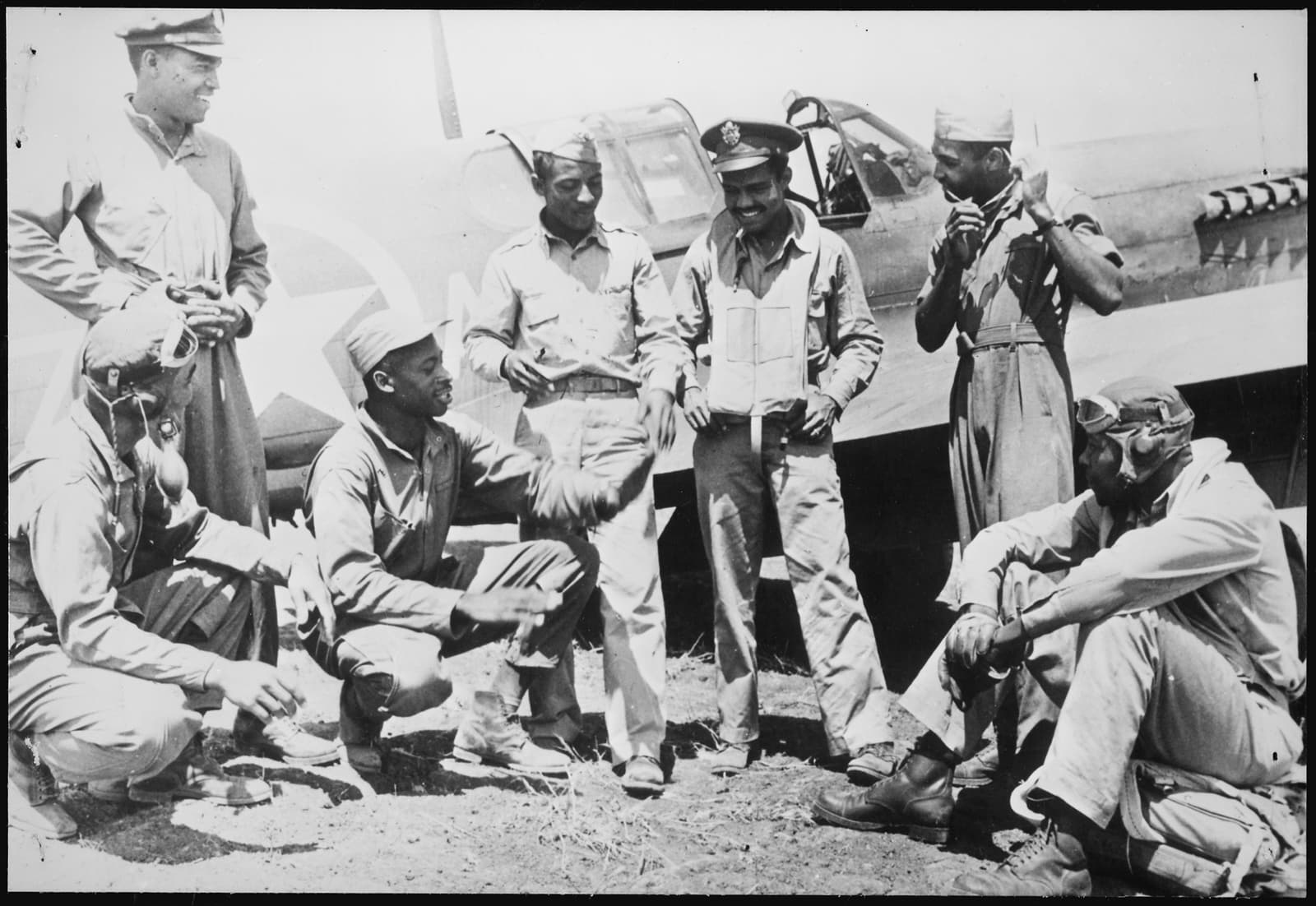
The fighter-pilot passage is especially resonant beside the cover photograph. Taken in February 1944, while the film was entering distribution, the photograph shows Black Army Air Forces pilots talking beside a P-40 at a Mediterranean base. It is not a still from The Negro Soldier, and it should not be used as generic proof that the film represents every serviceman’s experience. It is separate archival evidence: named by its record context, fixed to a month and theater of war, and connected to Army Air Forces organizations that were still segregated.[5][8]
The film’s occupational breadth proves participation and skill; it cannot by itself prove equality of access or treatment. That is the key test for this sequence. Representation answers who is present in the image. Institutional history asks under what rules, in which units, with what opportunities, and alongside whom. The film is strongest on the first question precisely where it is silent on the second.
37:20 onward — sacrifice closes the argument, not the policy gap
The film returns to the church for its close. A roll call of servicemen killed gives the patriotic history a present cost, and the congregation’s response turns individual names and portraits into collective sacrifice. Structurally, the ending completes a circle: history justified service, training demonstrated readiness, combat confirmed contribution, and worship gives that contribution moral meaning.[1]
It does not return to policy. The close implies that blood shed for the country ratifies an existing claim to full citizenship, but it names no mechanism for making the armed forces equal. That boundary is clearer from the later timeline. On July 26, 1948—four years after the film’s release—Executive Order 9981 declared equality of treatment and opportunity in the armed services to be federal policy and created a presidential committee to pursue it. The order was a policy turning point, not instant proof that practice changed everywhere at once.[7]
What the film changed—and what it could not admit
Calling The Negro Soldier propaganda does not settle its historical value. Propaganda describes a purpose and a method: the film selects facts and emotions to move military audiences toward unity and participation. It can do that while also expanding the range of dignified Black life available on an official American screen. The Black minister’s authority, the congregation’s attention, Robert’s ordinary ambition, and the closing inventory of skilled work are not cancelled by the omissions around them.[1][3][4]
The reverse is equally important. Better representation does not make the institution represented equal. The film resolves the contradiction rhetorically: it treats Black contribution as proof of democratic belonging, then refuses to name the segregated structure that exposes belonging as an unfulfilled promise. Its achievement and its limit are therefore inseparable. It widened the visible nation without explaining the policy boundary that still divided it.
That is why the film rewards close viewing rather than a simple verdict. Look at what appears, but also ask what comparison would have to appear for inequality to become visible. In The Negro Soldier, history, work, family, faith, and sacrifice fill the screen. Segregation survives in the space between those images.
Sources
- U.S. National Archives, “The Negro Soldier, 1944 (Digitally Restored),” War Department Orientation Film No. 51, National Archives Identifier 35956.
- Ulysses Lee, The Employment of Negro Troops, U.S. Army Center of Military History—official history of segregated service and the film’s development, distribution, structure, and military audience.
- American Film Institute Catalog, “The Negro Soldier”—credits, production chronology, script development, release history, and contemporary reception.
- U.S. National Archives, “Films at the National Archives in February”—historical appraisal of the film’s representational milestone and its omission of discrimination and segregation.
- Alan M. Osur, Separate and Unequal: Race Relations in the AAF During World War II, U.S. Air Force history—segregation policy, assignments, facilities, and wartime pressure for change.
- U.S. National Archives, “Brigadier General Benjamin O. Davis, Sr.”—Davis’s wartime role, investigations of discrimination, segregated units, and advice on the film.
- Harry S. Truman Presidential Library, “Executive Order 9981”—the July 26, 1948 order declaring equality of treatment and opportunity in the armed services as federal policy.
- U.S. Office of War Information / National Archives, “Pilots of a U.S. Army Air Forces fighter squadron,” February 1944—catalog record for the archival cover photograph, NARA ID 535763.