The Great Epizootic of 1872-73 is easy to misremember as a curious pre-automobile inconvenience: the year the horses got sick and people had to walk. That version is too small. The outbreak became a crisis because nineteenth-century North American cities had made the horse into a distributed power system. Horses moved passengers, parcels, coal, beer, building materials, fire engines, hearses, canal boats, and local freight. When equine influenza made them cough, weaken, and stop working, the city did not lose a quaint technology. It lost the last mile of almost everything.[1][2]
The causal chain was brutally simple. Dense cities concentrated thousands of horses in stables. Railways and urban markets kept replenishing those animals from other places. A respiratory disease found hosts in one city, then followed the same commercial links that moved animals and goods. Once it arrived, the illness did not need a high death rate to paralyze daily life. It only needed to make enough horses temporarily unusable at the same time.[2][3]
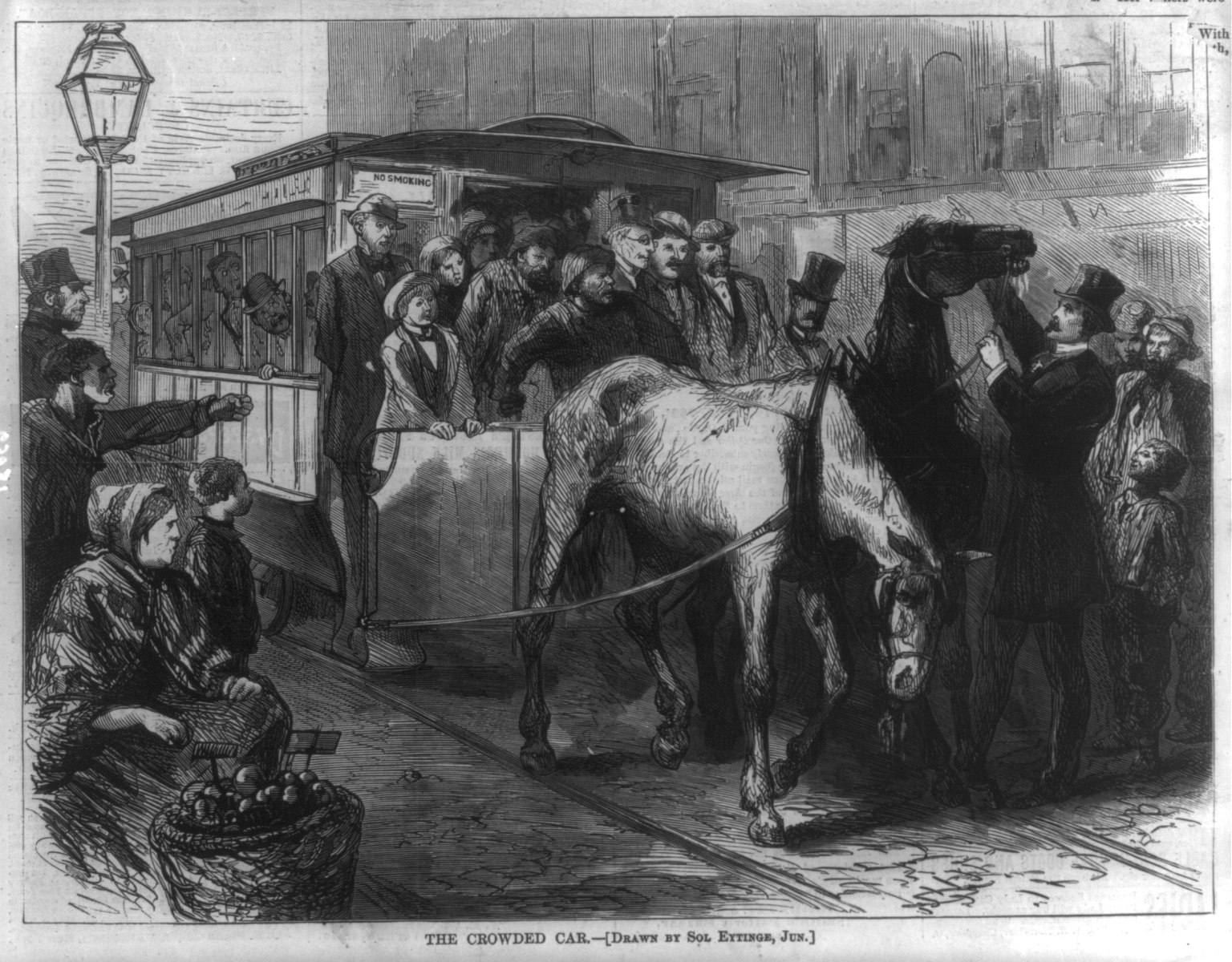
Image context: the cover is a real archival wood engraving after Sol Eytinge, published in Harper's Weekly in September 1872 and preserved through the Library of Congress/Wikimedia Commons record. It is not a diagram, chart, or generated visual. The overcrowded horsecar makes the article's mechanism visible: urban mobility rested on animal bodies already being asked to do system-scale work before the epidemic struck.[6]
The failure began outside Toronto
The first reported cases appeared near Toronto in late September 1872. James Law's contemporary report for the U.S. Commissioner of Agriculture traced the disease from horses pastured about fifteen miles north of Toronto into the city itself; by October 1, cases were being seen in Toronto, and within three days nearly all horses in the streetcar and livery stables were affected.[3] That speed matters. The early outbreak was not just a rural veterinary incident. It reached the places where animal power was concentrated for urban service.
From there, the chronology reads less like a local epidemic than a map of connected cities. Law reported the disease as general in Montreal and Quebec by October 18, in Buffalo by October 21, and at Brooklyn, Jersey City, and Boston by October 22. By October 23, reports included Hartford, New Haven, Providence, Newport, Portland, Augusta, Chicago, and other points; by late November and December the disease had moved into the South, the Midwest, New Orleans, Omaha, and Havana.[3] The dates are not decorative. They show a transportation society carrying an animal disease through its own operating network.
Modern scholarship sharpens that point. Sean Kheraj argues that the Great Epizootic revealed North American cities as linked disease pools: different cities shared similar equine labor systems, crowded stable environments, and commercial connections that made them hospitable to the same outbreak.[2] The disease did not spread because every city looked identical in architecture or climate. It spread because cities had standardized one crucial dependency: they all used horses as fractional, flexible power.
Mortality was not the main bottleneck
The outbreak was deadly for many animals, but its urban force came from incapacity. Thomas G. Andrews estimates that the Great Horse Flu sickened 90 to 99 percent of horses, donkeys, and mules across a huge northern American range, with an estimated 1 to 4 percent case-fatality rate among afflicted equines.[1] Those ranges are enough to explain why the event became economically severe without needing a scene of universal death. A delivery system can fail when the workers are alive but too weak to work.
Contemporary descriptions emphasized that weakness. Law defined the disease as a debilitating fever with respiratory inflammation and a usual course of ten to fifteen days.[3] In a farm setting, that might mean delay. In a city stable, it meant synchronized stoppage. A streetcar company did not need every horse dead to suspend service. A fire department did not need every team lost to slow response. A rail depot did not need every dray animal gone to become clogged with undelivered boxes.
New York made the scale visible. Oliver Lazarus's Gotham Center history places the disease in New York on October 21, notes that within days it affected the majority of the city's estimated 70,000 horses, and describes the animal workforce as the city's crucial energy supply.[4] That phrase is useful because it prevents nostalgia from softening the problem. The horses were not accessories to urban life. They were the flexible power units that connected railheads, piers, warehouses, markets, homes, and offices.
The last mile stopped first
Steam power did not rescue the city because steam did not solve every distance. Trains could bring goods to depots; ships could bring cargo to piers; factories could produce material. But goods still had to cross streets, reach shops, move from terminals to warehouses, and travel through neighborhoods. The Great Epizootic attacked that last-mile layer. Smithsonian's Ernest Freeberg describes produce rotting at docks, freight accumulating, coal fears rising, saloons missing beer deliveries, postmen relying on wheelbarrows, and companies hiring human crews to drag wagons.[5]
That is why the event is best understood as a systems failure rather than a simple disease episode. A modern analogy would not be one broken truck. It would be a sudden disabling of a whole class of small, local, dispatchable vehicles. The cities still had roads, depots, workers, shops, customers, and needs. What they lacked was the repeatable traction that made those parts touch.
The substitution attempts prove the point. Men and boys pulled wagons. Oxen were tried. Streetcar passengers and railroad employees sometimes became the motive force themselves. These improvisations were not comic side notes. They were emergency tests of what horses had been doing invisibly every day.[4][5] Human muscle could move some loads for a while, but it could not reproduce a citywide animal-power grid at normal scale.
Boston showed the emergency edge
The outbreak's most alarming boundary was emergency response. The Library of Congress's account of Alexander Graham Bell's Boston letters shows the city discovering the dependency in real time. Bell wrote to his family on October 28, 1872 that omnibuses had stopped, freight depots were filling with undelivered goods, horse doctors could not explain the disease, and even a funeral had been postponed because no horse was available for the hearse.[7]
Then came fire. On November 9, 1872, the Great Boston Fire destroyed a large part of the financial district. The Library of Congress article is careful about causation: the horse flu did not single-handedly cause the fire, but it slowed the response because normally horse-drawn fire wagons were compromised.[7] That distinction is the right one. Infrastructure rarely fails from one cause alone. It fails when one stressed layer removes margin from the next. In Boston, sick horses turned response time into a vulnerability.
The fire also shows why a short-lived animal disease could become historical evidence. Most horses recovered within weeks, and city life resumed. But the episode exposed the hidden assumptions behind normal operation. If fire protection depended on horse teams, then the health of those teams was part of fire protection. If freight distribution depended on drays, then stable ventilation and animal movement were part of freight logistics. The epizootic made those connections legible only because it broke them.
The disease followed the city humans had built
The outbreak also tested how contemporaries explained disease. In 1872, germ theory was not yet a settled public framework, and viruses were still beyond identification. Owners disinfected stables, changed feed, covered horses, tried remedies, or worked animals too soon because the economic pressure was immediate.[5] Law's report, however, already traced a communicable pattern through places, dates, imported horses, streetcar stables, canals, and rail-linked towns.[3]
Kheraj's later environmental-history reading makes the mechanism clearer: cities had built similar animal environments, then linked them tightly enough that a disease could behave continentally.[2] The epizootic was not nature invading the city from outside. It was a disease exploiting an urban ecology that humans had made: crowded stables, constant animal turnover, economic pressure to keep sick horses moving, and transport routes that connected one vulnerable equine population to another.
This matters because it keeps the lesson from becoming a simple anti-horse story. Horses were not obsolete in 1872. They were exactly the right kind of power for many urban tasks: flexible, mobile, and able to operate where rails, steam engines, and fixed machinery could not. The fragility came from making one biological labor system carry too many different urban functions at once. When the same animal-power layer supported transit, freight, food, fuel, emergency response, and ceremony, a disease of horses became a disease of the city.
Why the lesson faded
The Great Epizootic did not immediately reorganize urban life. That is one reason it became easier to forget. Horses recovered, deliveries resumed, and the visible crisis passed. Andrews's work on memory emphasizes how later recollections kept returning to the outbreak but also distorted or dimmed it, especially once other pandemics and new technologies changed what people thought counted as modern crisis.[1]
The deeper reason is that recovery can be mistaken for resilience. A city that returns to normal after a few weeks may look vindicated. In reality, it may have avoided a deeper reckoning because the failed layer came back online. The horse system recovered enough that cities could postpone structural change until electric streetcars, motor trucks, and other technologies made replacement practical. The immediate lesson was clear - horsepower was infrastructure - but the practical alternative was not yet ready.[1][5]
That is the lasting historical value of the Great Epizootic. It asks us to define infrastructure by dependency, not by material. A stable can be infrastructure. A horse can be infrastructure. So can a delivery route, a streetcar team, a fire wagon, a railhead dray, or a veterinary practice that keeps the whole system moving. In 1872, North American cities learned this by watching a respiratory disease interrupt motion itself.
The outbreak did not show that animal power was backward. It showed that any city can become fragile when many services lean on the same hidden layer. The Great Epizootic made that layer cough, and for a few weeks, the modern city heard how much of its machinery had a pulse.
Sources
- Thomas G. Andrews, "Remembering and Forgetting the Great Horse Flu of 1872-1873," Modern American History - article on outbreak scale, mortality estimates, public memory, and the historical afterlife of the 1872-73 equine influenza.
- Sean Kheraj, "The Great Epizootic of 1872-73: Networks of Animal Disease in North American Urban Environments," Environmental History - PDF on networked urbanization, crowded horse populations, and continental disease spread.
- James Law, "Equine Influenza Epidemic of 1872," Report of the U.S. Commissioner of Agriculture for the year 1872 - contemporary veterinary report and chronology of the outbreak's spread.
- Oliver Lazarus, "The Great Epizootic of 1872: Pandemics, Animals, and Modernity in 19th-Century New York City," Gotham Center for New York City History - New York case study on horse dependency, streetcar disruption, freight, and urban energy.
- Ernest Freeberg, "The Horse Flu Epidemic That Brought 19th-Century America to a Stop," Smithsonian Magazine - synthesis on equine influenza, supplies, coal, mail, fire response, and animal-welfare consequences.
- Wikimedia Commons, "The Crowded car, pair of horses unable to pull overcrowded street car in New York City, LCCN99614207" - Library of Congress/Harper's Weekly archival image used as the article cover.
- Josh Levy, "When the Horse Flu Came for Alexander Graham Bell's Boston," Library of Congress Manuscripts Blog - Bell family letters, Boston horse-flu disruption, and the Great Boston Fire context.