
Telstar is easy to remember as a first: the first active communications satellite, the first spacecraft to make live transatlantic television feel practical, the little black-and-white sphere that turned the Atlantic from a barrier into a relay path. But the more useful history is not simply that a television signal crossed an ocean. It is how much system had to be assembled before "live from across the Atlantic" could become a normal phrase.
On July 10, 1962, NASA launched Telstar 1 from Cape Canaveral on a Delta rocket for AT&T and Bell Telephone Laboratories.[2][3][4] The spacecraft was small by later satellite standards, but it was not passive. It received microwave signals from Earth, amplified them, and retransmitted them back down, which made it different from earlier reflector experiments that simply bounced weak signals.[3][4] NASA's history page describes a 171-pound, 34.5-inch sphere covered with solar panels and loaded with transistors; a Bell System technical paper preserved through NASA NTRS frames the project as an experiment in an active satellite capable of relaying a broadband communication channel.[2][4]
That technical premise changed the public imagination quickly. On July 11, 1962, the Pleumeur-Bodou station in France received the first transatlantic television signal from Andover, Maine, via Telstar, including images of a U.S. flag outside the Maine ground station.[2][5] On July 23, a broader public broadcast followed, linking North American and European television audiences through a timed satellite pass.[6] The milestone was therefore not a single magic transmission. It was a sequence: launch, first technical picture, public program, and then a policy argument about who would control satellite communications after the experiment proved the point.
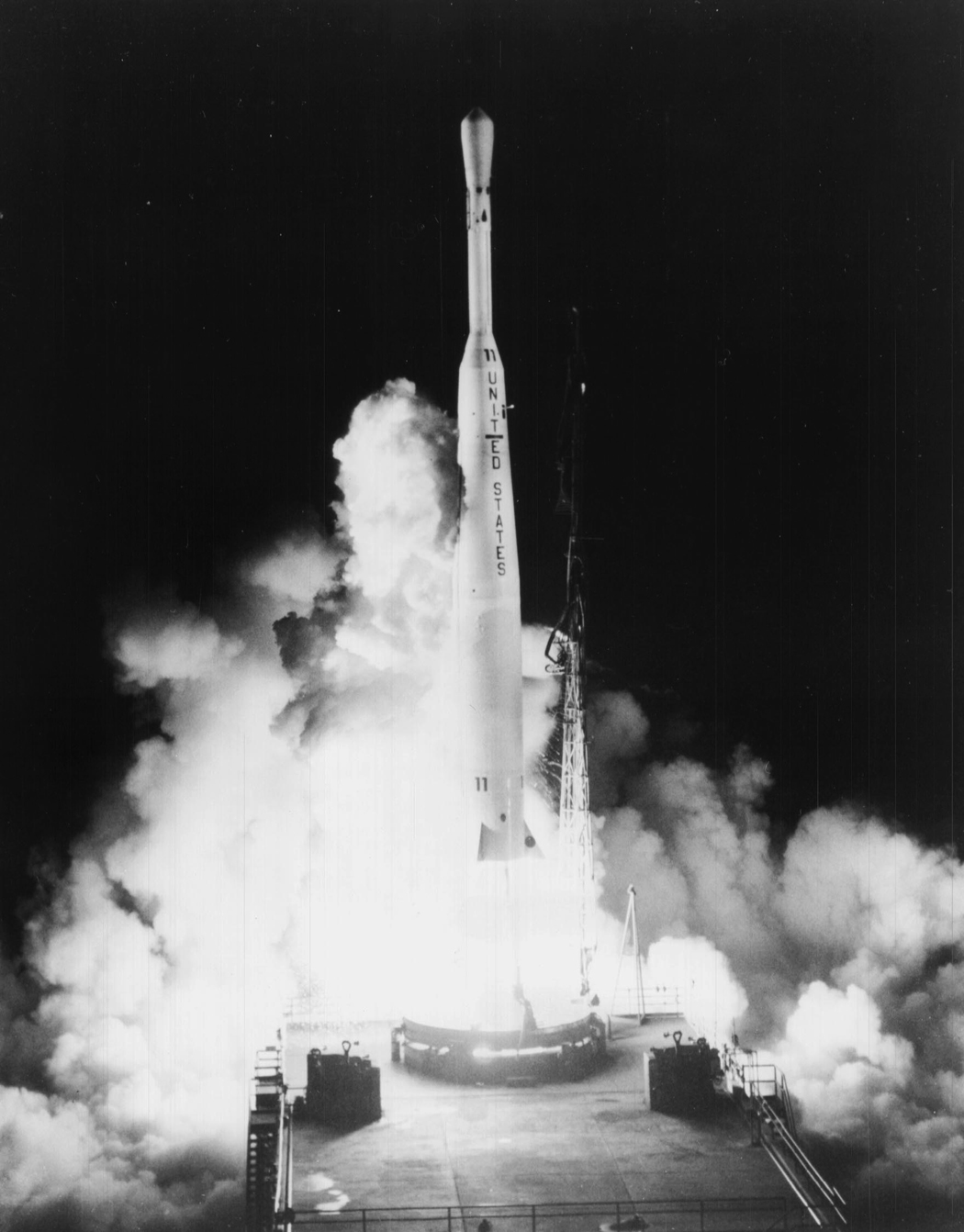
Image context: the cover image is NASA's archival photograph of Thor/Delta 316 lifting off with Telstar 1 from Space Launch Complex 17B.[2] It is a real launch photograph, not a diagram, chart, or generated visual. The image keeps the article grounded in the fact that media history here depended on launch vehicles, night operations, antennas, and engineers before it could become a television experience.
The Archival Video
The embedded film is "AT&T Archives: Telstar!", uploaded by the AT&T Tech Channel from AT&T Archives and History Center material.[1] It is not a later explainer detached from the institution that built the system. Its value is that it preserves the Bell System's own way of narrating Telstar: launch preparation, ground-station work, satellite design, tracking, and the transformation of television from recorded shipment to near-instant exchange.
The first thing to watch for is how little the film treats television as glamour by itself.[1] The dramatic object is not a studio camera or celebrity presenter. It is infrastructure: a launch vehicle, a spherical satellite, tracking antennas, microwave links, control rooms, and engineers trying to make a moving orbital relay behave as a dependable broadcast path. That emphasis is historically right. Before Telstar, television programs could be recorded, placed on tape, flown across the ocean, and replayed later.[5] Telstar changed the clock. It made transatlantic television a problem of orbital availability rather than physical transport.
That clock was tight. IEEE's milestone account notes that Telstar 1's elliptical orbit took about 2 hours and 37 minutes, and that the maximum usable transmission time between Europe and the United States was about 20 minutes per pass.[5] The Bell System research paper shows why this was not merely a scheduling annoyance: the useful experiment was an active repeater in orbit that could provide television or multiplex telephony only when geometry, radio equipment, and ground stations were all aligned.[4] The archival film is best read with that constraint in mind. Every scene of tracking and preparation is a reminder that "live" did not yet mean always-on. It meant catching the machine at the right place in the sky.
What The Footage Shows That A Milestone Label Misses
Telstar's public memory often collapses into the satellite's appealing surface: a sphere, a grid of panels, a futuristic soccer-ball look. The video gives that object context. The satellite was only one node in a larger communications chain. The Andover, Maine station and the European receiving sites had to track a moving target precisely; Bell Labs had to make tiny spaceborne electronics survive launch and radiation; NASA had to place a privately financed communications experiment into orbit; television networks had to prepare programming that fit a narrow window.[2][4][5][6]
That systems view also explains why the first pictures mattered so much. NASA notes that Telstar relayed a U.S. flag outside the Andover station to France soon after launch, then carried television, telephone calls, data transmissions, and facsimiles.[2] Smithsonian Magazine's account of the 50th anniversary frames the physics problem neatly: ordinary television signals travel in straight lines, so Earth's curvature limits how far a ground signal can go before it must be repeated.[6] Telstar placed the repeater in orbit. The broadcast did not defeat distance by making Earth smaller; it inserted a moving technical intermediary above the horizon.
The July 23 public broadcast made that intermediary culturally legible. Smithsonian Magazine describes an exchange of programs, including a Kennedy press conference, baseball, and images of familiar U.S. landmarks such as the Statue of Liberty and Mount Rushmore.[6] Those choices were not random decoration. They made a technical demonstration feel like a shared event. Viewers were not being asked only to admire electronics. They were being asked to recognize that a live image could now move between continents quickly enough to alter diplomacy, sports, news, and ceremony.
The footage also preserves the optimism and limitation of 1962 at the same time.[1] Telstar worked, but it was experimental. The National Air and Space Museum notes that radiation exposure compromised the satellite's electronics in November 1962, leading to deactivation in February 1963.[3] That short life is part of the story. Telstar did not immediately deliver the permanent global television network people now take for granted. It proved a route, exposed failure modes, and created pressure for more durable institutions and satellites.
The Policy Afterlife
The experiment raised a governance question almost as quickly as it raised a technical one. The Smithsonian's object record states that Telstar forced a policy problem: should satellite communications be operated by private corporations or under government auspices?[3] The United States answered by creating COMSAT and supporting INTELSAT, moving the field toward a government-directed international communications-satellite system for more than two decades.[3] In other words, Telstar's success made private engineering evidence available for public institutional design.
That policy turn is easy to miss if the satellite is treated only as a charming early-space artifact. Telstar was developed by AT&T and Bell Labs, launched by NASA, received by ground stations in the United States, France, and Britain, and watched by audiences who experienced it as television rather than as procurement policy.[2][4][5][6] Its historical importance lies precisely in that overlap. A corporate laboratory solved a communications problem with government launch support; television networks translated the result into public spectacle; governments then had to decide how such a capability should be organized at scale.
This is why the archival film still works as evidence.[1] It does not show a finished global system. It shows a proof-of-concept becoming persuasive. The launch scenes make the risk visible. The ground-station scenes show that satellite communication was still a laborious act of alignment. The broadcast references show why the labor mattered. When the chain held, an event on one side of the ocean could arrive on the other side while it was still happening.
Legacy: The Moment Before Routine
Today, live international video is so ordinary that the achievement can become invisible. A video call, a sports feed, a space-agency livestream, or a breaking-news hit from another continent all depend on infrastructures that make distance feel boring. Telstar belongs to the moment before that boredom. Its passes were short, its electronics were vulnerable, and its ground stations were enormous. Yet those limits make the breakthrough clearer. The first live transatlantic television links were not a smooth consumer convenience. They were a disciplined choreography of orbit, antenna, signal, schedule, and trust.
The best way to read Telstar, then, is not as a lone gadget in space. It was a public rehearsal for global simultaneity. NASA's launch, Bell Labs' active repeater, the Andover and Pleumeur-Bodou stations, the July 11 first technical pictures, the July 23 public broadcast, and the later COMSAT/INTELSAT policy settlement all belong to the same historical arc.[2][3][4][5][6] Live television crossed the Atlantic only after engineering, media, and governance briefly lined up inside a 20-minute orbital window. The archival film matters because it lets us see that alignment before it hardened into infrastructure people stopped noticing.
Sources
- AT&T Tech Channel, "AT&T Archives: Telstar!" - YouTube upload from AT&T Archives and History Center footage on Telstar launch, stations, and early results.
- NASA, "Telstar Opened Era of Global Satellite Television" - history page on Telstar's launch, size, orbit, first television pictures, NASA-AT&T agreement, and launch image used for this article.
- National Air and Space Museum, "Telstar" - object record for the Telstar backup spacecraft, first-active-satellite context, radiation failure, and COMSAT/INTELSAT policy afterlife.
- B. Crawford, C. C. Cutler, R. Kompfner, and L. C. Tillotson, "The Research Background of the Telstar Experiment" - Bell System Technical Journal paper preserved by NASA NTRS on active satellite repeaters, broadband relay goals, traveling-wave-tube development, ground-station antennas, and the research path into Telstar.
- Engineering and Technology History Wiki, "Milestones: First Transatlantic Reception of a Television Signal via Satellite, 1962" - IEEE milestone account of Andover, Pleumeur-Bodou, July 11 reception, orbit period, and 20-minute transmission window.
- Smithsonian Magazine, "Fifty Years Ago Today, the First Communications Satellite Was Launched Into Space" - museum-context article on the physics problem, international demonstration, Kennedy/baseball/landmark broadcast, and Telstar's experimental legacy.