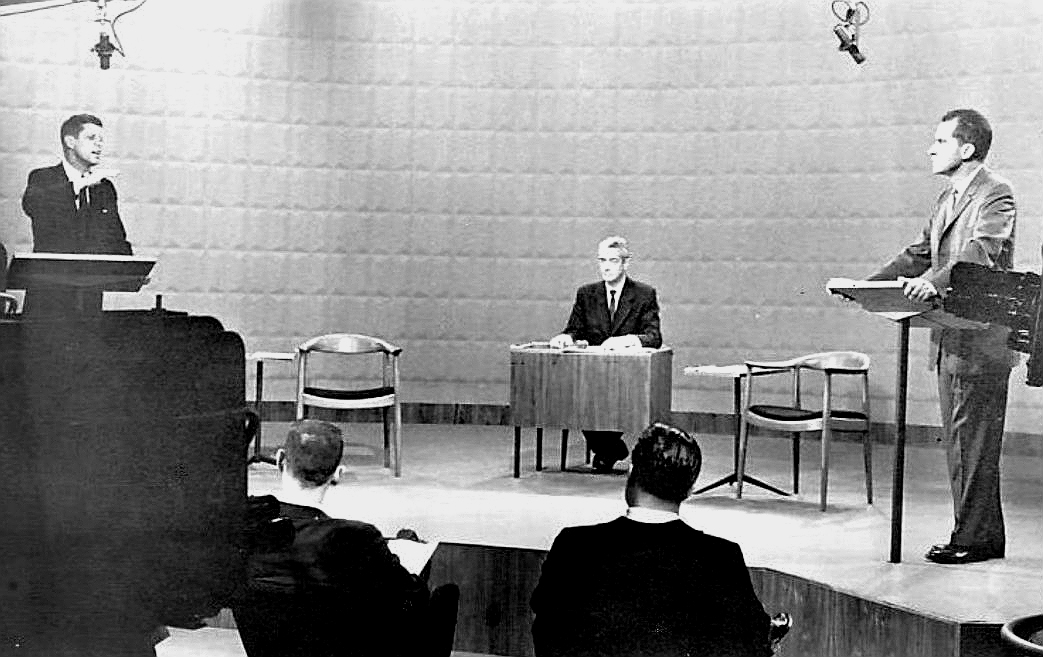

On September 26, 1960, John F. Kennedy and Richard Nixon met inside the WBBM-TV studio in Chicago for the first of four nationally televised general-election presidential debates. The event is often remembered through a simple contrast: Kennedy looked composed, Nixon looked worn down, and television punished the candidate who treated the camera like an afterthought. That memory is useful but too thin. The better historical question is not whether image beat substance. It is how a serious political argument changed once it had to survive a studio.
The transcript shows that this was not an empty beauty contest. Howard K. Smith opened with rules agreed by the candidates: roughly eight minutes for each opening statement, questions from a panel of correspondents, and closing statements at the end. The first debate was restricted to domestic issues, yet Kennedy and Nixon both connected schools, labor, farms, civil rights, economic growth, and social welfare to the Cold War test of national strength.[2] The camera did not remove policy from the room. It forced policy to appear as composure, tempo, eye line, suit color, sweat, and disciplined stillness.
That is why the archival video matters. The embedded upload comes from the John F. Kennedy Library Foundation's YouTube channel and preserves TNC:172, the first Kennedy-Nixon debate as a television object, not just a printed transcript.[1] A reader can learn the argument from the words, but the footage shows the argument being processed by lights, microphones, framing, pauses, and alternating shots. Presidential debate history after 1960 would never again be only about who answered best. It would also be about who understood the machine carrying the answer.
The Archival Broadcast
The first thing to watch is the set's plainness.[1] There is no cheering crowd, no town-hall movement, no campaign bunting. Kennedy and Nixon stand separated by a neutral background while Smith and the questioners sit lower in the frame. The studio makes politics look procedural. That is one reason the broadcast still feels modern: it turns political authority into something that has to be held under inspection. The candidate does not simply address the other candidate. He addresses a dispersed household audience while being watched by cameras that magnify fatigue and smooth over some kinds of force.
The second thing to notice is that both men knew the debate was a national teaching exercise, even if they handled the visual grammar differently. Kennedy's opening frames domestic capacity as a test of whether freedom can hold its own in a divided world. Nixon answers by accepting the premise that internal strength matters, then arguing that the Eisenhower record shows movement rather than stagnation.[2] The debate is not small. It is a domestic-policy argument built under Cold War pressure. What television changed was not the range of subjects; it changed the evidence by which viewers judged command of those subjects.
Purdue's summary of scholarship on the debates is useful because it keeps the event from hardening into a single myth. The page notes that scholars continue to argue over the debates' exact electoral impact, while also emphasizing that the 1960 debates brought new criteria to presidential campaigning and made appearance, media exposure, and credibility much harder to separate.[3] That balance is important. The lesson is not "television elected Kennedy" in one clean stroke. The lesson is that television added another test to the presidency: whether the candidate could look steady while thinking, answering, waiting, and being compared.
What The Camera Added
The footage makes waiting visible.[1] A transcript records who spoke. The camera records what happened while the other man spoke. Nixon has to listen under observation; Kennedy has to keep still while Nixon disputes his premise. The viewer sees silence as behavior. This is a major change from older campaign rhetoric, where a stump speech could be remembered as voice, text, crowd reaction, and newspaper excerpt. In the studio, the silent interval becomes part of the political performance.
The camera also made style reusable. The Museum of the Moving Image's Living Room Candidate archive preserves a Kennedy campaign commercial that recycled debate footage and turned excerpts from the first debate into campaign argument.[4] That afterlife matters. The debate was not only watched once; it became raw material for later persuasion. A line delivered under neutral network rules could be extracted, narrated over, reframed, and sent back into living rooms as a paid campaign message. The debate therefore sat at the hinge between public-service broadcast and campaign advertising.
That hinge helps explain why the "image versus substance" summary is misleading. Image was not a separate layer pasted on top of substance. It became part of how substance traveled. Kennedy's recurring claim that the country had to move again depended on pace and confidence as well as words. Nixon's answer depended on competence and record as well as rebuttal. Television did not make policy irrelevant; it made policy compete inside a visual format where hesitation, heat, makeup, camera angle, and suit contrast could support or weaken the same sentence.[3]
The archival still used as this article's image reinforces the point.[5] Kennedy and Nixon look almost like figures in a demonstration room: two lecterns, moderator centered, panelists seated in the foreground, blank wall behind. It is an austere scene, but that austerity is the historical evidence. The studio strips the campaign down to managed comparison. In that space, politics becomes a series of small visual decisions as much as a sequence of policy claims.
The Legacy Of A Managed Room
After 1960, televised debates did not become continuous immediately. The next presidential general-election debates would not become a regular expectation until later cycles. But the Kennedy-Nixon encounter had already shown the new rule: a candidate could not treat mass television as a neutral pipe. The medium organized the event. It decided how long a pause felt, whether a glance looked evasive, whether a forceful reply sounded confident or defensive, and whether a candidate's body seemed to confirm or contradict his argument.
The broadcast also changed how presidential history is archived. The transcript remains essential because it preserves the structure of argument: openings, questions, answers, rebuttals, and closing statements.[2] The video preserves a different layer: the texture of being judged live. Watch the debate and the familiar claims about Kennedy's composure and Nixon's difficulty become less like gossip and more like institutional history. The presidency had entered a room where competence would be read through television craft.
That is the lasting value of this footage. It does not show politics becoming shallow. It shows politics becoming mediated in a stricter way. In 1960, presidential argument still had to carry facts, promises, attacks, and policy distinctions. But from that night forward, it also had to carry them under lights, through camera grammar, and into homes where the viewer's first judgment might form before the sentence was finished. The Kennedy-Nixon debate turned presidential politics into a studio test, and the office has been auditioning under that test ever since.
Sources
- John F. Kennedy Library Foundation, "TNC:172 Kennedy-Nixon First Presidential Debate, 1960," YouTube video.
- Commission on Presidential Debates, "September 26, 1960 Debate Transcript" - transcript and format notes for the first Kennedy-Nixon presidential debate.
- Purdue University Department of History, "Scholarly Analysis of the Kennedy-Nixon Debates" - overview of scholarly debates about television, appearance, campaign media, and the 1960 debates' significance.
- Museum of the Moving Image, The Living Room Candidate, "1960 Kennedy vs. Nixon" - campaign-ad archive showing how debate footage and television advertising were used in the 1960 campaign.
- Wikimedia Commons, "File:First 1960 presidential debate.jpg" - file page for the Associated Press wirephoto used as this article's image.