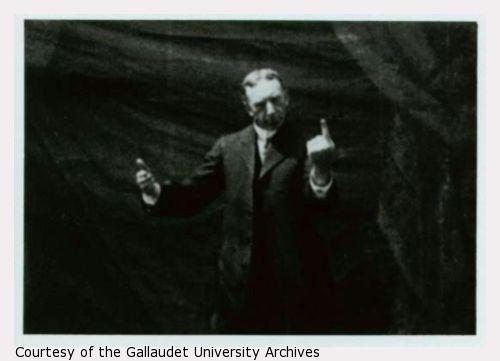
In a letter dated 29 March 1915, George W. Veditz reported that he had watched himself on film. He had expected an unflattering appearance, but the result pleased him: “I could understand myself all right!” Enclosed was an English version of the signed address he had recorded in 1913, written down from memory after the viewing.[1]
That small exchange makes the purpose of The Preservation of the Sign Language unusually tangible. Veditz wanted future viewers to encounter the signing of people they could never meet. His own return to the screen offered one test: could a moving image carry a person's language across time? Reading his appeal alongside its later English rendering also exposes what gets lost when a signed performance becomes a page.
A language pushed out of its classrooms
Veditz's appeal grew out of an educational struggle. Oralism privileged speech and lipreading, sometimes excluding signing altogether. The 1880 Milan Congress endorsed oral education and gave its advocates institutional authority. As archivist Christopher Shea explains, those decisions helped oralists displace teachers and curricula that used signs.[3]
The speech describes the consequences through the people who experienced them. In Carol Padden's English translation, Veditz accuses educators of disregarding deaf people's feelings, wishes, and needs. His comparison between European and American schools is openly partisan: he invokes suffering abroad to warn his American audience that its own institutions are vulnerable.[2]
The argument concerns who gets to judge an education. A school can pronounce its method successful while refusing the testimony of its pupils. Veditz turns that arrangement around by addressing deaf people as an audience capable of assessing the institutions that claim to serve them. Read in that light, his anger is part of the evidence: it records a struggle over whose account should count.
The people inside the preservation plan
The appeal becomes more concrete when it turns to aging teachers and accomplished signers. Veditz names people whose manner of signing he wants later generations to inherit. Georgetown University's Historical Sign Language Database identifies this passage as the speech's turn toward motion pictures as a means of preservation.[4]
What matters here is the distance between preserving a proposition and preserving its expression. An English page can tell a reader what a speaker argued. A moving image can also retain how someone organized an address in a visual language. The distinction helps explain why Veditz's list of admired individuals belongs inside the proposal. Their particular use of language is what he wants to make available.[4]
The financial passage gives that ambition a practical scale. In Padden's translation, Veditz reports a $5,000 fund and imagines what $20,000 could support: signed performances, sermons, and lectures, with audiences extending beyond the United States.[2] These are proposals for a cultural repertoire. A vocabulary list would preserve signs in isolation; his examples would preserve people doing things with them—persuading, performing, teaching.
That is this essay's reading of the sequence: first identify the threatened community, then the people whose language deserves recording, then the forms of public life the recordings could carry forward. The appeal asks its audience to imagine future viewers as participants in that life.
Two versions, two kinds of evidence
Padden's 2004 study, “Translating Veditz,” compares the film with the English account enclosed in the 1915 letter. Veditz qualified his recollection with “as well as I remember it.” Padden identifies three sections appearing in a different order and material present in one version but absent from the other. His English rendering was therefore neither a shooting script nor a verbatim transcript.[1]
One comparison shows the stakes. Where the signed address conveys teachers forcibly casting deaf people aside, Veditz's English describes a “hand of steel.” Padden treats such choices as evidence of a writer working expressively between languages.[1]
For a historian, the differences make both records valuable. The film establishes a performed sequence; the letter establishes how Veditz later chose to represent that address in English. Silently merging them would manufacture a single, tidier source. Keeping them distinct allows us to ask what each version accomplishes for its audience.
The recording also needed keeping
The National Association of the Deaf's project extended beyond this one address. Shea describes films made between 1910 and 1921, including reminiscences, poetry, jokes, and a sermon, which circulated to clubs. He also records losses: inadequate preservation funding cost original prints. Fourteen films survived through the work of the NAD, Gallaudet University, and the Library of Congress, with transfers to later formats.[3]
That history places a limit on the camera's promise. Making a recording created something that could be carried forward; people still had to copy, store, and make it available. The survival of Veditz's appeal depended on that continuing work.
His understandable self on the screen marked an early success in a project that later custodians had to sustain. The surviving film lets later audiences meet an advocate speaking in the language he defended. The English versions help readers enter his argument. Their differences remind us why he wanted the camera there in the first place.
Sources
- Carol Padden, “Translating Veditz,” Sign Language Studies 4, no. 3, Spring 2004, pp. 244–260, especially pp. 244–247 — Veditz's 1915 letter to Roy Stewart and comparison of the signed and written addresses; author's UC San Diego copy, PDF.
- George W. Veditz, “The Preservation of the Sign Language,” National Association of the Deaf, 1913; translated from the film by Carol A. Padden — educational argument, named signers, fundraising, and proposed repertoire; authorized translation reproduced by handeyes, PDF.
- Christopher Shea, “Preservation of the Sign Language,” National Film Registry essay, Library of Congress — oralism, the Milan Congress, production, circulation, and preservation of the NAD films, PDF.
- Georgetown University, Historical Sign Language Database, Veditz corpus, section XII, “Motion Picture Films as Solution for Preservation,” clause 12a — signed-language annotation and English translation of the proposal to preserve particular signers' language.
- Disability History Museum, “George Veditz Signing, Figure 1,” item 435, 1913 — Gallaudet University Archives photograph taken from a National Association of the Deaf film; image provenance and reproduction.