The third condition of the 5 July 1922 arrangement for Russian refugees places a limit on an apparently useful piece of paper. Receiving an identity certificate did not itself give its holder permission to return to the state that issued it. That required a separate authorisation.[1]
A traveller could therefore possess a recognised document and still face a dangerous uncertainty about coming back. The question was consequential for someone hoping to look for work elsewhere: how freely could you leave a place of refuge if departure might mean losing access to it?
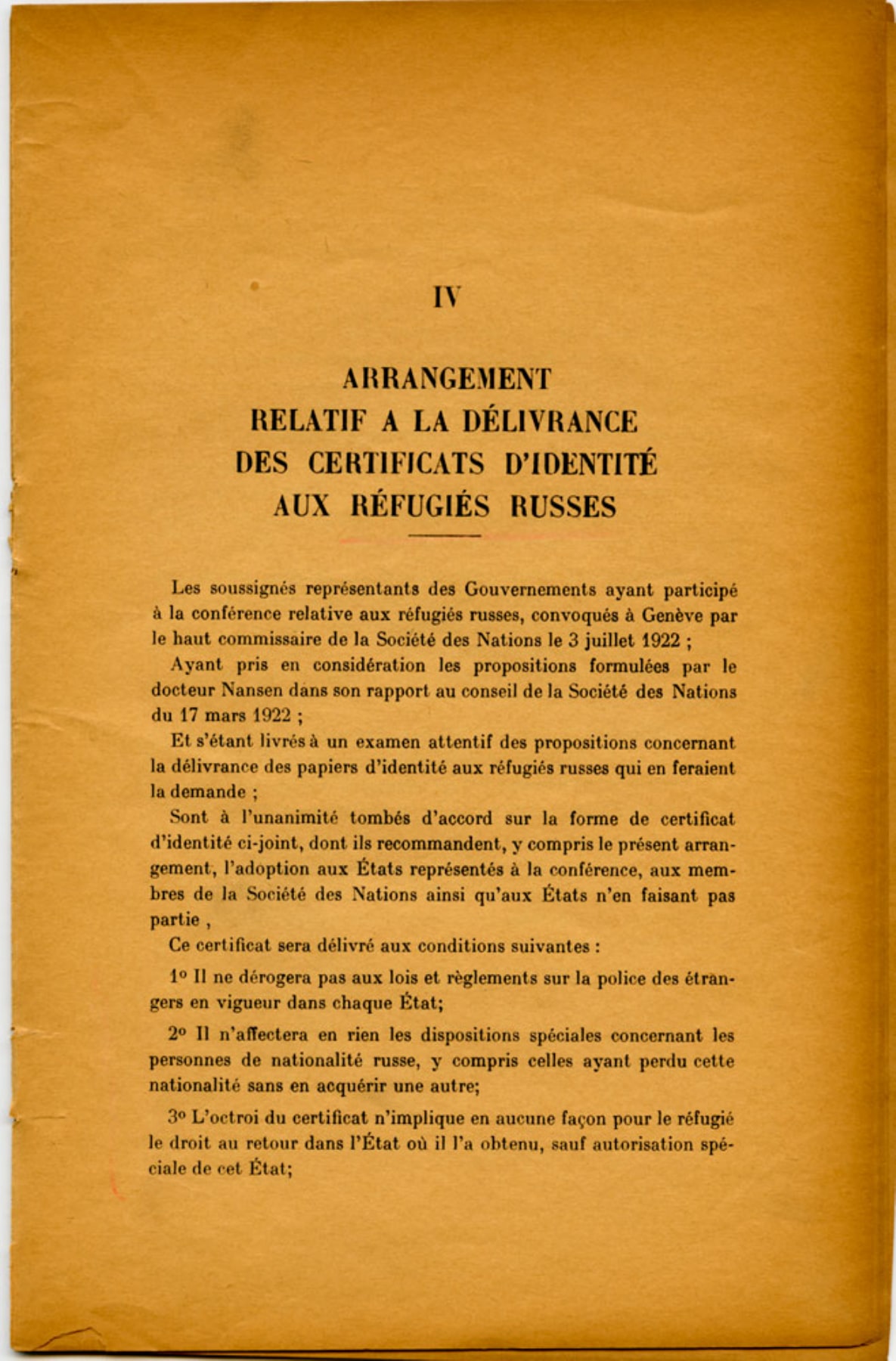
The page's physical modesty suits its subject. Beneath the large heading, the crucial restriction occupies only a few lines. Later correspondence shows officials trying to change the practical consequences of those lines without surrendering governments' control over admission.
What the certificate left undecided
The arrangement's first conditions preserved national rules governing foreigners and special provisions affecting Russians, including those who had lost their nationality without acquiring another. Condition 3 then reserved readmission to the issuing state's separate consent. Its closing phrase, “sauf autorisation spéciale de cet État,” means “unless specially authorised by that state.”[1]
The wording distinguishes identifying a person from accepting responsibility for receiving that person again. Here, return means re-entry to the country that supplied the certificate. It does not mean repatriation to Russia. A reader who overlooks that distinction misses the problem the later amendments sought to address.
The worry reached Washington
On 22 September 1922, the Russian financial attaché S. Ughet wrote from New York to DeWitt C. Poole at the United States Department of State. He wanted to know how American officials would treat refugees presenting the new certificates for visas. Ughet feared that people might exchange existing passports for the certificates under the impression that they thereby secured the League of Nations' protection.[2]
His letter records an anticipated misunderstanding, not evidence that every refugee held that belief. Yet it catches the gap between the prestige of an international initiative and the specific assurances carried by a document.
Poole's reply, dated 30 October 1922, offered qualified reassurance. American practice already allowed applicants lacking acceptable passports to declare identity and nationality on a separate form, to which a visa could be attached if granted. A Nansen certificate could furnish additional evidence; Poole did not consider that evidence necessarily conclusive. He also declined to prejudge concrete cases.[3]
An identity document, an entry visa and permission to return thus remained separate questions. The correspondence makes that separation visible before any traveller reaches a border counter.
A way back could make departure easier
The most revealing explanation comes in a letter sent by League Secretary-General Eric Drummond to the American Secretary of State on 10 June 1924. Drummond was forwarding Nansen's plan to extend identity certificates to Armenian refugees. The proposed form added a space authorising return to the issuing country, accompanied by a recommendation that governments give permission where possible.[4]
Drummond linked the change to livelihoods. In the League's experience, a certificate permitting return helped its holder make temporary visits abroad to explore employment or business. He argued that this could also encourage eventual emigration. The ability to come back made it easier to investigate a possible future elsewhere.[4]
That is the letter's striking reversal. A government seeking to facilitate onward movement might gain something by agreeing to readmit a traveller. Leaving could become a manageable experiment instead of a decision whose consequences could not be undone.
The argument was also carefully addressed to governments' concerns. Drummond stressed their continued freedom of action and acknowledged that Nansen had not made return available in every case. His letter advocates a reform and explains its rationale; it supplies no figures measuring how often the proposed permission actually produced employment or permanent resettlement.[4]
The exception survived the amendment
The 12 May 1926 arrangement, covering Russian and Armenian refugees, moved the recommendation into an express principle. Paragraph 3 approved putting return visas on identity certificates for refugees leaving a country. But the sentence preserved governments' freedom to make exceptions “in special cases.”[5]
Both halves matter. Read only the opening, and the change can sound like an unconditional guarantee. Read only the exception, and the shift in the preferred practice disappears. Authorities were now being encouraged to provide for return as part of facilitating movement, while retaining discretion to refuse it in particular circumstances.[5]
The instrument's scope also remained limited to defined groups of refugees. UNHCR's 1965 historical review describes the interwar arrangements as responses to particular problems and classifies the identity-certificate arrangements of 1922, 1924, 1926 and 1928 as recommendations. It distinguishes them from the binding obligations introduced by later conventions.[6]
These texts establish a change in the recommended approach; they cannot establish uniform treatment at every consulate or frontier. Their narrower achievement is still substantial. They recognise that the freedom to seek a livelihood abroad could depend on preserving a place to which the traveller could return. The small clause at the bottom of the 1922 page had exposed a large uncertainty in the journey.
Sources
- League of Nations, arrangement of 5 July 1922 concerning identity certificates for Russian refugees — conditions 1–3; historical printed copy and model certificate, pp. 31–33, digitised by OFPRA. Image: first page of this scan.
- S. Ughet to D. C. Poole, 22 September 1922, in Foreign Relations of the United States, 1924, volume I, document 34 — anticipated confusion about the certificate and League protection.
- D. C. Poole to S. Ughet, 30 October 1922, in Foreign Relations of the United States, 1924, volume I, document 35 — American visa practice and the evidentiary value of identity certificates.
- Eric Drummond to the Secretary of State, 10 June 1924, in Foreign Relations of the United States, 1924, volume I, document 36 — Armenian certificates and the case for authorising return.
- League of Nations, Arrangement Relating to the Issue of Identity Certificates to Russian and Armenian Refugees, 12 May 1926, Treaty Series volume LXXXIX, no. 2004, paragraph 3 — return visas and special-case exceptions; text hosted by UNHCR Refworld.
- UNHCR, background paper for the Bellagio colloquium on refugee law, 21–28 April 1965, paragraphs 26–29 — the scope and recommendatory character of the interwar arrangements.