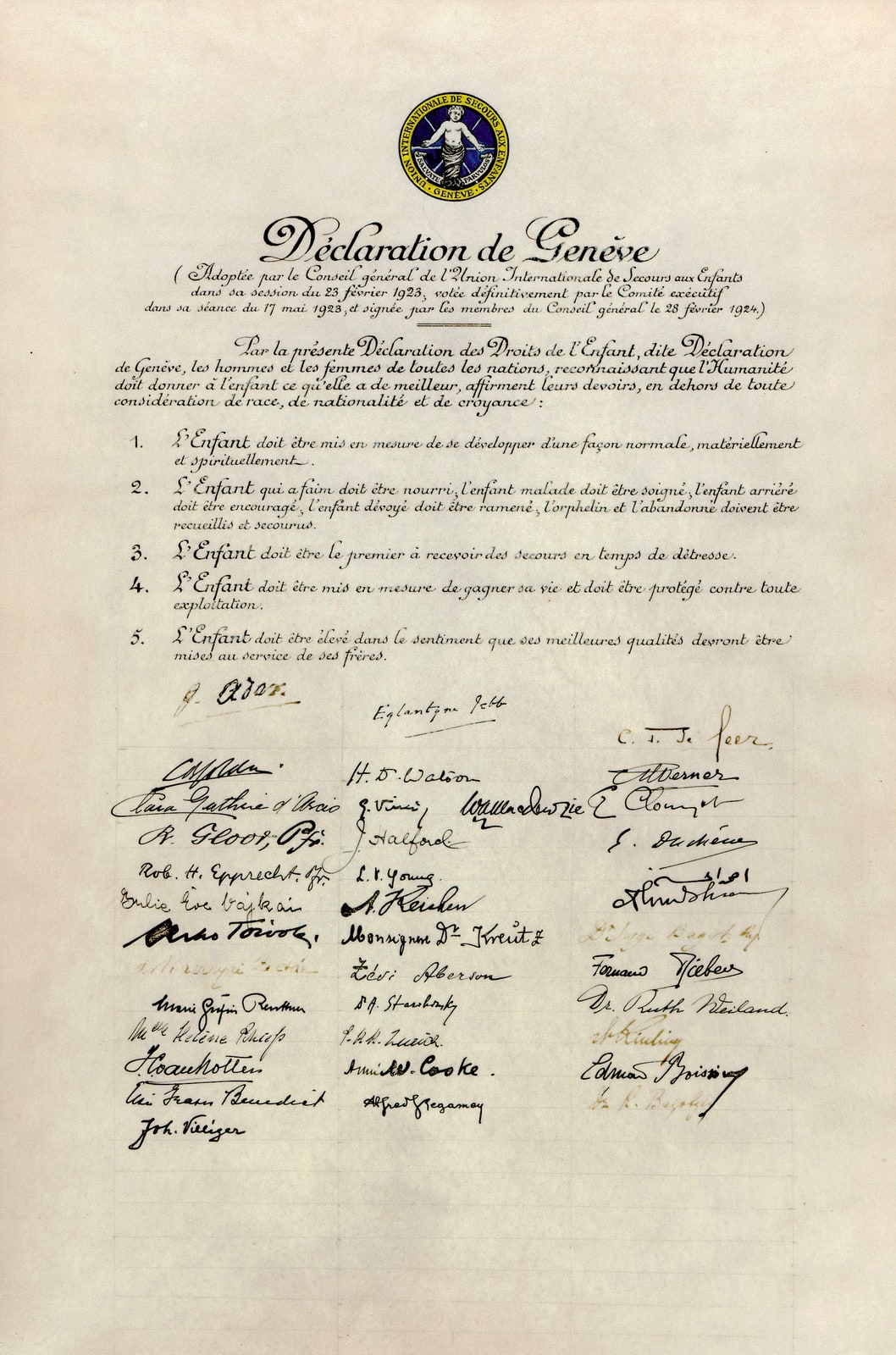
The signatures take up much of the surviving sheet. Above them, the Geneva Declaration sets out its promises to children in five short principles. The copy preserved by Geneva's State Archives bears names including Eglantyne Jebb and Gustave Ador, witnesses to a campaign that brought a relief organisation's declaration into international politics.[1]
Yet the English text contains a revealing shift. Its title announces children's rights; its preamble speaks in the voice of adults who “declare and accept it as their duty.” The people signing undertake an obligation. The children whose lives are at stake receive its benefits. That arrangement gives the declaration its force—and helps explain its limits.[2]
A promise that crossed the former front line
The declaration grew from an uncomfortable demand: British donors should help children in countries Britain had recently fought. After the First World War, the continuing Allied blockade contributed to hunger in Germany and Austria. Jebb and her sister Dorothy Buxton publicised the suffering, and in May 1919 the Save the Children Fund was launched at London's Royal Albert Hall.[3]
Relief soon stretched further. During the Russian famine, the organisation sent a ship carrying food and other supplies; through the winter of 1921 and much of 1922, it supported daily meals for children and adults. Its own institutional history describes how repeated emergencies turned an initially temporary fund into a permanent organisation.[3]
This experience makes the declaration's opening refusal to discriminate by nationality more concrete. National belonging had helped determine who attracted sympathy. The preamble asked its readers to accept a duty that survived those loyalties. Read against the relief campaign, its universal language becomes a challenge to the donor as well as a promise to the child.[2][3]
From relief appeal to public undertaking
Jebb wanted principles that would reach beyond the next collection of donations. Geneva's State Archives describes her conviction that distributing aid alone could not address the causes of suffering. The International Save the Children Union, established in Geneva in January 1920, provided an organisation through which that ambition could travel.[4]
The declaration circulated before the League endorsed it. On 21 November 1923, Ador read it over the radio from the Eiffel Tower. On 28 February 1924, a ceremony at Geneva's Musée d'Art et d'Histoire brought together public officials, educators, medical professionals and international organisations; a copy was formally entrusted to the cantonal archives. The League's Assembly adopted the declaration on 26 September 1924.[4]
Broadcasting, signatures and archival deposit gave a short text several different public lives. A listener could hear it, a supporter could put a name to it, and an institution could preserve it. These acts did not themselves deliver food or schooling. My reading is that they made the undertaking harder to treat as a passing appeal: adults were being asked to associate themselves publicly with a continuing standard.
What the five principles demanded
UNICEF's account groups the declaration's commitments around development, assistance in need, priority in emergencies, protection against exploitation and an upbringing attentive to others. Its scope therefore extended beyond keeping a child alive through the next crisis. It also concerned the kind of life relief should make possible.[6]
The third principle makes the priority especially sharp. In distress, the child should receive relief “first.” In a queue for scarce help, that word requires an order of claims. The fourth joins the capacity to earn a living with protection against exploitation; it does not supply a minimum working age or rules for employers. These are broad standards with practical consequences still to be worked out.[2]
The document's compression was both useful and limiting. Five principles could be read aloud and carried across languages. They could also leave adults agreeing on a phrase while disagreeing about the measures it required. The historical account published by the child-rights organisation Humanium stresses that the declaration was not legally binding. Its commanding tone should not be mistaken for an enforcement system.[5]
That distinction changes how we assess the achievement. A public standard can make conduct answerable to criticism without giving an injured person a procedure for obtaining a remedy. The declaration supplied a language for insisting that children were owed something. The machinery for specifying and securing those obligations remained unfinished.
The child eventually gets a voice
Later instruments expanded the promise. The United Nations' 1959 declaration expressly addressed education and play, among other rights. In 1989, the Convention on the Rights of the Child set out a much fuller account of children's place in social, cultural and political life.[6]
Two provisions show the distance travelled. Article 4 of the Convention requires participating states to take measures to implement the rights it recognises. Article 12 addresses children capable of forming their own views: they must be able to express those views on matters affecting them, with weight given according to age and maturity. The Convention entered into force on 2 September 1990.[7]
These additions matter to the reading of the older sheet. The 1924 text places the child chiefly in the position of someone adults must feed, protect and prepare for life. The later right to be heard introduces another relationship: the person receiving protection also has something to say about it.[2][7]
The signatures remain a fitting place to end. They record adults putting their names beneath a promise. The declaration's historical achievement was to widen the circle of people to whom that promise was owed. Its unfinished question was how the child could make the adults answer for it.
Sources
- Genève internationale, “1923: Geneva Declaration on the Rights of the Child” — signed archival object, Union adoption history and image provenance; source: Archives d'État de Genève.
- International Save the Children Union / League of Nations, Geneva Declaration of the Rights of the Child, 1924 — English primary text, reproduced by Humanium; preamble and principles I–V.
- Save the Children UK, “Our History” — the 1919 founding, postwar relief campaigns and the Russian famine response of 1921–1922.
- Archives d'État de Genève, “La Déclaration des droits de l'enfant” — institutional history, radio proclamation, February 1924 ceremony, September adoption and archive reference Archives privées 33.
- Humanium, “Geneva Declaration of the Rights of the Child, 1924” — the relationship between children's rights, adult obligations and the declaration's non-binding status.
- UNICEF, “History of child rights” — the substance of the 1924 declaration and the expansion of international standards in 1959 and 1989.
- United Nations, Convention on the Rights of the Child, 20 November 1989, reproduced by UNICEF — entry into force and articles 4 and 12 on implementation and children's views.