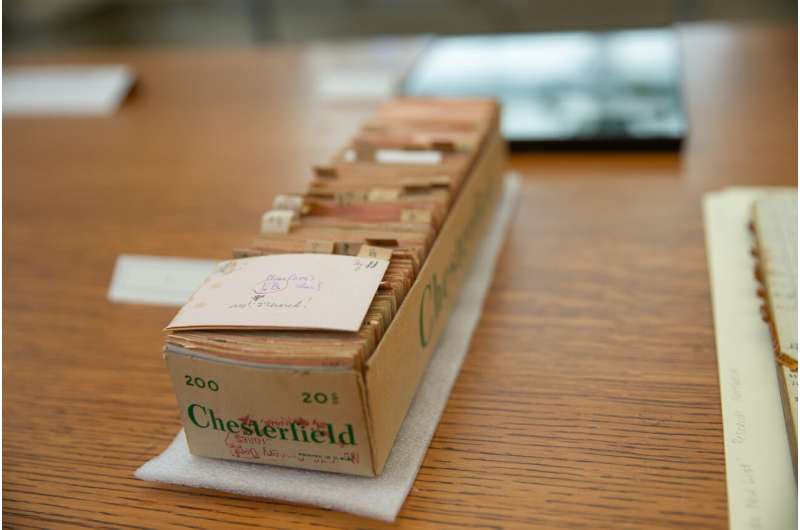
The cigarette carton has become a filing cabinet. In Andrew Higley's photograph of Alice Kober's surviving research materials, handwritten cards fill a long cardboard box on a wooden table. These were working records for a problem that occupied the Brooklyn College classicist for years: how to investigate writing whose words nobody could yet read.[1]
Linear B survived on clay tablets from Bronze Age Greece and Crete. Its eventual decipherment in 1952 is associated with the British architect Michael Ventris. Kober had died two years earlier. Yet her contribution can be described more precisely than as help supplied to a future discoverer: she established relationships among signs while withholding guesses about their actual sounds.[5]
How could an unreadable text yield that much information? The answer begins with the little slips, but it depends on what Kober chose to count—and what she refused to conclude.
A second working day
Kober's research took place around a demanding teaching life. In the account by Margalit Fox excerpted in Brooklyn College Magazine, she returned to Linear B after classes and marking, working in the Flatbush house she shared with her mother. She had trained herself across languages, linguistics, and statistics. This was sustained preparation for a problem that offered few immediate rewards.[2]
The archive preserves a more specific measure of the pressure. Its finding aid cites a May 2, 1949 letter in which Kober connected teaching five classes with exhaustion and anxiety about her health. It also records her use of greeting cards, envelopes, and other reused paper to keep her research compact and cope with paper shortages.[3]
The resulting files were an intellectual instrument. A tablet held signs in the order an ancient writer had chosen. Separate slips allowed a researcher to bring occurrences together under different questions: where a sign appeared, which signs accompanied it, and how apparently related words changed. The archive's description records precisely this rearrangement of material to study frequency and patterns.[3]
Seen this way, the cartons preserve decisions as well as labor. Every useful comparison required deciding which details belonged together. The repeated handling of paper was part of the reasoning.
The difficulty of getting something to count
There was another constraint: excavated tablets were not automatically available to scholars. Arthur Evans's excavations at Knossos had produced a large body of inscriptions from 1900, but publication lagged. After his death in 1941, John Myres inherited the task of preparing Scripta Minoa II. War, age, and the accumulated state of Evans's materials slowed the work. The volume finally appeared in 1952, with substantial help from Kober.[4]
For her, access meant planning around a brief opportunity. The archival finding aid describes timed copying trials before a 1947 Oxford visit: she estimated how much she could record, even allowing for the effect of cold on her fingers. The problem had a physical scale—documents, hours, hands—as well as a linguistic one.[3]
Counting also required a reliable definition of a sign. Emmett Bennett's work distinguished separate Linear B characters from different handwritten versions of the same character. Without that distinction, an investigator might count a writer's variation as a new sound. His classification and Kober's analysis addressed different parts of the same difficulty: establishing what, exactly, the surviving marks allowed scholars to compare.[5]
Relationships before sounds
Kober concentrated on groups of words with recurring beginnings and changing endings. In her 1948 article, “The Minoan Scripts: Fact and Theory,” she insisted that similar spelling alone was insufficient. The words' positions and contexts had to justify treating the changes as grammatical. Her earlier papers of 1945 and 1946 had developed this investigation of inflection: changes in word form associated with grammatical function.[6]
The crucial possibility was that Linear B signs represented syllables. If related forms preserved the last consonant of a word's stem but changed the following vowel, the written sign at that boundary would change too. Comparing several such groups could reveal signs sharing a consonant and others sharing a vowel. As Anna Judson explains, Kober could therefore arrange relationships without knowing the particular sounds involved.[5]
An imagined example, following Cambridge's explanation, makes the distinction clearer. Suppose two unknown signs eventually turn out to mean pa and po. An investigator might first establish only that they share their opening consonant. That does not reveal p, a, or o. It nevertheless rules out many readings: each sound assignment must remain compatible with the observed relationship.[4]
This was the value of the grid. It gave a later proposal consequences beyond a single word. A promising reading would have to survive its effects elsewhere in the system.
A question mark left in place
Kober presented her conclusions cautiously. Her 1948 paper called the proposed arrangement a “tentative phonetic pattern” and spelled out its assumptions. She acknowledged that they were not yet proved. Additional evidence had to support the pattern; otherwise it would have to be abandoned.[6]
That qualification belongs inside the achievement. Looking back from a successful decipherment, it is easy to turn an investigative step into an inevitable discovery. Kober's paper lets us encounter the uncertainty while it was still real. She had constructed a useful way to ask questions, with conditions under which its answers could fail.
Her restraint also kept different kinds of knowledge separate. Recognizing a grammatical pattern, proposing a relationship between sounds, and reading a word were distinct advances. Collapsing them would have made an attractive guess look more complete than it was.
What the next reader could do
In 1952, Ventris tested the possibility that certain tablet words represented Cretan place-names. The network of relationships made those guesses powerful: proposed values could be carried into other signs and words. Readings increasingly pointed to Greek, overturning his earlier preference for an Etruscan connection.[4]
John Chadwick then supplied specialist knowledge of Greek and joined Ventris in preparing their 1953 scholarly publication. Their collaboration continued through Documents in Mycenaean Greek, published in 1956. Cambridge's account distinguishes the initial decipherment from the subsequent work of checking and explaining it.[7]
Kober's death in 1950 makes an alternative ending tempting. Perhaps she would have completed the decipherment herself. The surviving evidence cannot settle that possibility. It can show the analysis she published, the material she organized, and the relationships later work could use.
Her papers moved with the Program in Aegean Scripts and Prehistory archive to the University of Cincinnati in 2024. The collection includes correspondence and publications alongside the handwritten slips.[8] Together, they make it possible to examine an achievement that disappears when discovery is reduced to the moment an ancient word becomes pronounceable. Before that moment, Kober had made the signs answerable to one another.
Sources
- Michael Miller, University of Cincinnati, “Archive tells of cracking ancient Greek language,” published by Phys.org (October 10, 2024): Andrew Higley's photograph of Kober's cigarette-carton research files.
- Margalit Fox, excerpt from The Riddle of the Labyrinth, in Brooklyn College Magazine, Fall/Winter 2013, pp. 6–7: Kober's study, teaching, and home working life.
- S. A. Trombley, Alice E. Kober Papers finding aid, revised by C. Costlow (2007), pp. v–vi: correspondence, copying trials, reused paper, and the organization of research notes.
- University of Cambridge, Mycenaean Epigraphy Group, “The Decipherment Process”: publication delays, Kober and Bennett's contributions, and Ventris's place-name tests.
- Anna P. Judson, The Undeciphered Signs of Linear B (Cambridge University Press, 2020), chapter 1 excerpt, especially pp. 7–8: sign classification, inflection, and Kober's grid of phonetic relationships.
- Alice E. Kober, “The Minoan Scripts: Fact and Theory,” American Journal of Archaeology 52.1 (1948), pp. 82–103, especially pp. 96–98: primary account of the inflection hypothesis, contextual tests, and explicit limits; scan hosted by the University of Alberta.
- University of Cambridge, Faculty of Classics, “The Decipherment of Linear B: Introduction”: Ventris's decipherment and the subsequent collaboration with John Chadwick.
- University of Cincinnati, Department of Classics, “Archives,” including the Alice Kober Collection: the 2024 acquisition of the PASP archives and the surviving material.