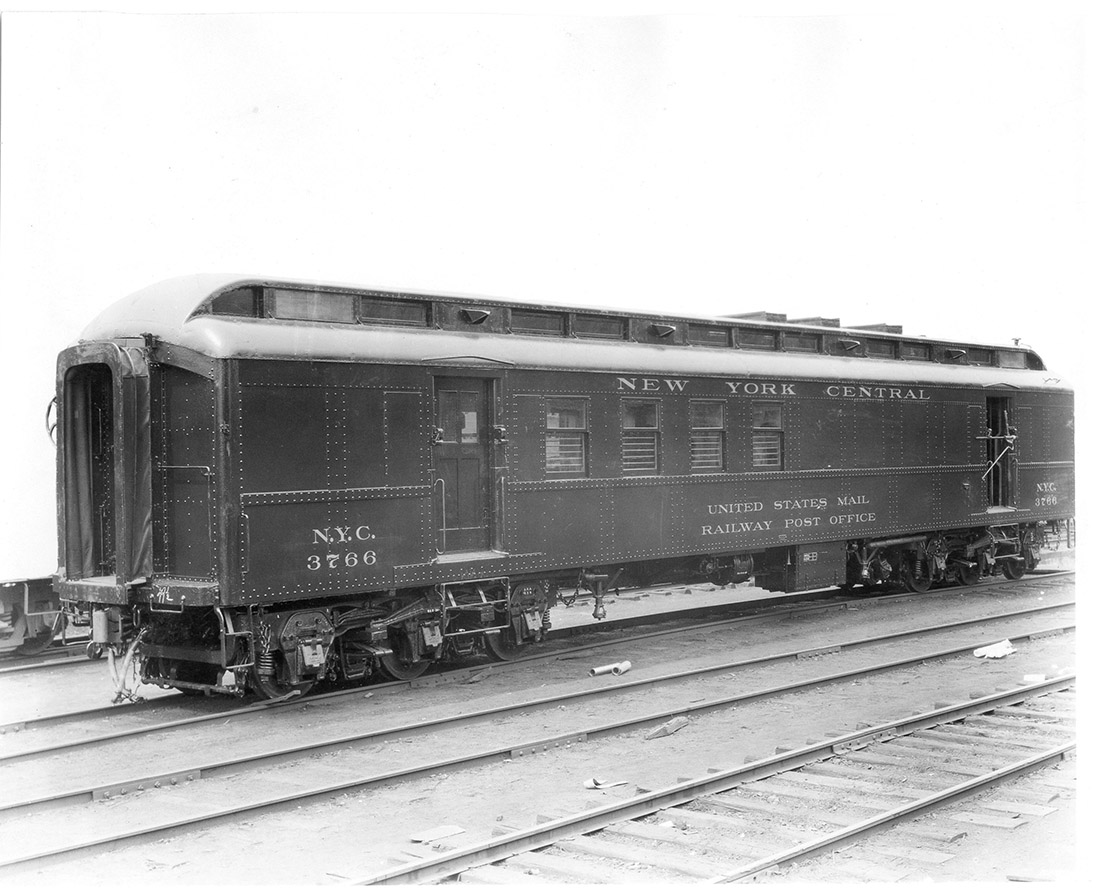
The mail car needed to be a workplace before it became a moving vehicle. In a National Archives account of the Santa Fe's Train No. 8 during the decade after World War II, some clerks reported to Los Angeles Union Station three hours before its 11:30 p.m. departure. They arranged racks, received pouches, and began sorting. The working office occupied a 60-foot car; four more cars carried stored mail.[1]
Once the train left, the addresses kept moving through their hands. That was the railway post office's central achievement: a letter could approach its destination while somebody prepared it for the next stage of delivery. Distance and clerical work were being dealt with together.
The delay inside the journey
Putting a sack on a fast train solved only part of the delivery problem. An unopened sack still needed somebody to discover where its contents should go. USPS's historical account identifies the weakness of the earlier arrangement: mail waited inside bags during travel, then reached a major distributing post office for sorting.[5]
The railway post office moved that operation aboard. Its advantage is easiest to see by following an imaginary letter through a junction. If it arrives already assigned to the appropriate onward pouch, it can be transferred toward its destination. If it arrives among unsorted letters, somebody must open, examine, and redistribute them first. An engine can shorten the journey between junctions; sorting during that journey can reduce the delay at the junction itself. This reconstruction illustrates USPS's explanation of the time saved; individual letters followed different routes.[5]
The change developed through experiments. Archivist Fred J. Romanski traces an 1862 initiative on the Hannibal and St. Joseph Railroad in Missouri, followed by the August 28, 1864 Chicago–Clinton, Iowa, route that helped establish broader service. Earlier British and French traveling post offices also mattered: this was an American expansion of an existing idea, with predecessors at home as well as abroad.[2]
An address was a routing problem
A clerk needed to know more than the alphabet. Where should a letter leave this train? Which connecting service would take it onward? The National Park Service's account describes clerks learning hundreds of post offices and studying the intersecting railway services and their timings.[3] The card-case examinations described by Romanski tested that knowledge: clerks sorted addressed cards into compartments from memory, with both accuracy and elapsed time recorded.[2]
That requirement explains why a sorting case could not deliver speed by itself. Compartments provided places to put letters; trained judgment supplied the meaning of each placement. A neatly sorted pouch sent toward the wrong connection would still be a failure. The useful unit of work was a correct onward journey.
The Santa Fe account shows how crews divided the task. Some clerks handled particular classes of mail, while others concentrated on states. Mail entered the working car at stations and through catches made without stopping. At Ash Fork, Arizona, another crew took over. The account also distinguishes working mail from sacks that stayed closed in storage cars until farther along the route.[1]
That distinction matters. The train did not need everyone to touch every sack. It needed work performed where it would improve the next transfer. Moving an office onto wheels made sorting available during travel; it did not make repeated sorting desirable.
A town could hand over mail without stopping the train
The trackside crane solved a different delay. A railway could serve a small community's mail without giving it a passenger stop. Romanski dates the Ward mail-bag catcher's introduction to 1869: a steel arm attached to the car caught a pouch suspended beside the line. Outgoing mail was thrown from the car for collection.[2]
Consider what had to precede that brief exchange. The outgoing pouch had to be ready before the car reached the town. The incoming pouch had to be hanging where the catcher could reach it. The clerk had to recognize the approaching exchange point. The device connected work completed on the ground with work completed aboard; its dramatic movement was the final step in a coordinated handover.
The same urgency had a human cost. Romanski's history documents wrecks, unsafe wooden cars, and disputes over uncompensated overtime. The ability to finish a distribution before the next connection depended on people working inside a moving railway vehicle, exposed to its hazards.[2] Postal speed belonged partly to the clerks' working conditions.
There were limits to what the car could absorb. After parcel post began in 1913, growing package traffic encouraged sorting in terminal facilities. Large volumes of bulky mail required room that a working car could not readily provide.[2] The railway post office remained one component of a larger operation, sharing its work with stationary offices and storage cars.
Why the office disappeared before rail transport did
The final American railway post office run came on June 30, 1977.[2] Its disappearance can look like a simple victory of faster vehicles. A contemporary government review gives a more specific explanation.
In its 1978 assessment, the General Accounting Office found termination economically justified by reduced available rail service, expanding air and truck transport, and mail delivery standards. Yet the same summary reported that USPS still used Amtrak to carry mail between Washington and New York.[4] An office could close aboard a train while sacks continued to travel on it.
That evidence points to a distinction between the usefulness of railway transport and the usefulness of railway sorting. The mobile office gained its advantage from suitable routes, connections, and work that could be completed between them. As those conditions changed, the two activities could be separated again. The cleverness of the catcher arm or the clerk's memory could not, alone, preserve the arrangement.
Back at the sorting case, the achievement remains tangible. Each letter put into the right pouch before the next exchange represented work that would no longer be waiting at the far end of the journey. The railway post office made the miles count twice.
Sources
- National Archives, “A Typical Day as Train No. 8 Speeds Eastward,” Prologue, Fall 2005 — separate operational sidebar on the Santa Fe crew, working and storage cars, and crew changes.
- Fred J. Romanski, “The Fast Mail: A History of the U.S. Railway Mail Service,” Prologue, Fall 2005 — history based on Post Office Department records in Record Group 28; experiments, examinations, exchanges, working conditions, terminal sorting, and the New York Central photograph: Part 1 and Part 2
- National Park Service, Steamtown National Historic Site Museum Collection, “Letter. Railway Mail Service/Boston 9, MASS./Seventh War Loan,” May 7, 1945 — catalogue essay on clerks' routing knowledge and work, accompanying the historical document.
- U.S. General Accounting Office, “Postal Service's Discontinuance of Railway Post Offices and Methods of Transporting Mail,” GGD-78-97, July 26, 1978 — report-page highlights on the closure decision and continuing Amtrak carriage.
- United States Postal Service, “Universal Service and the Postal Monopoly: A Brief History,” section on increasing speed and reliability — why sorting aboard trains saved time.