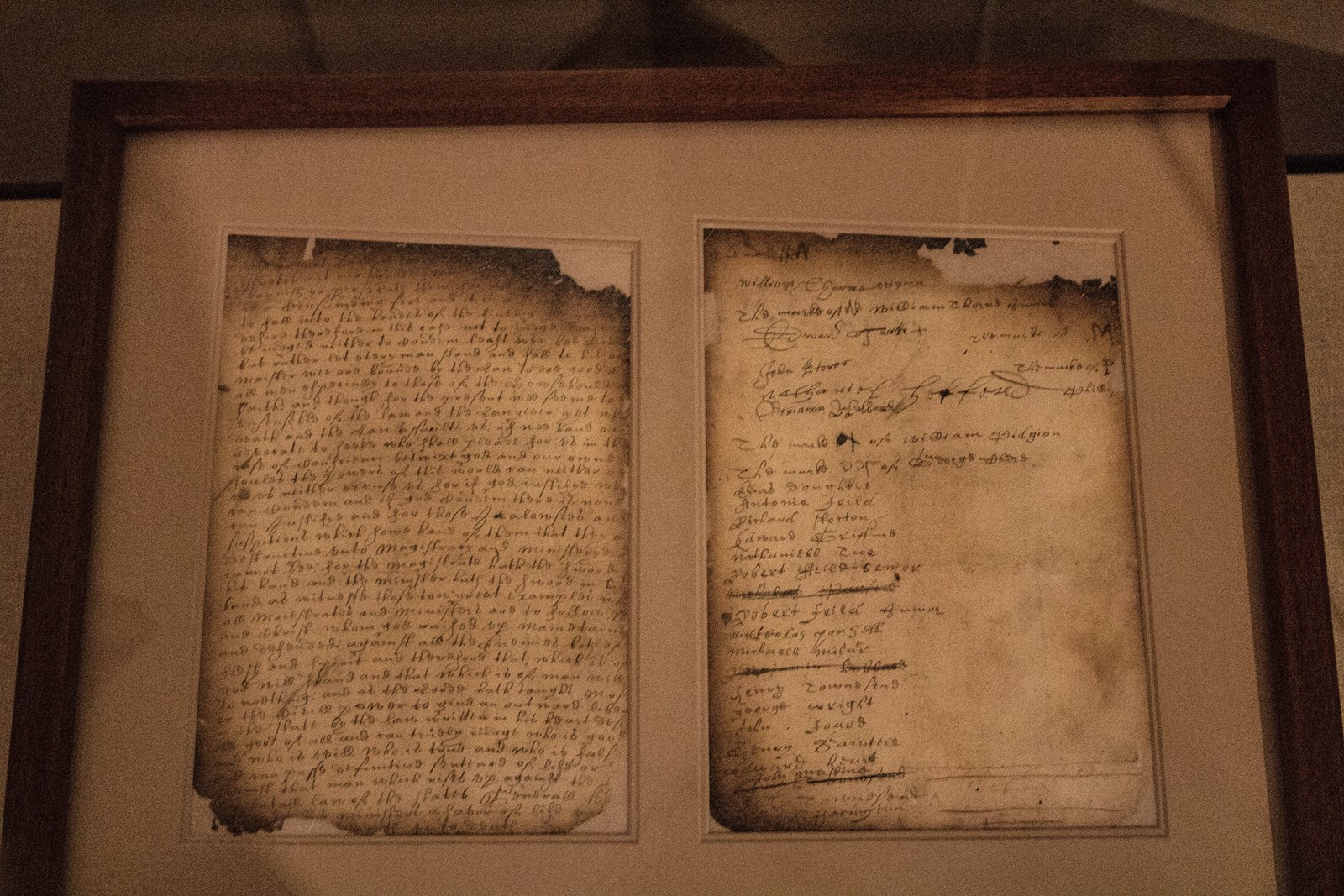
The Flushing Remonstrance begins with a problem at the door. Peter Stuyvesant, director-general of New Netherland, had forbidden residents to “receive or entertain” Quakers. On 27 December 1657, inhabitants of Flushing, now part of Queens, answered that they could not obey. Welcoming the people whom government wanted excluded was, they argued, an obligation of conscience.[1]
Read closely, the petition asks a demanding question: what is freedom of belief worth if a person may be punished for giving another believer somewhere to go? Its answer moves through Scripture, the example of Holland, and the town's charter before arriving at a concrete promise about access to homes. The argument keeps returning to what the petitioners themselves will do.
A prohibition becomes a question of judgment
The opening sentence carefully separates an accusation from a fact. Quakers are “supposed to be,” “by some,” people who lead others astray. Those qualifications leave the charge with its accusers. The petitioners decline to adopt it merely because it has arrived inside an official command.[1]
That refusal has a religious foundation. The document invokes divine judgment and the danger of condemning someone whom God might justify. It asks who could defend the petitioners' souls if obedience to the governor brought them into conflict with God. Political authority could punish their bodies; it could not answer for them at the final judgment. This is the petition's first reversal: compliance, usually presented as the safe course, becomes a spiritual risk.[1]
The writers also address the suspicion that Quakers threaten civil government and the ministry. They appeal to Moses and Christ as models of authority under God's protection. In the logic of the text, rulers and ministers need not treat every religious difference as a danger to their survival. The petitioners retain a place for government while challenging its demand that they help persecute their neighbors.[1]
Historian Evan Haefeli's study for the National Park Service explains the crucial institutional distinction. Dutch liberty of conscience protected personal belief while reserving public religious privileges to the Reformed Church. Those arrangements left considerable room for conflict over gatherings and preaching. The Flushing petition presses against the boundary between a belief held inwardly and a belief acted upon in company.[2]
The reach of a biblical vocabulary
The document then widens its field of vision. Its famous reference to “Jews, Turks and Egyptians” places people outside the petitioners' own Christian community within a shared human descent from Adam. Holland appears as an example of a state whose glory lies in extending peace and liberty across religious difference.[1]
This passage should be read as advocacy. It tells the governor which version of Dutch practice the petitioners want him to honor. The praise does political work: a colonial official is being measured against an ideal attributed to the country he represents. Whether every Dutch jurisdiction met that ideal is a separate historical question.
The petition next names Presbyterians, Independents, Baptists and Quakers. Its movement from broad humanity to particular Christian groups brings the argument back toward the people actually at risk. The writers express willingness to recognize something of God across these divisions. They do not require agreement on doctrine before accepting a duty of care.[1]
The language is thoroughly Christian, and the reasoning depends on that commitment. A modern reader can miss its force by treating the biblical passages as ornamental preliminaries to the rights claim. Here, Scripture supplies the reason for refusing the order. The petitioners' faith makes hospitality compulsory even when the identity of the visitor makes it dangerous.
What the petition promises
Near the end, the argument becomes an undertaking. If the people in question come peaceably, the writers will refrain from violence and permit “free egresse and regresse” to their town and homes. The promise concerns movement through inhabited space: arriving, entering, leaving and returning. Freedom acquires a place where it can be exercised.[1]
There is a condition here. The welcome applies to people approaching in love, and the petition continues to recognize civil authority. It does not offer a theory under which conscience excuses every action. Its sharpest claim is that peaceful religious difference cannot by itself cancel the duties people owe one another.
The final paragraph invokes Flushing's 1645 charter, granted in the name of the States General, and closes with a declaration of loyal subjecthood. The petitioners present themselves as defending an existing promise. Their disagreement with Stuyvesant becomes a dispute over which obligation obedience requires them to uphold.[1][3]
The evidentiary limits matter. Haefeli notes that the actual anti-Quaker ordinance has been lost; its operation must be reconstructed from the petition and other contemporary accounts. We can inspect the petitioners' wording directly. Our knowledge of the command they opposed reaches us through a less complete record.[2]
A refusal that still required defending
The petition did not immediately secure acceptance. The State Museum records that some signers were arrested and imprisoned.[3] In 1662, John Bowne was arrested for holding Quaker meetings, and his exile eventually carried the dispute to the Dutch West India Company's directors in Amsterdam.[2][4]
Bowne House preserves a particularly revealing sequel: his final written protest to the directors, dated 9 June 1663 in the New Style calendar. The museum distinguishes it from a courtroom speech, for which no transcript survives. The directors had sought a promise of obedience to colonial ordinances before providing the restitution and passage he wanted. Bowne objected that this would require the very surrender of conscience for which he had already suffered exile.[4]
The museum's account also complicates an easy victory scene. Bowne departed without the guarantees he sought, unaware that the directors had already sent Stuyvesant a rebuke and instructions to tolerate Quakers. A favorable instruction and a satisfactory resolution for the person appealing were different things. Conscience still had to contend with the terms on which authorities would recognize it.[4]
The surviving paper
The archival image above shows a contemporary official copy. According to the New York State Museum, a provincial secretary entered the text and names into the Dutch Colonial Council minutes in 1657; the original petition's whereabouts are unknown. The surviving record was scorched in the 29 March 1911 Capitol fire. The National Park Service later published the photograph in connection with a 2018 exhibition.[3][5]
Its damaged edges belong to the history of preservation. Its sentences preserve a different kind of vulnerability: the position of people who acknowledge a government's authority while refusing a particular command. The Remonstrance's lasting force lies in the distance it makes conscience travel. What begins as an inward obligation ends with a commitment to keep a door open.
Sources
- Historical Society of the New York Courts, “The Flushing Remonstrance, 1657” — full English text of the petition dated 27 December 1657, including its closing appeal to the town charter.
- Evan Haefeli, “The Flushing Remonstrance, the Bowne House, the Quaker Meeting House in Flushing, New York: A Trajectory of American Religious Freedom” — historical study hosted by the National Park Service, especially the discussions of belief and public worship, the lost ordinance, and Bowne's arrest and appeal.
- New York State Museum, “Iconic, Historic Document To Be Exhibited Dec. 27 at NYS Museum,” 21 December 2009 — the 1645 charter, punishment of signers, the contemporary official copy, and its archival history.
- Bowne House, “John Bowne's Protest to the Dutch West India Company, 1663” — English and Dutch manuscript copies, transcription, calendar explanation, and the conditions attached to Bowne's return.
- National Park Service, “Document that inspired Bill of Rights on display at Federal Hall National Memorial,” 2018 — source of the photograph of the surviving Remonstrance and account of its exhibition.