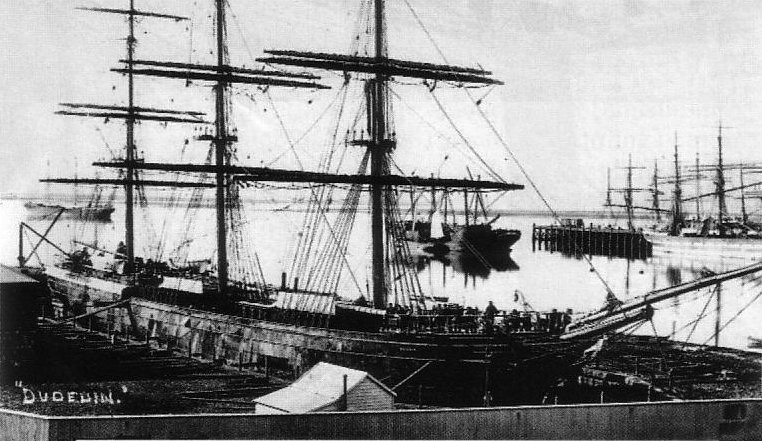
Before the Dunedin could carry frozen meat from New Zealand to London, a local engineering firm had to make it another crankshaft. On 7 January 1882, the Otago Witness reported that Kincaid, M’Queen and Co. were replacing the broken shaft in the ship’s refrigerating machinery. They had forged the replacement from scrap iron under a steam hammer; machining it had kept a lathe running “night and day” for a fortnight.[1]
That small workshop report opens a larger question. How did an experimental cargo become a trade capable of changing what a country farmed? The repair makes a useful starting point because it catches refrigeration in the act of becoming practical: dependent on metalworkers, time, and a part that could fail. The cold aboard the Dunedin had to be made and maintained before anyone could sell what it preserved.
The meat had to reach the machine
William Soltau Davidson, general manager of the New Zealand and Australian Land Company, had followed overseas experiments in refrigerated shipping. He arranged to equip the Albion Line’s sailing ship Dunedin with a freezing plant and insulation. His undertaking adapted existing technology to a New Zealand export route.[4]
Its supply line began at Totara Estate, near Ōamaru, where the company added a slaughterhouse in 1881. Davidson and local manager Thomas Brydone supervised the preparation of hundreds of sheep a day. Ōamaru’s harbour works were incomplete, so the carcasses travelled by rail to Port Chalmers. The geography of the experiment followed the transport that was actually available.[3]
The sequence matters. The meat was cooled at the estate, carried to port, and frozen aboard the ship.[2] Loading therefore joined two operations: moving a perishable product and processing it for a long voyage. The ship supplied a service that later freezing works would perform ashore.[5] Its departure depended on the successful completion of work that began well inland.
Cold had to circulate
The newspaper’s crankshaft report records one of the supporting capacities this arrangement required. A broken component could halt the experiment; a workshop able to forge and machine a replacement could restart it. The report cannot tell us how reliable the whole installation would prove, but it shows that technical competence outside the ship helped make the voyage possible.[1]
The Dunedin left Port Chalmers on 15 February 1882. At sea, the cold itself needed attention. NZ History recounts how poor circulation in the hold prompted Captain John Whitson to crawl inside and cut additional air holes, exposing himself to dangerous cold. The problem lay in getting cold air through the cargo space. A functioning plant did not guarantee that its cooling reached everywhere it was needed.[2]
This episode comes through later historical accounts; the ship’s log has not been examined here. Te Ara describes blocked ducts and ice clearance, also identifying airflow as the difficulty. It records another complication: sparks from the refrigerating engine set the sails alight twice. Powering the cold could endanger the canvas that moved the ship.[6]
These details explain the work hidden inside a successful arrival. The voyage combined machinery with people who noticed trouble and intervened. In London in May 1882, the cargo provided evidence that this particular combination could survive the journey.[2]
The next cargo needed a different arrangement
A successful experiment creates a new question: how often can it be repeated? Jane Tolerton’s history of agricultural processing records that the cargo sold in London within a fortnight, at more than twice the price it would have fetched in New Zealand. That price difference offered an incentive, although it was not itself a calculation of profit after processing, freight, and other expenses.[5]
Expansion changed where the work happened. Burnside’s freezing works opened in 1882; by 1892, New Zealand had 21 works. Slaughtering, dressing, and freezing could now be grouped on shore. Works near wharves shortened the transfer to ships; elsewhere, insulated railway carriages carried the frozen carcasses. The voyage’s improvised arrangement developed into a network of specialised facilities.[5]
The commercial arrangements needed construction too. NZ History identifies Davidson’s work on marketing and insurance as part of establishing the industry.[2] Preserving the cargo made a distant sale possible. Finding buyers and providing for the risk of loss helped make another shipment worth financing.
Shipping then accelerated the cycle. Gavin McLean’s history describes the shift from converted sailing vessels to more efficient steamships. Journeys of three or four months could fall to 30 or 40 days, and ships could complete three round trips annually instead of one. More frequent service increased the opportunities to move goods and passengers. These expensive vessels also strengthened dependence on British owners and shipping conferences, which coordinated charges and allocated tonnage.[4]
A working voyage was only the beginning
Hugh Stringleman and Robert Peden find that low prices during an international depression kept the trade from becoming consistently profitable until the mid-1890s. Its expansion depended on improvements in shipping efficiency and costs as well as the ability to freeze meat.[6]
A saleable carcass changed incentives on the farm. Breeders increasingly sought animals suited to meat as well as wool, while more intensive pasture and feed production supported them. The new trade also developed alongside political decisions about land: the subdivision of large estates and the acquisition of Māori land for settler farming. Refrigeration helped make smaller farms viable, but the resulting landscape depended on ownership and government policy as well as machinery.[6]
Seen across these stages, the Dunedin’s importance becomes more precise. Its cargo demonstrated a route through several obstacles: preparing meat, getting it to port, keeping it frozen, and reaching a buyer. A lasting industry required those steps to become dependable enough for people to organise their work around them. The workshop lathe belongs in that history as surely as the sailing ship: it helped turn an imported device into something that could keep working here.
Sources
- Otago Witness, “News of the week,” 7 January 1882, p. 8 — contemporary report on Kincaid, M’Queen and Co.’s replacement crankshaft; digitised by Papers Past, National Library of New Zealand.
- Manatū Taonga — Ministry for Culture and Heritage, “First frozen meat shipment leaves New Zealand,” NZ History, updated 26 January 2021 — preparation, voyage, airflow intervention, marketing, and insurance.
- Gavin McLean, “Totara Estate,” NZ History, 2013, updated 4 October 2024 — slaughterhouse, estate operations, and the railway route to Port Chalmers.
- Gavin McLean, “Shipping: The ‘Home boats’,” Te Ara — the Encyclopedia of New Zealand, 2009 — refrigerated sailing ships, faster steam services, and British shipping ownership.
- Jane Tolerton, “Agricultural processing industries: Freezing works, 1880s to the 1970s,” Te Ara, 2010 — the cargo’s sale, shore-based freezing, and insulated railway transport.
- Hugh Stringleman and Robert Peden, “Sheep farming: The refrigerated meat trade,” Te Ara, 2009, updated 2015 — voyage difficulties, delayed profitability, land policy, and changing farming practices.
- Wikimedia Commons, “SS Dunedin loading 1882.JPG” — archival photograph of the ship at Port Chalmers, sourced from Meat and Wool New Zealand; used as the article’s sole image.