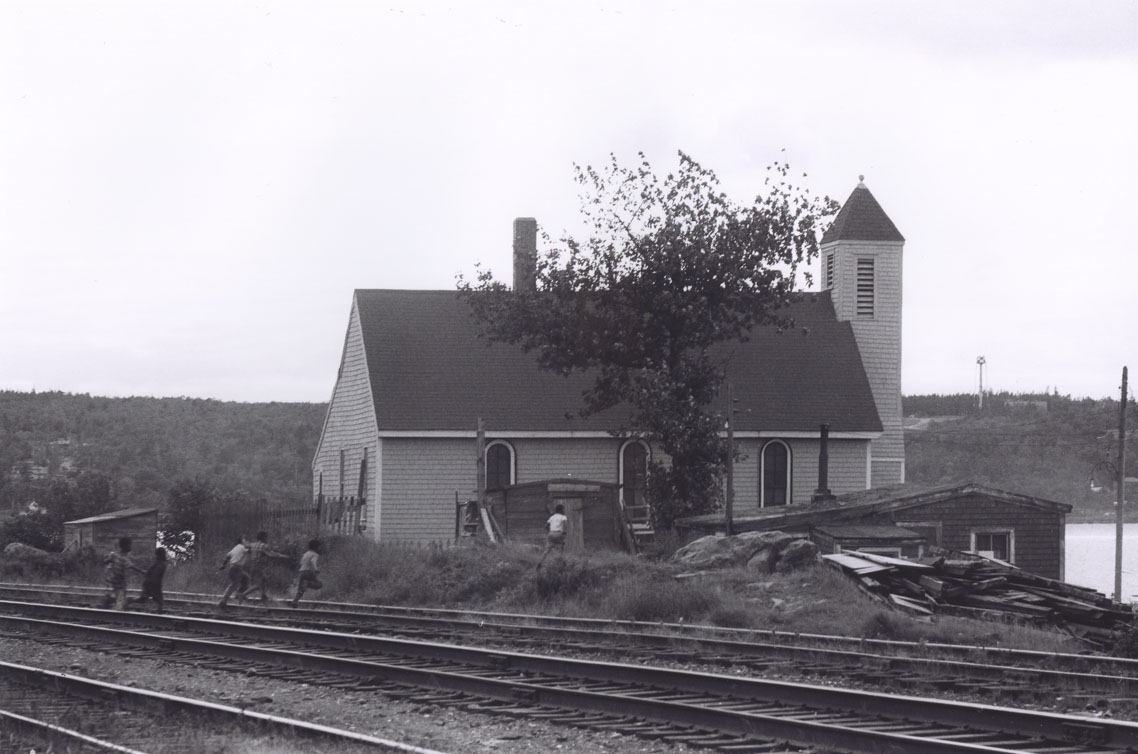
In Bob Brooks's photograph, boys cross railway tracks toward a church. The Nova Scotia Archives dates the scene to about 1965: Africville, on Halifax's Bedford Basin, during the years when the city was dismantling the community. The picture preserves something a memorial cannot reconstruct by itself—a church approached from within the everyday life of a neighborhood.[1]
Decades later, a replica of that church became the Africville Museum. Its opening returned a recognizable gathering place to the shore, while the houses and the shared daily life around them remained absent. The building asks a difficult question of commemoration: how much can a place of return repair when returning home is no longer possible in the old way?[2][3]
The church before it became a symbol
Africville's congregation began in 1849. The settlement had its own school and property owners, but Halifax withheld municipal services while allowing unwanted facilities to crowd its edges. Railway tracks divided it; the city dump arrived nearby in the mid-1950s. The archive's account places those decisions beside the later removal, making neglect part of the history of clearance rather than merely its background.[4]
The museum's community history adds an essential detail: residents paid municipal taxes. Their lack of water, sewage infrastructure, and other services did not mean they had chosen to live outside civic obligations. The label of a slum concealed a relationship between a neighborhood and the city that had failed to serve it.[3]
The church accommodated worship, family milestones, and public argument. Brooks photographed the meeting held there on 23 August 1962, after a city development report recommended eliminating Africville. Relocation began in 1964; the last resident's building was bulldozed in January 1970.[4] Remembering only the church's destruction would miss this earlier role as a room where residents could assemble to contest decisions about their future.
That history explains the force of rebuilding it. A church was an institution the community had made useful across many parts of life. Recovering its shape could identify the place immediately to people whose memories were attached to it. Recovering those uses would be a larger undertaking.
Returning before there was a museum
Commemoration began through the work of former residents. The Africville Genealogy Society formed in 1983, the year the museum's timeline also records the first annual reunion in the park.[5] Coming back together gave the cleared ground a recurring social use. The disappearance of the houses did not decide whether people still belonged to one another.
Parks Canada's designation record, dated 22 September 1997, recognizes the landscape, surviving traces, and the community's continued use of the site. Its description identifies Africville as a place of pilgrimage and makes continuing public access part of its heritage value.[2] This is an unusually useful way to understand a memorial landscape: the people who return are part of what is being preserved.
The sequence matters. A visitor encountering a finished museum might assume that public recognition brought Africville back into memory. The reunions show another direction of influence. People kept meeting, organizing, and giving the site meaning before the reconstructed building supplied a permanent address for that work.
An apology with more than one ending
At Halifax's Community YMCA on 24 February 2010, Mayor Peter Kelly delivered the municipal apology. The event transcript also records commitments of C$3 million toward rebuilding and operating the church and 2.5 acres of land beside Seaview Park.[6]
For Africville Genealogy Society president Irvine Carvery, the rebuilt church would offer a resting place for the spirits of those who had died. At the same event, Eddie Carvery accepted the apology but called for individual compensation and a public inquiry. Former resident Terry Dixon explicitly acknowledged disagreement over the settlement.[6]
These responses establish two distinct measures of repair. A shared institution could restore dignity and a place to gather; demands for compensation asked what former residents were still owed individually. The transcript supports both readings. Neither a celebratory opening nor the existence of dissent establishes what every displaced family considered sufficient. Assessing material repair would also require following compensation and land outcomes, beyond the ceremony's promises.
What the new walls hold
According to the museum's history, the replica opened in the autumn of 2011, with its exhibits launched during the reunion weekend in July 2012. Bertha Mantley, then 91, cut the ribbon at the church opening.[3] The presence of an elder made the passage between remembered community and reconstructed place tangible.
Inside, the museum identifies objects rescued from the destruction: the original pulpit, the town sign, and children's marbles. Interviews carry former residents' memories into the building.[7] These objects work at different scales. The pulpit recalls an institution; the marbles bring the visitor down to a child's game. Together they make it harder to reduce Africville to either an urban planning dispute or an abstract lesson about resilience.
A replica has a particular honesty when its newness remains clear. It can house surviving objects and sustain gatherings without suggesting that the intervening loss has vanished. Here, the distinction between the old pulpit and the new walls is part of the story: some material fragments survived, while a larger setting had to be made again.
Brooks's photograph holds that missing setting in view. The boys are going somewhere within their neighborhood. The museum gives later generations a way to recognize the destination and understand what surrounded it. Its strongest commemorative work is to keep those ordinary journeys imaginable, alongside the decisions that brought them to an end.[1][7]
Sources
- Nova Scotia Archives, Bob Brooks, “Boys crossing railroad tracks towards Seaview African United Baptist Church, Africville,” circa 1965 — photograph and archival identification.
- Parks Canada, “Africville National Historic Site of Canada” — designation date, landscape, community use, and heritage value.
- Africville Museum, “The Story” — municipal neglect, community life, reconstruction, and the distinct 2011 opening and 2012 exhibit launch.
- Nova Scotia Archives, “Gone but Never Forgotten: Bob Brooks' Photographic Portrait of Africville in the 1960s” — settlement, service exclusions, the 1962 meeting, and relocation chronology.
- Africville Museum, “Africville Timeline” — the 1983 formation of the Genealogy Society and first annual reunion.
- Halifax Municipal Archives, “Africville: Recognizing the Past, Present, and Future,” 24 February 2010 — ceremony transcript, especially 00:28–00:31, 00:51–00:52, and 01:09–01:18.
- Africville Museum, “During Your Visit” — the church's community functions, surviving objects, and oral-history exhibits.