On the morning of 18 January 1911, a Curtiss biplane approached the stern of USS Pennsylvania in San Francisco Bay. The armored cruiser lay at anchor. Across a temporary wooden platform, ropes waited above the planking, each weighted at both ends. Eugene Ely had to put his aircraft onto that narrow surface and make the hooks beneath it catch. The bags would then move with the plane, helping bring it to rest.[1]
It was the first airplane landing aboard a warship.[4] The landing joined two accomplishments that are easy to compress into one. Ely had to reach the ship under control; equipment prepared aboard had to absorb his remaining forward motion. Following that sequence reveals how much of this celebrated flight happened on the deck.
Building a place to come back to
Two months earlier, on 14 November 1910, Ely had flown from a platform on USS Birmingham in Hampton Roads. The departure was perilously close to a failure: the aircraft dipped into the water, damaged its propeller tips, and showered his goggles with spray. He recovered and landed on a nearby beach. Captain Washington I. Chambers, working to advance naval aviation, now wanted to establish that an airplane could return to a ship.[2]
At Mare Island Navy Yard, workers fitted Pennsylvania with a wooden landing platform above her after deck and gun turret. The ship acquired a runway within the outline of an existing warship, with its masts and weapons still defining the available space.[1][2]
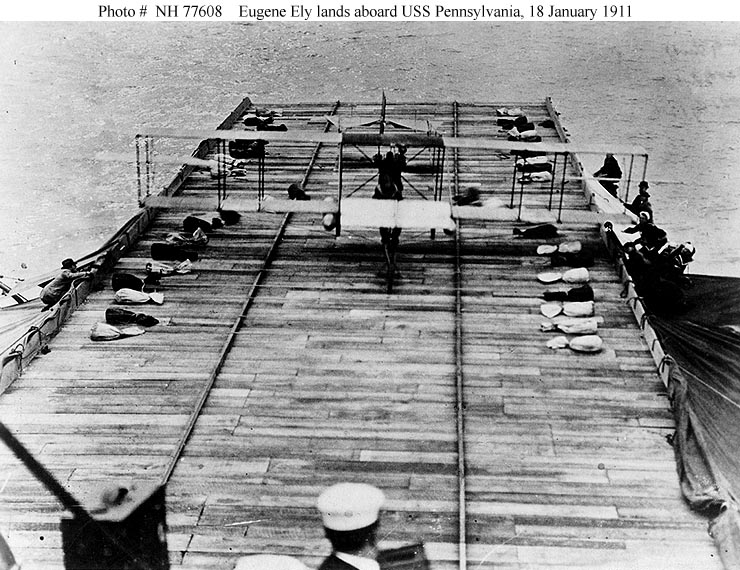
The physical arrangements deserve attention before the pilot appears. Patriots Point Naval & Maritime Museum describes parallel wooden rails running along the deck, with transverse ropes stretched above them. Pairs of fifty-pound sandbags weighted the ropes. Canvas screens provided a final barrier farther forward. The installation divided the task into stages: give the aircraft somewhere to touch down, engage its hooks, slow it, and provide protection if the stop went wrong.[3]
Keeping the ropes raised made them available to the hooks. Weight alone would accomplish little if the airplane passed over the gear without engaging it. Once caught, the weighted lines could drag along the platform. That movement was part of the braking action, so a photograph showing displaced bags records the apparatus doing its work.[3]
The platform arrives too quickly
Ely flew from the field beside Tanforan racetrack. Spectators watched from shore, ships, and small craft around the cruiser. He circled to inspect the arrangements and positioned his aircraft for an approach from astern.[1]
The wind complicated that approach. In Daniel J. Demers's reconstruction for Naval History, based partly on contemporary San Francisco reporting, Ely described wind pushing him sideways before he straightened toward the platform. At its after end, a sudden upward movement of air carried the aircraft farther along than he intended. His correction brought it down to the ropes, and the hooks engaged.[4]
How many ropes remained ahead of him is less certain. Demers reproduces Ely's claim that his hooks caught the fourth through eleventh ropes, then notes that other accounts and photographs suggest he missed more of the early lines. Touchdown and hook engagement are also separate moments. A wheel reaching the planking does not establish that a hook has already caught. The surviving evidence supports a successful arrested landing more securely than it supports an exact rope-by-rope replay.[4]
What the photograph can establish
The Naval Historical Center's landing gallery places photographs in approximate sequence from two viewpoints. Its description of NH 77507 identifies the ropes, the boards supporting them, and canvas along the platform's sides. For NH 77608, reproduced here, the catalog explicitly identifies the arresting lines as engaged and the bags as moving forward.[5]
That makes this image unusually useful. The aircraft occupies the improvised runway, while the equipment around it shows how the runway could be so short. The photograph preserves a relationship between plane and deck: they have become connected through the catching gear. Reading the image alongside its catalog description gives firmer ground than assigning precise speed or stopping distance from a still frame.
Clear the ropes, turn the aircraft
The landing left Ely aboard a ship with his airplane facing into its temporary runway. After the reception and lunch, the cleared platform and turned aircraft made the departure possible. Roughly an hour after arriving, he flew back to shore.[1]
The turn-round belongs inside the achievement. A landing platform had briefly become a parking place, a working area, and then a takeoff run. Thinking through those successive uses exposes a practical question that the photograph of touchdown cannot answer by itself: how would a ship repeatedly handle aircraft while continuing its other work?
There were competing answers. Scot MacDonald's naval history records that, about a month later, Glenn Curtiss taxied a seaplane alongside the same cruiser in San Diego. Sailors hoisted it aboard, then returned it to the water. This offered another route between aircraft and ship, using the sea as the landing surface.[2]
Success still needed an institution
John Hammond Moore's account in Proceedings preserves a skeptical response from the British aviation journal Aero, dated 25 January 1911. It treated Ely's deck landing as dangerous exhibition work and preferred an aircraft that could alight on water and be lifted aboard. The objection concerned repeatability: a slight steering error on that narrow deck could destroy the machine.[6]
Moore also traces Ely's effort to turn the demonstration into employment. On 30 January, Ely wrote to Chambers asking how to obtain work at a prospective experimental station. Chambers's reply praised the achievement but offered no immediate position. Those letters, quoted from Chambers's papers, reveal a gap between proving something possible and funding people to develop it. Public acclaim had brought Ely attention; it had not created the job he sought.[6]
A House committee report of 20 February 1931, recommending authority for a posthumous Distinguished Flying Cross, made the relationship explicit. Ely had been a civilian outside the naval organization, yet his flights had helped establish the possibilities of landing aircraft aboard ships. The report recognized a contribution made across that institutional boundary.[7]
On the morning itself, the decisive evidence was more tangible. An airplane arrived, caught weighted ropes, stopped, and departed again. The sandbags could be put back in place. Making that sequence dependable enough for a fleet required a much longer effort.
Sources
- Naval Historical Center, “Eugene Ely's Flight to USS Pennsylvania, 18 January 1911—Narrative and Special Image Selection,” completed 6 January 2003; ibiblio mirror — preparation, approach, reception, and return flight.
- Scot MacDonald, Evolution of Aircraft Carriers, U.S. Navy, 1964, pp. 4–5 — Birmingham departure, Pennsylvania experiment, and the subsequent seaplane demonstration; U.S. Government Publishing Office PDF.
- Patriots Point Naval & Maritime Museum, “An American First—18 January 1911,” 18 January 2011 — construction of the temporary platform, raised arresting lines, weighted bags, and protective screens.
- Daniel J. Demers, “What Goes Up . . .,” Naval History, volume 25, number 1, 2011 — reconstruction using contemporary newspaper accounts, including Ely's approach and uncertainty over which ropes engaged.
- Naval Historical Center, “Eugene Ely's Flight to USS Pennsylvania—Landing on the Ship,” photographic catalog; ibiblio mirror — archival photographs NH 77507 and NH 77608, their sequence, and descriptions of the arresting gear.
- John Hammond Moore, “The Short, Eventful Life of Eugene B. Ely,” Proceedings, January 1981 — Aero's contemporary criticism and Ely's correspondence with Chambers about naval employment.
- U.S. House Committee on Naval Affairs, Report 2791, “To Authorize the Posthumous Award of a Distinguished Flying Cross to Eugene B. Ely,” 20 February 1931 — Ely's civilian status and the Navy's assessment of his contribution; official report, PDF.