On 16 October 1759, John Smeaton watched his new Eddystone lighthouse from a boat several miles away. Inside the lantern, twenty-four candles had been lit. His account, excerpted by MyLearning, follows the light as the boat draws farther off: first bright, then apparently diminishing, then unexpectedly stronger again. The engineer was judging the building from the place where it had to work—from the sea, through the eyes of someone trying to find it.[1]
More than a century later, the tower acquired an audience on land. Its upper portion was dismantled and rebuilt on Plymouth Hoe, opening there in September 1884.[2] Between those moments lies a peculiar history of survival. A lighthouse celebrated for holding together became a monument through the careful separation of its parts.
Making stone hold together
Smeaton inherited a problem with two disastrous precedents. Henry Winstanley's lighthouse had been swept away in the storm of 1703; John Rudyerd's timber successor burned in 1755. For the third tower, surviving waves and resisting fire belonged to the same design problem. Stone offered a different starting point, but simply piling heavy blocks on an exposed reef would not make a dependable building.[3]
The connections mattered. Linda Hall Library's exhibition reproduces the foundation plans from Smeaton's published account. The lowest courses fitted into recesses cut in the rock, while the blocks above interlocked and were pinned between levels. The plans let a reader follow how an uneven natural surface became a foundation for a tower. Each fitted stone helped establish the position of the next; the strength came from their relationships as well as their weight.[3]
Getting those components to the reef remained a separate ordeal. Boats had to carry stones, lifting equipment, tools, and provisions into conditions that could prevent a landing altogether. MyLearning's account also describes Smeaton's use of hydraulic lime, which could set underwater. The work demanded both a structure that could withstand the sea and materials that builders could actually use there.[1]
A long life with a changing light
The building did not spend its working life frozen in the condition Smeaton first saw. Its granite exterior enclosed Portland stone, and its tapered profile supported a lantern whose equipment changed. Oil lamps and reflectors replaced the candles in 1810. Lenses followed in 1845, improving the light's intensity.[2]
Those alterations matter because the familiar tower can make its history look like one completed invention. In service, it was also a place where successive technologies had to fit. The Box's history identifies a limitation alongside the worsening rock: the tower was too small for the latest machinery. Keeping an old structure useful required room for changes that its original builder could not have specified.[2]
The warning beneath the tower
On 25 February 1878, the question reached the House of Commons. Was the existing lighthouse to be encased, or would another be built? Sir Charles Adderley, president of the Board of Trade, answered that the sea had undermined the supporting rock and seriously weakened the foundation. He distinguished the absence of immediate danger from the longer judgment that the tower could no longer be regarded as safe.[4]
Trinity House had decided on a new site roughly forty yards away. Adderley named the Mercantile Marine Fund as the source of payment, but could not yet give a cost or completion date before tenders were received. The exchange catches a project at a revealing stage: the decision to replace the light was firm, while its price and timetable remained unsettled. Waiting for collapse would have answered the safety question far too late.[4]
For a time, two towers
James Douglass's replacement was completed in 1882. An illustration published that year in The Eddystone Lighthouses, reproduced by Linda Hall Library, shows the new structure beside Smeaton's still-standing tower. The juxtaposition preserves an interval easily lost in the story of a monument's removal: the old lighthouse had a successor before it acquired its new form ashore.[5]
The library's account describes the replacement as much taller and more massive. It also distinguishes the later destinations of Smeaton's masonry: the lower portion stayed on the reef, while the upper portion went to Plymouth. The lighthouse's survival was therefore divided between two places. Offshore, its base retained the physical connection to its working site. On land, its recognizable upper shape could become something people approached on foot.[5]
A second building project
Preservation needed its own organization. Archivist Debbie Watson's account of the city's minute book records the Old Eddystone Lighthouse Committee meeting on 22 February 1882. By its next meeting, subscribers had provided £929. Local firms offered reconstruction work and dressed granite for a new base; other businesses volunteered services ranging from plumbing to catering. Public subscriptions eventually reached £1,200.[6]
The foundation stone on the Hoe was laid on 20 October 1882, but the landward journey had obstructions of its own. Watson records delays when railway conversion work failed to provide the quarry sidings needed to move stone. The project also recovered domestic fragments: old woodwork went into a berth and furniture for the living room. Its materials carried traces of occupation as well as engineering.[6]
The reconstructed tower formally opened on 24 September 1884. These details come through the archivist's reading of the committee record. They give the familiar word “saved” a practical content: subscriptions, donated work, transport, and decisions about what to retain.[6]
A tower with a new footing
Historic England's listing describes the resulting building precisely as the resited upper part of the former lighthouse on a new base. It records painted granite masonry, small windows, and an octagonal glazed lantern. That description keeps the reconstruction legible. The tower on the Hoe contains an old building, but its footing belongs to the effort to preserve it.[7]
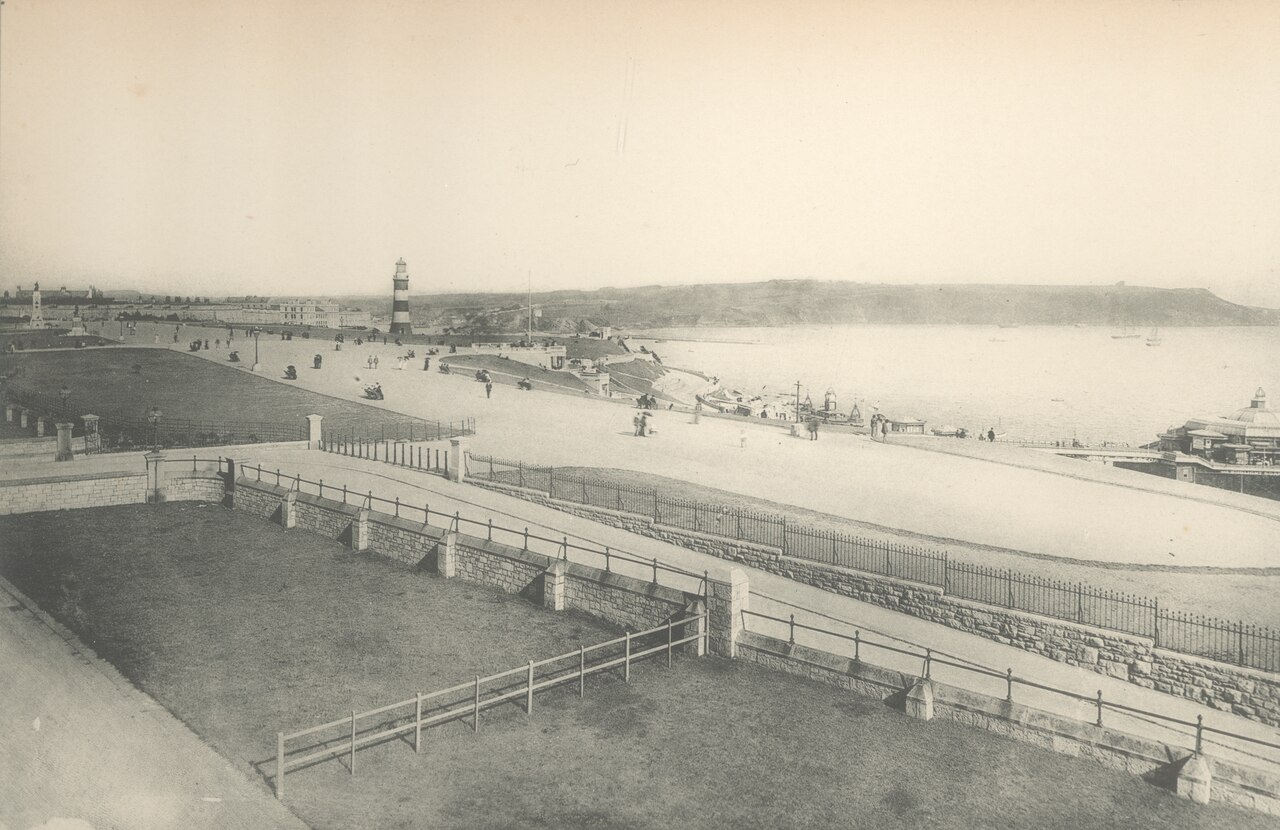
The archival photograph, catalogued as published in 1899, shows how thoroughly the setting had changed. The tower stands beside a broad promenade, with scattered people and benches between it and the camera. Railings, lawns, and paths divide the foreground. It is a view of the lighthouse within the city's ordinary public space. The photograph cannot show the move itself, but it records the surroundings that the move made possible.[8]
Seen this way, the move changed the conditions under which Smeaton's work could endure. A structure designed to resist displacement had to become movable; masonry made for a dangerous reef had to be supported in a public landscape. The achievement ashore depended on recognizing which parts could carry the lighthouse's identity into that new setting. The new base is evidence of the work that made the old tower available to later generations.[7]
Sources
- MyLearning, “The Eddystone Lighthouse,” John Smeaton learning resource — sea transport, hydraulic lime, and Smeaton's account of the first lighting.
- The Box, Plymouth, “About Smeaton's Tower” — building materials, lighting upgrades, space limitations, and the move ashore.
- Linda Hall Library, “Lighthouses,” Centuries of Civil Engineering — the earlier towers and foundation plates from Smeaton's 1791 and 1793 accounts.
- UK Parliament, “Mercantile Marine—The Eddystone Lighthouse.—Question,” House of Commons, 25 February 1878, volume 238, columns 297–298 — contemporary safety assessment and replacement decision.
- Linda Hall Library, “The New Eddystone Lighthouse” — the replacement and the frontispiece of E. Price Edwards and others, The Eddystone Lighthouses, 1882.
- Debbie Watson, archivist, “The Relocation of Smeaton's Tower,” Plymouth Community History Festival, 18 May 2020 — account drawn from the city's relocation committee minute book.
- Historic England, “Smeaton's Tower,” National Heritage List entry 1386470 — identification of the relocated upper structure and its new base.
- Leiden University Libraries, KITLV 110903, “Hoe te Plymouth, met links Smeaton's vuurtoren,” via Wikimedia Commons — archival photograph, catalogued publication 1899; photographer and exposure date unknown, CC BY 4.0.