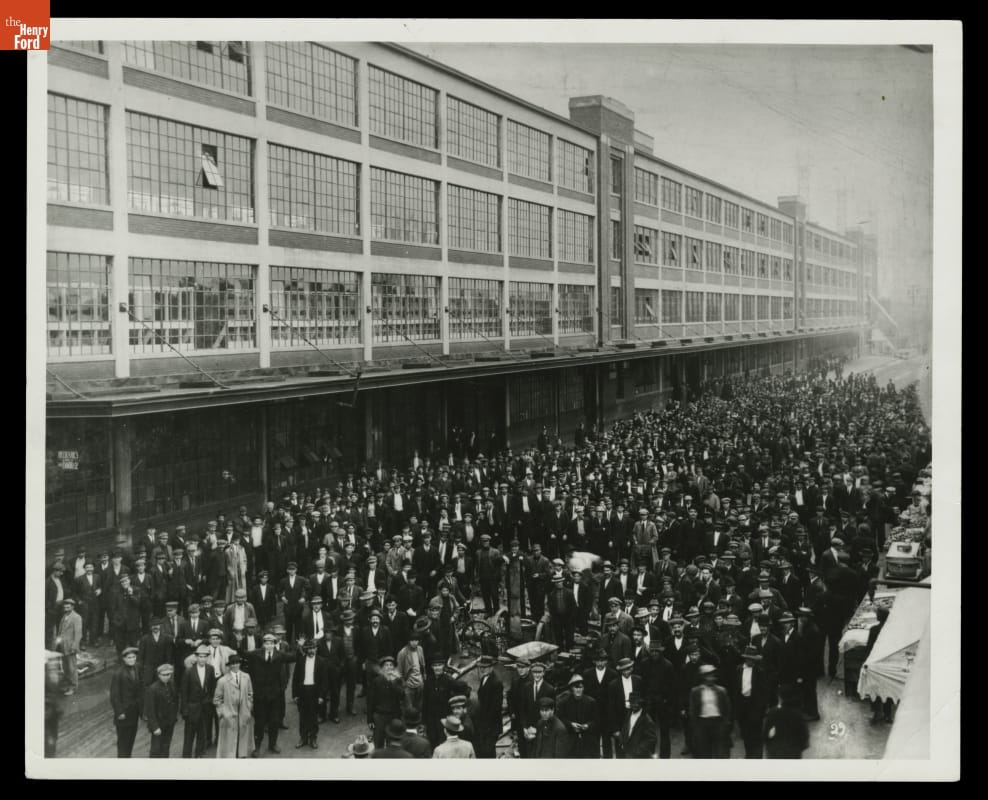
The photograph shows applicants massed outside Ford's Highland Park plant in January 1914. The money had brought them there: the company had announced five dollars for an eight-hour day, against the previous $2.34 for nine hours. It is an irresistible image for a story about a generous employer transforming working lives. Yet the museum's record of the photograph contains a qualification that the crowd cannot show. Receiving the new income depended on passing an investigation into one's private life.[1]
The familiar shorthand—Ford doubled his workers' wages—preserves the scale of the offer while obscuring its machinery. The five dollars combined wages with conditional profit sharing. To understand what changed, follow the money past the factory gate and into the house.[2][3]
What the board actually approved
The minutes of January 5, 1914, name three directors present: Henry Ford, H. H. Rackham, and James Couzens. Their resolution described a plan to distribute company earnings more evenly between shareholders and labor. It authorized a minimum income of five dollars for eight hours for men over twenty-two, with increases for higher earners that would preserve differences between pay levels. The plan was to take effect on January 12 and was expected to add $10 million to expenditure during the year.[2]
Those details complicate the universal promise suggested by the headline. The board specified an age and sex category, distinguished income from wages, and retained a hierarchy among workers. This was a designed compensation system with eligibility boundaries. The minutes establish its formal terms; they cannot, by themselves, tell us how consistently individual workers received the money.
The production problem helps explain the offer. During 1913, Ford's moving assembly line greatly accelerated manufacture, but repetitive, tightly paced work drove employees away. Matt Anderson, The Henry Ford's transportation curator, describes the resulting expense of replacing and training people. A line that moved predictably still needed people willing to remain beside it.[3]
The queue outside Highland Park therefore records a change in the attractiveness of the job. It offers no direct evidence that the work itself had become easier. That distinction matters whenever the photograph is used as a verdict on conditions inside.
The employer followed the pay packet home
Under the original arrangement, the extra money took the form of a supplement to ordinary wages. Ford's Sociological Department investigated whether employees met company expectations concerning drinking, savings, boarders, cleanliness, and family conduct. Inspectors could withhold approval for the full bonus until a household corrected what they considered a problem.[3]
The company's own 1915 handbook, Helpful Hints and Advice to Ford Employes, gives this intervention a benevolent vocabulary. Its preface presents the scheme as assistance to employees and dependents, combining material improvement with moral development. Page 7 then makes the connection to payment explicit: workers seeking to qualify as profit sharers were expected to select respectable housing and neighborhoods and maintain sanitary homes. The book was intended to supplement investigators' personal visits.[4]
Read together, those passages show why advice carried unusual force. An employer could describe a preferred way of living as helpful guidance while attaching income to compliance. A worker's home became part of the company's assessment of his suitability. The handbook is evidence of management's ambitions, however, rather than a reliable survey of what every household actually did.
A second archive provides a glimpse of enforcement. In a study of the James Couzens Papers at the Library of Congress, historian Josh Levy describes a sixteen-page report recording employee penalties during the last three quarters of 1915. The surviving papers also include a household investigation covering debts, recreation, a son's employment, and a wife's illness.[5]
The same penalty fund paid for assistance including rent, hospital expenses, food, clothing, and coal. That evidence gives the strongest sympathetic interpretation its due: families received tangible help. It also reveals the institutional bargain. The company collected intimate information, judged conduct, and decided who deserved support. Relief and surveillance could operate through the same office.[5]
A blessing could still be exhausting
The most useful correction to a tidy success story comes from a letter dated January 23, 1914, less than three weeks after the announcement. The unnamed wife of a final assembler wrote directly to Henry Ford. She credited the money with real value, calling it “a blessing,” before adding: “but oh they earn it.”[6]
Her complaint was practical. She alleged that men could not leave the line for the toilet and asked why a relief worker could not take their place. Her husband, she reported, was working while ill and being hurried by a swearing foreman. She also described deductions for tools and the theft of belongings left without lockers.[6]
This is one household's testimony, not a measurement of conditions across the plant. Its force lies in holding together experiences that celebratory accounts tend to separate: gratitude for higher income and anger at the labor required to obtain it. She appealed to Ford as someone who might intervene, even assuring him that he could not know what was happening. The letter therefore preserves both criticism of the factory and hope invested in its owner.[6]
The contrast with the handbook is revealing. Management offered instruction on improving the home. The letter asked management to examine the workplace. Each located the need for reform on the other side of the factory gate.
By 1921, Anderson writes, the Sociological Department had largely dissolved. Its intrusive administration proved difficult to sustain.[3] That later retreat matters: the historic importance of higher pay does not make every condition originally attached to it essential or admirable.
The five-dollar day deserves its reputation as a consequential wage experiment. The documents also require a more precise account of who set the terms. The crowd sought a better income; directors defined eligibility; investigators inspected households; a worker's wife asked for time to use the toilet. Keeping all four in view restores the human negotiations concealed inside a famous daily rate.
Sources
- The Henry Ford, “Crowd of Applicants outside Highland Park Plant after Five Dollar Day Announcement, January 1914.” Photograph, provenance, location, and wage comparison; object 84.1.1660.P.833.29, image THF94858.
- Ford Motor Company, Meeting Minutes Book, 1911–1919, p. 72, January 5, 1914. Board resolution, eligibility, implementation date, and projected expenditure; The Henry Ford, image THF218954.
- Matt Anderson, “Ford's Five-Dollar Day,” The Henry Ford, January 3, 2014. Assembly-line labor turnover, conditional profit sharing, home inspections, and the department's decline.
- Ford Motor Company, Helpful Hints and Advice to Ford Employes, 1915, pp. 3 and 7. The company's account of household improvement and eligibility expectations; The Henry Ford, object 64.167.951.2.
- Josh Levy, “How to Build an Ideal Worker at Ford's Highland Park Plant,” Library of Congress, July 9, 2026. Analysis and reproduced excerpts of the 1915 penalization report and household investigation in the James Couzens Papers, box 142.
- “Letter to Henry Ford from the Wife of an Assembly Line Worker,” January 23, 1914. Full transcription and manuscript images; The Henry Ford, Fair Lane Papers, object 64.167.1.94.