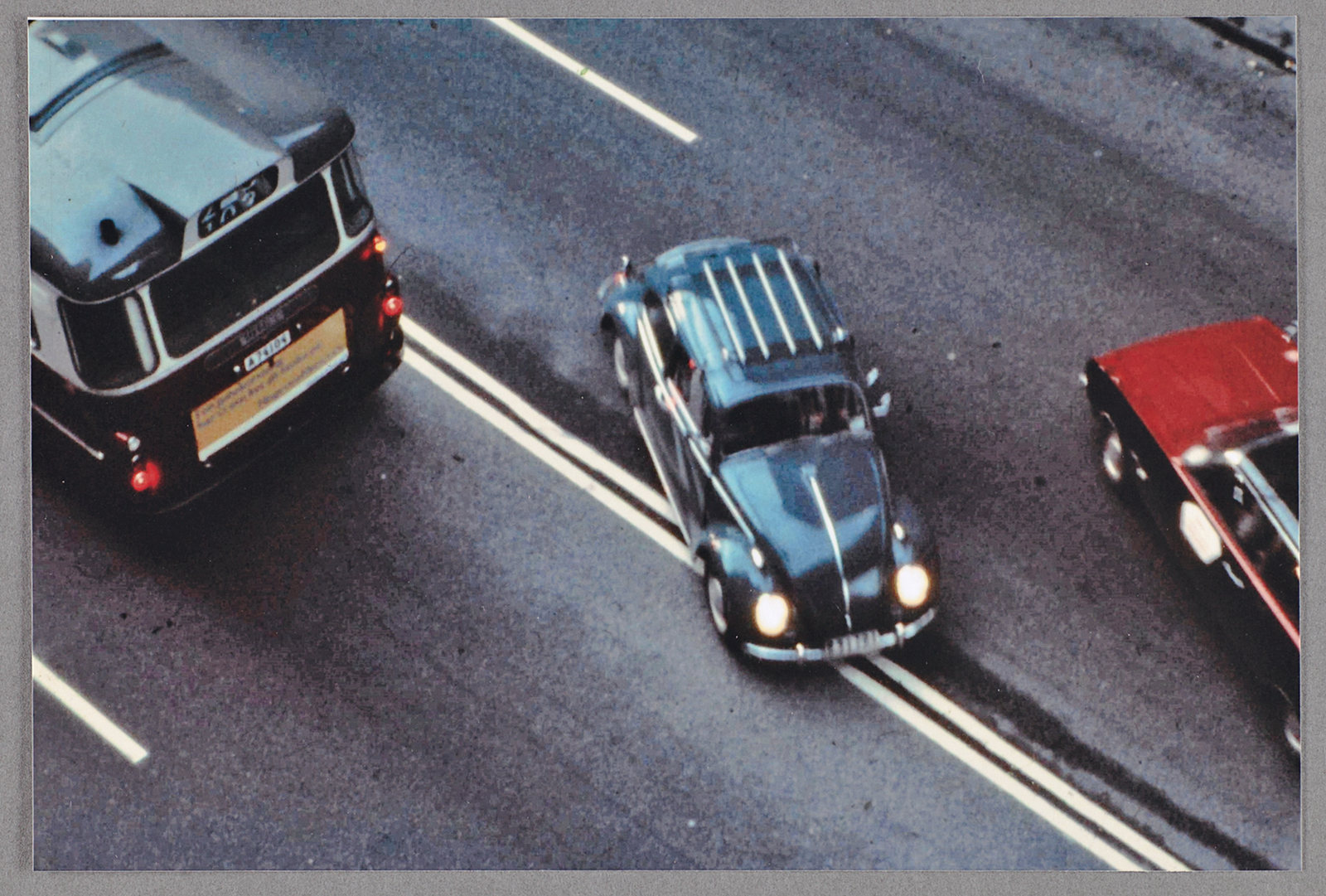
At 5:00 a.m. on September 3, 1967, Sweden began driving on the right. The sentence sounds instantaneous: a clock struck, motorists crossed the center line, and one rule replaced another. Yet the road beneath those motorists had already been changing for years. Bus doors had moved. Signals had been rewired. New signs waited under covers. White lane markings for the future lay beside yellow markings for the present.[3]
Eight months later, on May 26, 1968, Iceland made the same change. Roads closed from 3:00 to 6:00 a.m.; for the next hour, only doctors, firefighters, police, and others with essential journeys were allowed to drive. General traffic resumed at 7:00.[6][7] Iceland's version was smaller, but it followed the same essential logic. To reverse an everyday habit without asking thousands of people to improvise at once, the state first removed most movement from the road.
That resemblance was not accidental. Iceland's 1965 right-traffic bill said that its traffic-law committee had used information from Sweden, and it attached an Icelandic translation of a November 1964 memorandum from Sweden's Right-Hand Traffic Commission. The document described Swedish committees, bus conversions, publicity, temporary speed limits, volunteers, and the planned H-Day before Sweden had actually carried it out.[2] Iceland therefore borrowed a design before it could borrow a proven result.
The comparison sharpens a simple question: how does a law that reverses a physical reflex become ordinary behavior? Sweden and Iceland answered with more than legal commands. They built temporary systems in which signs, vehicles, media, police, schools, mechanics, and road users all rehearsed the same future.
The political decision came before public consent
Neither change began with a national consensus waiting to be implemented.
In Sweden's 1955 advisory referendum, 83 percent of voters favored keeping left-hand traffic. Parliament nevertheless chose right-hand traffic in May 1963, voting by nearly six to one after decades of proposals and renewed pressure for European coordination.[3] The government's February 1963 proposition defined the scope carefully: roads, streets, and trams would change, while railways and the Stockholm metro would not.[1] This was not a total reversal of every transport convention. It was a bounded redesign of the surfaces where road users met one another.
Sweden's case rested heavily on geography. It alone kept left on the European mainland while Norway and Finland kept right. Cross-border vehicle traffic was rising, and most Swedish cars already placed the steering wheel on the left, an awkward arrangement for overtaking while driving on the left.[1][3][4] Parliament overrode the referendum not because popular reluctance had vanished, but because officials judged that the surrounding transport system had changed the cost of remaining exceptional.
Iceland had no land border. Its bill openly acknowledged that international harmonization was less urgent on an island. It then made a different mobility argument: air and sea travel was shortening the psychological distance between traffic systems; tourists increasingly carried habits across borders; rental cars widened the exposure; and most Icelandic cars other than buses already had left-hand steering.[2] The same reform thus answered different pressures. Sweden sought continuity across borders. Iceland sought compatibility across imported vehicles, visitors, and a transport world arriving by ship and aircraft.
Iceland's formal sequence began with an Alþingi resolution on May 13, 1964, calling for immediate preparation. A committee report followed on February 4, 1965, the government ordered a bill in April, and the resulting 1965 proposal set out the machinery for a change in spring 1968.[2] Law moved first in both countries. Consent, machinery, and reflex had to be assembled afterward.
Sweden built a road that could change state
Sweden faced the larger conversion. A contemporary U.S. Bureau of Public Roads report counted about 8 million people and 2 million motor vehicles. By H-Day, a fleet of 7,700 buses included partially rebuilt vehicles, fully rebuilt vehicles, new right-traffic buses, and transitional buses with doors on both sides. Across the country, about 800 signals were revised and an estimated 220,000 signs were replaced or newly installed.[3]
The cleverest work made two systems coexist briefly. New signs appeared early where drivers could learn them, while signs that would misdirect left-hand traffic stayed masked. Sweden changed road markings from yellow to white, allowing future right-traffic lines to be painted before the switch. Drivers were told to follow yellow until H-Day and white afterward. Some directional arrows were painted without their heads; crews added the decisive shapes during the closure.[3]
This was not merely efficient roadwork. It converted a dangerous all-at-once rebuild into a sequence of reversible states: visible now, covered until later; usable on the left, ready for the right. Municipal and regional authorities prepared local plans, but a national commission coordinated standards, funding, safety research, law, vehicles, and publicity.[3] Central authority supplied one deadline. Distributed institutions made that deadline physically possible.
The change also arrived with a safety envelope. Urban limits that had been 50 kilometers per hour fell temporarily to 40; the general rural limit began at 60 for two days before rising to 70. Nearly 150,000 volunteers stood at busy crossings in the first days, wearing white cuffs and reminding pedestrians which way to look.[3] Sweden did not treat the 5:00 a.m. crossing as proof that adaptation was complete. It assumed that old reflexes would survive the new rule.
Bo Wingård's photograph above preserves the apparent contradiction. Three vehicles occupy a road striped for movement, yet the blue car is visibly crossing the lines. The image looks like disorder because transition itself is the subject. Wingård was seventeen, and the National Library of Sweden presents his photographs with his eyewitness account of the night in Stockholm.[5] What the frame cannot show is the administrative order surrounding that single uncertain motion.
Iceland translated the system, then cut it to scale
Iceland's planning papers make the transfer unusually visible. The 1965 bill did not merely mention Sweden as an example. It reproduced the Swedish commission's organizational anatomy: a central body advised by technical, economic, and safety specialists; advance changes to buses and roads; intensive use of press, radio, television, schools, employers, police, military personnel, and volunteers; a nighttime restriction on traffic; and close supervision when movement resumed.[2]
At the same time, Iceland's own survey exposed a different material problem. More than 5,000 newer road signs would need relocation or adjustment, and Reykjavík's signals required changes, but alterations to the roads themselves were expected to be comparatively small. The bill counted 280 registered public-service vehicles carrying ten or more passengers, including 68 urban buses in Reykjavík, Akureyri, Kópavogur, and the Hafnarfjörður route. Bus doors, seating, fare equipment, and headlights carried much of the conversion cost.[2]
Those figures are not a miniature copy of Sweden's totals. They reveal what policy transfer actually did. Iceland borrowed categories—vehicle, road, law, user, information—then populated them with its own workshops, towns, routes, and bottlenecks. Its bill estimated that domestic workshops would need two years to modify the necessary vehicles and another half-year to prepare purchases and production. A single morning's rule change depended on a multi-year industrial calendar.[2]
The public campaign was similarly adapted. Sweden's National Library describes a publicity machine of stickers, leaflets, television, radio, and a pop song telling “Svensson” to keep right.[5] Iceland held its own H-song competition. The magazine Vikan turned its issue around so that readers opened it from what would normally be the back, converting page-turning into a joke about changing direction. RÚV also broadcast the morning live, switching from the studio to a reporter in a moving car as the official change took effect.[7]
These songs and stunts were not ornamental propaganda added to engineering. They carried a low-frequency safety instruction into kitchens, classrooms, shops, and memory. A driver might encounter the H symbol on a sign; a pedestrian might hear the same cue on the radio. The campaign made redundancy culturally enjoyable.
The road closure turned one dangerous instant into phases
Sweden and Iceland both advertised a precise H-hour, but neither entrusted safety to that instant alone.
For most of Sweden, traffic was suspended for about five hours on the Sunday morning of the change. Stockholm's more extensive closure lasted 28 hours while crews completed the work that could not coexist with left-hand traffic. Vehicles began moving right at 5:00 under reduced speeds, police supervision, volunteer assistance, and an altered street plan.[3][4]
Iceland divided the morning even more explicitly. From 3:00 to 6:00, the closure gave road crews possession of the network so they could reverse signs and finish physical changes. Between 6:00 and 7:00, essential traffic formed a controlled first wave. At 7:00, the general public entered a road system that had already been used by authorized drivers.[6][7]
The difference reflects scale and settlement. Sweden had to coordinate millions of vehicles, dense cities, trams, border traffic, and thousands of buses. Iceland had fewer urban systems but a dispersed national road network and many small communities that still had to change together. Sweden's staging was dominated by conversion volume. Iceland's was dominated by synchronizing a thinner network across distance. In both, the closure did more than create time for labor. It separated incompatible users and tasks: old traffic, road crews, essential drivers, then everyone else.
That sequence is the core mechanism. A law can declare a new side of the road, but it cannot allow a bus to discharge passengers safely through a door facing moving traffic. It cannot make a covered signal visible or erase an old arrow. It cannot stop a pedestrian's head from turning automatically. The temporary system translated the legal rule into material cues before exposing the whole public to it.
A smooth handover is not the same as a proven safety effect
The immediate Swedish change passed without the catastrophe many feared. Yet the early numbers resist a simple victory claim. The first two months brought fatal accidents below the seasonal average and total accidents around average, while injury crashes involving bicycles and mopeds ran higher than usual. Traffic volume dipped only slightly. The same period also included lower speeds, stricter pedestrian rules, new signs, altered circulation, volunteer assistance, and intense publicity.[3][4]
The careful conclusion is therefore limited: the transition itself did not produce mass chaos. The evidence does not isolate which part of the package caused later accident patterns. Stockholm's archival account likewise notes that accidents fell during the following half-year but warns that the side-switch coincided with speed limits and a broader reorganization of traffic.[4]
Iceland institutionalized the same uncertainty before its H-Day. Systematic accident registration began in 1966 specifically to make meaningful comparisons before and after right-hand traffic arrived in 1968.[8] Measurement was part of preparation, not an after-the-fact search for a triumphant statistic.
This boundary matters because the most famous photographs invite a national-character story: disciplined Scandinavians simply did what the clock required. The referendum result in Sweden, the long Icelandic legislative process, the engineering lead times, and the thick safety envelopes point elsewhere. Cooperation mattered, but it worked inside a structure designed to make the correct action easier, slower, more visible, and repeatedly reinforced.
Sweden changed sides first. Iceland then carried a Swedish planning document into its own lawmaking, watched the larger experiment happen, and staged a local version eight months later. The durable lesson of the two H-Days is not that an entire country can change a habit in one morning. It is that the morning succeeds only after institutions have spent years ensuring that almost nothing important is left to the morning itself.
Sources
- Sveriges Riksdag, Kungl. Maj:ts proposition nr 58 år 1963 — the official Swedish government proposition defining the case, scope, and institutional basis for the right-traffic change.
- Alþingi, Frumvarp til laga um hægri handar umferð, Parliamentary Document 87 (1965) — Iceland's government bill, committee report, implementation estimates, and attached translation of the Swedish Right-Hand Traffic Commission memorandum.
- David M. Baldwin, “Sweden Changes to Right-Hand Driving,” Highway Research Record 234 (1968), pp. 29–36 — contemporary U.S. Bureau of Public Roads report on planning, vehicle and road conversion, H-Day operations, volunteers, speed limits, and early accident evidence.
- Stockholmskällan, “Högertrafikomläggningen 1967” — Stockholm's municipal archive, library, and museum consortium on the 1955 referendum, the 1963 decision, traffic growth, implementation, and the limits of attributing later accident changes to one cause.
- National Library of Sweden, “Dagen H” — Bo Wingård's archival photograph collection and eyewitness account, with institutional context on Sweden's mass-media campaign and the 5:00 a.m. switch.
- Akureyri Museum, “H-dagurinn á Akureyri” — local museum reconstruction of Iceland's road-closure phases, sign work, essential-traffic hour, and first right-hand journeys in Akureyri on May 26, 1968.
- RÚV, “Hægri umferð í tónum” — Icelandic public broadcaster account of the H-song competition, the reversed Vikan issue, radio's role, and the live broadcast during the May 1968 change.
- Icelandic Transport Authority, “Accident register information” — official account explaining that systematic road-accident registration began in 1966 to support comparison before and after the 1968 traffic change.