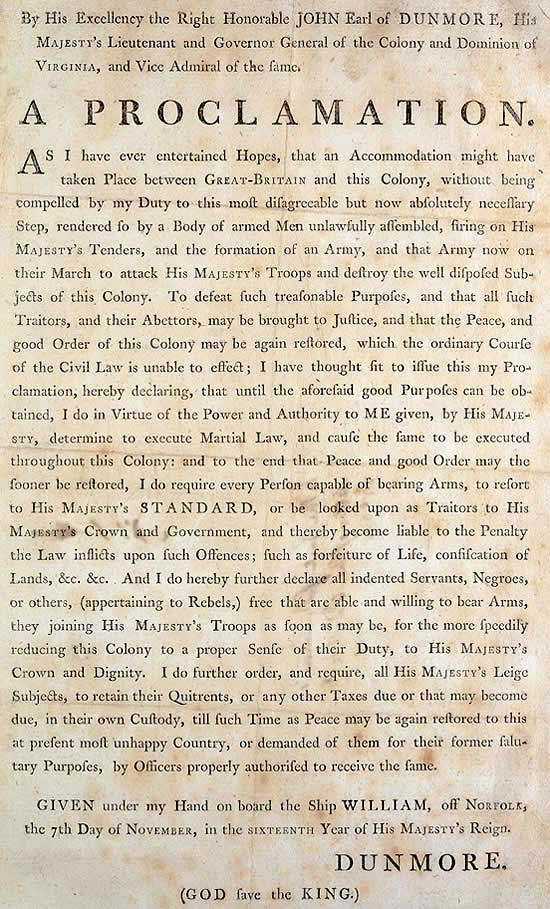
Lord Dunmore's Proclamation is easy to remember badly. It can be flattened into a simple sentence: a British royal governor offered freedom to enslaved people who joined the king. That sentence is true enough to be useful, but too neat to explain why the document terrified Virginia's Patriot leadership and attracted enslaved people toward British lines in late 1775. A close reading shows a harsher instrument. Dunmore did not write a universal emancipation decree. He wrote a martial-law order that made loyalty, labor, property, and Black military service part of one emergency machine.[1][2]
The first clue is where the document says it was issued: "on Board the Ship William," off Norfolk, on November 7, 1775.[2] Dunmore was not governing from Williamsburg as a secure royal official. The Virginia Museum of History & Culture's timeline places him seizing Williamsburg's ammunition stores in April 1775, fleeing the capital for a British ship on June 8, and facing escalating raids and militia conflict in the Tidewater by the fall.[3] The broadside therefore begins from displacement. Its authority is not calm civil administration. It is a governor trying to reassemble royal power from the deck of a vessel.
That physical setting matters because the document's first legal move is not freedom. It is emergency rule. Dunmore says ordinary civil law cannot restore peace and order, then declares "Martial Law" throughout the colony.[1][2] The proclamation's freedom clause has to be read inside that frame. It is not presented as a general theory of human rights. It is presented as one measure among others for defeating rebellion, punishing treason, gathering armed support, and forcing Virginia back to what Dunmore calls duty to the Crown.[2]
The Proclamation Starts By Naming Treason
The opening paragraph is defensive in tone but aggressive in effect. Dunmore claims he had hoped for accommodation between Great Britain and Virginia, then says armed men, militia formation, and attacks on the king's forces have made the "disagreeable" step necessary.[2] This is a classic emergency argument: I did not choose exceptional power; disorder forced it upon me.
Once that claim is made, the proclamation redraws the colony's population. People capable of bearing arms are told to resort to the king's standard or risk being treated as traitors, with life and land exposed to legal penalties.[2] The language is not merely rhetorical. It makes neutrality hard. If a white Virginian can fight but does not come to Dunmore, the document threatens to move him from subject to rebel. The freedom clause that follows is built on the same sorting logic.
That is why the phrase "appertaining to Rebels" does so much work.[2] Dunmore does not free all enslaved people in Virginia. He targets enslaved people and indentured servants who belong to rebels and who are able and willing to bear arms. Loyalist slaveholders are not dispossessed by the clause. People unable to join the military are not its core beneficiaries. Women, children, older people, and those whose owners remained loyal to the Crown fall outside the clean version of the promise. The proclamation's moral force came from enslaved people's use of it, but its legal design remained conditional and strategic.[4][5]
Freedom Is Attached To Military Use
The key sentence offers freedom to "indentured Servants, Negroes, or others" who can bear arms and join His Majesty's troops.[2] That sequencing is important. The document does not imagine freedom first and service second. It attaches freedom to usefulness in war.
For Patriot slaveholders, this was explosive because it crossed two boundaries at once. It threatened property in human beings, and it did so by inviting those people into military alignment with the British. For enslaved people, the same sentence could be read very differently: not as Dunmore's benevolence, but as an opening made by imperial crisis. Charles W. Carey's Virginia Tech thesis argues that enslaved people's own willingness to take up arms helped create the conditions for the proclamation, rather than Dunmore simply awakening one morning as the sole author of Black military agency.[4] Justin Iverson's later study similarly frames Hampton Roads in 1775 and 1776 as a place where enslaved people saw the revolutionary conflict as a chance to challenge bondage directly.[5]
That distinction changes the document's center of gravity. Dunmore was using enslaved people's flight and potential service to weaken rebels. Enslaved people were using Dunmore's military need to pursue freedom. The same printed sentence carried both calculations.
Publication Made The Threat Portable
The proclamation was drafted on November 7 and published on November 14, 1775, according to the Virginia Museum of History & Culture.[3] Publication turned an order from a ship into a circulating object. It could be reprinted, denounced, hidden, read aloud, carried by rumor, or encountered indirectly through the fear it produced.
The Library of Congress item page helps keep that material fact in view. Its copy is a one-page broadside, printed in Williamsburg by Alexander Purdie, measuring 19 by 31 centimeters.[1] That scale is part of the politics. It was small enough to circulate as printed ephemera, but official enough to announce a governor's claim to emergency authority. It did not need a courtroom to matter. It needed eyes, roads, plantations, taverns, militia camps, wharves, and ships.
The VMHC account notes the Patriot counter-campaign almost immediately. A November 25, 1775 Virginia Gazette letter warned enslaved and indentured people not to be tempted by the proclamation, while the Virginia Convention issued its own proclamation on December 14 promising pardon to those who returned.[3] Those responses show that Patriots recognized the document as more than British propaganda. It had created a rival channel of authority. The colony's ruling elite now had to answer people whom the law usually treated as property, because those people had been invited to act as wartime subjects.
The Ethiopian Regiment Shows The Clause Becoming Action
The proclamation's afterlife was not confined to text. VMHC says Dunmore recruited about 300 Black men for what became known as his Ethiopian Regiment within the following month, with some reportedly associated with the phrase "Liberty to Slaves."[3] NCpedia's account of the regiment places those men at Great Bridge on December 9, 1775, where Dunmore's forces were defeated and forced toward evacuation.[6] Carey's thesis follows the regiment through the Battle of Great Bridge, the Portsmouth enclave, Gwynn's Island, and other engagements, while emphasizing the efforts and decisions of the Black soldiers themselves.[4]
The military result was limited. Dunmore did not retake Virginia. Disease, logistics, defeat, and evacuation constrained the force. But the political effect was larger than the campaign. Iverson argues that the Ethiopian Regiment helped make the Revolutionary War about slavery itself, not only imperial independence.[5] That claim should not be overstated into saying Dunmore was an abolitionist. The proclamation was still selective, coercive, and loyalist. But it exposed a contradiction Patriots could not easily manage: their language of liberty existed beside a slave society whose enslaved people could recognize freedom when an enemy offered even a conditional route toward it.
The Document's Real Shock Is Its Combination
The broadside is unsettling because it combines things later memory wants to separate. It is a freedom document and a martial-law document. It is an anti-rebel weapon and a path seized by enslaved people. It threatens confiscation of land while undermining ownership of people. It invokes royal authority while revealing that royal authority in Virginia had become fragile enough to need fugitives, sailors, soldiers, and print.
That is why the best reading avoids two simplifications. The first is the loyalist simplification: Dunmore as liberator. The document did not free the enslaved people of Loyalists, did not promise freedom apart from British military need, and did not end slavery where British power survived. The second is the Patriot simplification: Dunmore as mere incendiary. Enslaved people were not passive sparks in someone else's plot. They read the war for openings, moved toward British lines, accepted the risks of service, and forced the Revolution's liberty language into contact with its slaveholding reality.[4][5]
The proclamation's durable importance lies in that collision. On a single printed page, in November 1775, the American Revolution in Virginia became harder to describe as only a constitutional dispute among white subjects of empire. The document made visible a different battlefield: who could claim liberty, who could grant it, who could use it, and who was willing to fight when freedom appeared in the narrow form of a military clause.
Sources
- Library of Congress, "By his Excellency the Right Honourable John Earl of Dunmore... A proclamation," printed broadside item record, Williamsburg, 1775.
- Encyclopedia Virginia, "Lord Dunmore's Proclamation (1775)," full primary-document transcription and contextual note from Virginia Humanities.
- Virginia Museum of History & Culture, "Lord Dunmore's Proclamation," museum overview with timeline, publication context, reaction, and image credit.
- Charles W. Carey, "Lord Dunmore's Ethiopian Regiment," Virginia Tech master's thesis, 1995, institutional repository record.
- Justin Iverson, The Ethiopian Regiment in the American Revolution: Black Banditti and Liberty to Slaves, Palgrave Macmillan, DOI record and publisher page.
- NCpedia, "Dunmore's Ethiopian Regiment," encyclopedia entry on the regiment, Great Bridge, evacuation, and Black Pioneers context.
- Wikimedia Commons, after Sir Joshua Reynolds, "John Murray, 4th Earl of Dunmore," National Galleries of Scotland portrait image record.