The Night Witches are easy to remember as legend: women in fragile biplanes, engines cut, gliding through darkness while German soldiers heard something like a broom in the air. The nickname is useful because it preserves the enemy's fear. It is also dangerous because it can make the regiment sound like a folk tale instead of a military system.
The clearer history is less magical and more impressive. The Soviet 588th Night Bomber Regiment, later honored as the 46th Guards Night Bomber Aviation Regiment, turned weak equipment into a repeatable harassment method. Its crews used Polikarpov Po-2 biplanes, flew at night because daylight would expose them, accepted light bomb loads, and returned again and again so that German rear areas lost sleep, repair time, and confidence.[1][3][4]
The myth worth correcting is not that the Night Witches were exaggerated into existence. They were real, and the fear around them was real. The myth is that their importance came mainly from romance: bravery plus a spooky nickname. The evidence points to a harder explanation. Their power came from the disciplined use of constraints.
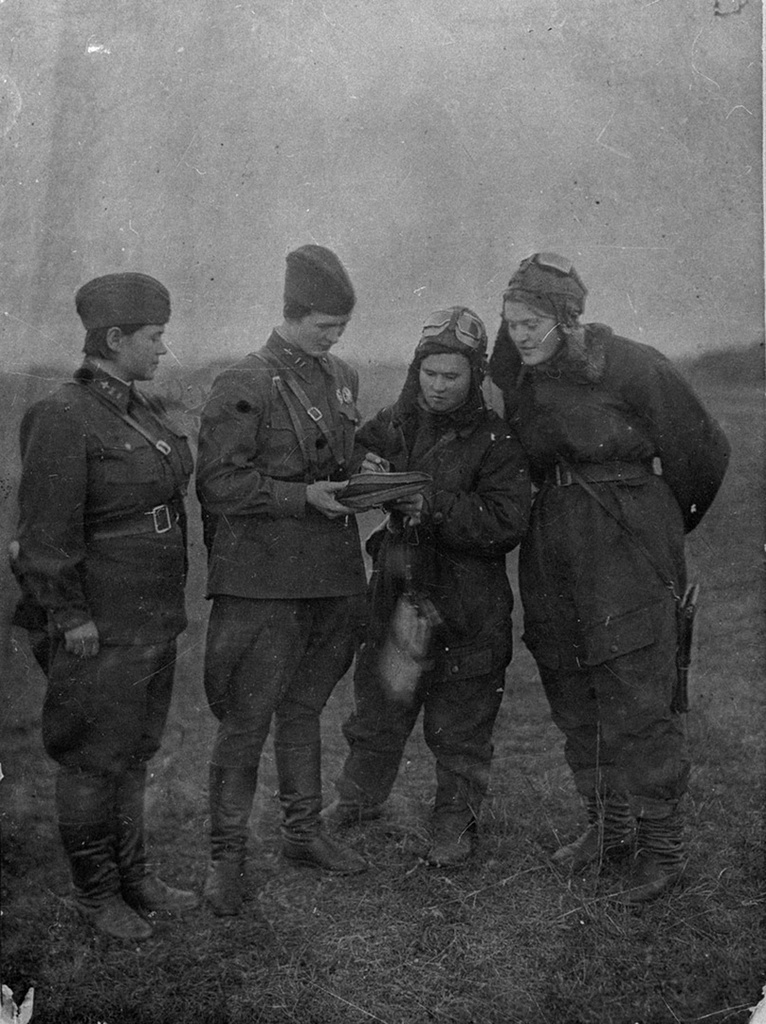
Image context: the cover photograph is a real wartime image from 1942, attributed on Wikimedia Commons to Yevgeny Khaldei and described as showing aviators of the 588th Night Bomber Regiment. It belongs here because this article is not treating the Night Witches as a loose symbol. It is reading them as a formed unit with crews, command, training, aircraft, and a mission profile.[5]
Myth: the nickname explains the regiment
The German nickname Nachthexen, or Night Witches, captures the psychological effect of the raids, but it does not explain how the regiment came into being. The institutional origin sits in 1941, after Germany's invasion of the Soviet Union. Marina Raskova, already a celebrated Soviet aviator, pushed for women's combat aviation units, and Stalin approved Aviation Group 122 that October.[1][2][4]
That group produced three regiments: the 586th Fighter Aviation Regiment, the 587th Bomber Aviation Regiment, and the 588th Night Bomber Regiment.[1][3] The 588th became the most famous partly because it remained all-female, including ground and support roles, and partly because its mission put it into a repeated nightly relationship with German troops.[1]
This matters because the nickname can erase the bureaucratic and training story. The women were not simply volunteers thrown into aircraft as a desperate spectacle. They came through Soviet aviation culture, wartime mobilization, and a specific military decision to form women's air units under Raskova's leadership.[1][2] The spooky name arrived later, from the other side of the front. The regiment's own historical meaning begins earlier, with a state trying to convert skilled women pilots, navigators, mechanics, and commanders into usable combat capacity.
Myth: obsolete aircraft made them a curiosity
The Po-2 looks, at first glance, like the reason to treat the story as improbable. It was a slow biplane with open cockpits, wood-and-canvas construction, and training-aircraft origins. National WWII Museum's account notes that the 588th flew two-woman crews, usually a pilot and navigator, and that the aircraft lacked the modern margins of a purpose-built bomber.[1] HistoryNet's Po-2 profile gives the broader aircraft logic: an old U-2 trainer was converted into a night bomber because the Soviet air war needed simple, available machines that could work near the front.[4]
But weakness is not the same as uselessness. The Po-2's limited bomb load forced repetition. Its slow speed made it unsuitable for daylight attack against modern fighters, but darkness changed the equation. Its low-altitude night work made the aircraft a nuisance that was hard to ignore and not always easy to catch. A modern fighter designed for speed did not automatically solve the problem of a slow, low, dark target arriving at awkward intervals.[3][4]
The core evidence is tactical adaptation. The crews could not make the Po-2 fast, armored, or heavy-lifting. They could make it persistent. They could operate close to the front, make multiple sorties, attack depots, crossings, troop concentrations, and rear positions, then return with more small bomb loads.[1][4] The machine was not transformed into a conventional bomber. It was used as a harassment aircraft, and harassment depends on rhythm as much as explosive weight.
Myth: the famous glide was the whole tactic
Popular accounts often isolate the most cinematic detail: engines throttled back or cut, the aircraft gliding toward the target, the sound arriving before the bombs. That detail matters. Sources on the regiment repeatedly connect the nickname to the eerie approach and to the psychological stress of night raids.[1][3][4] But the glide was not a magic trick that explains the campaign by itself.
The stronger evidence is the sortie count and the work schedule. The National WWII Museum describes more than 24,000 missions by the regiment, while HistoryNet gives the same broad scale and emphasizes repeated night-bombing operations from 1942 until May 1945.[1][3] Another HistoryNet aircraft history describes the Po-2 crews as flying more than 23,000 sorties by war's end.[4] Exact counts vary by source and classification, but the pattern is stable: this was not a story of one spectacular raid.
Repetition changes the meaning of the tactic. A single glide attack is a surprise. Many glide attacks across many nights become labor, maintenance, navigation, refueling, briefing, repair, fatigue management, and target selection. The regiment's impact depended on the dull parts of war as much as the dramatic approach: keeping aircraft flying, sending crews out repeatedly, matching light bomb loads to suitable targets, and making the enemy defend sleep time.[1][3][4]
That is why "night-shift weapons system" is a better phrase than "daring stunt." The aircraft, crews, ground staff, airfields, targets, and schedule worked together. The fear came from sound and darkness, but the military value came from making those sensations repeat often enough to affect enemy behavior.
Myth: the gender story is only inspirational
The regiment's all-female composition is historically central, but it should not be flattened into a simple inspirational sidebar. Soviet women had entered aviation clubs before the war, and the National Air and Space Museum frames the Night Witches in relation to Soviet military history, Operation Barbarossa, environmental demands, and Raskova's campaign for women to fly combat missions.[2] Gender was not separate from operations. It shaped who had to prove competence, who was selected, who commanded, and how the unit was remembered.
The all-female character of the 588th also made ordinary military labor visible in unusual ways. The story is not only pilots in cockpits. It includes navigators working without the comfort of modern instruments, mechanics supporting old aircraft in field conditions, commanders assigning missions, and crews accepting risk in aircraft stripped down for weight and range.[1][3] Calling the regiment brave is accurate but insufficient. The evidence shows a combat organization, not a symbolic delegation.
There is also a memory problem. Western retellings often love the nickname because it sounds cinematic. That can produce a strange reversal: the enemy's label becomes the hook, while Soviet organization, women's aviation training, and the regiment's operational endurance become background. A better reading keeps the nickname but refuses to let it do all the work. The Germans named the fear; the regiment built the method.
The better evidence
The Night Witches mattered because they made a weak aircraft fit a specific job. They did not win by making the Po-2 into something it was not. They won usefulness from what it could still do: fly slowly, operate at night, launch from forward fields, carry small bomb loads repeatedly, and pressure rear-area targets when enemy troops wanted rest.[1][3][4]
They also matter because they complicate the usual boundary between myth and evidence. The nickname was not invented from nothing. German soldiers really did associate the aircraft's night approach with fear, and the sound became part of the regiment's afterlife.[1][2] But the evidence underneath that memory is institutional and mechanical: Aviation Group 122, the 588th, the Po-2, two-woman crews, repeated sorties, risk accepted under severe equipment limits, and a combat record strong enough for the unit to receive Guards status in 1943.[1][3][4]
The legend survives because it has a vivid sound. The history survives because the sound was attached to a working system.
Sources
- Brittany A. Huner, National WWII Museum, "Night Witches: The Soviet Women Pilots Who Terrified Nazi Soldiers" (2025) - formation, aircraft, crews, campaign scope, and morale effect.
- National Air and Space Museum, "Night Witches: Soviet Women Who Flew Combat Missions in WWII" (2019) - AirSpace episode page and transcript framing the regiment in Soviet aviation and wartime mobilization.
- Jerry D. Morelock, HistoryNet, "The Night Witches: The USSR's All-Female WWII Bomber Squadron" - unit formation, command, sorties, Po-2 limits, and decorations.
- Stephen Sherman, HistoryNet, "Red Mule: The Polikarpov Po-2" - aircraft history, U-2/Po-2 night-bomber adaptation, Stalingrad context, and later 46th Guards record.
- Wikimedia Commons, "Foto 'Letchitsy 588-go nochnogo legkobombardirovochnogo aviapolka' (181388 10).jpg" - 1942 Yevgeny Khaldei archival photograph used as the article image.