The Donora smog began as something a steel town knew too well: bad air. That familiarity is what made the disaster so dangerous. In late October 1948, Donora, Pennsylvania, and nearby Webster sat under a persistent inversion while emissions from zinc and steel works accumulated near the ground. By the time the episode ended, the official Public Health Service investigation counted 20 deaths and found that 5,910 people, or 42.7 percent of the local population studied, had been affected by smog-induced illness.[1]
The event is easy to reduce to a morality sentence: factories polluted, people died, clean-air politics followed. The sharper reconstruction is more mechanical. Donora became deadly when four sequences overlapped: a narrow industrial valley with long-normalized smoke, several days of stagnant weather, a medical emergency that entered homes before it entered law, and a federal investigation that translated coughing, age, deaths, and factory emissions into a new kind of environmental evidence.[1][2][3]
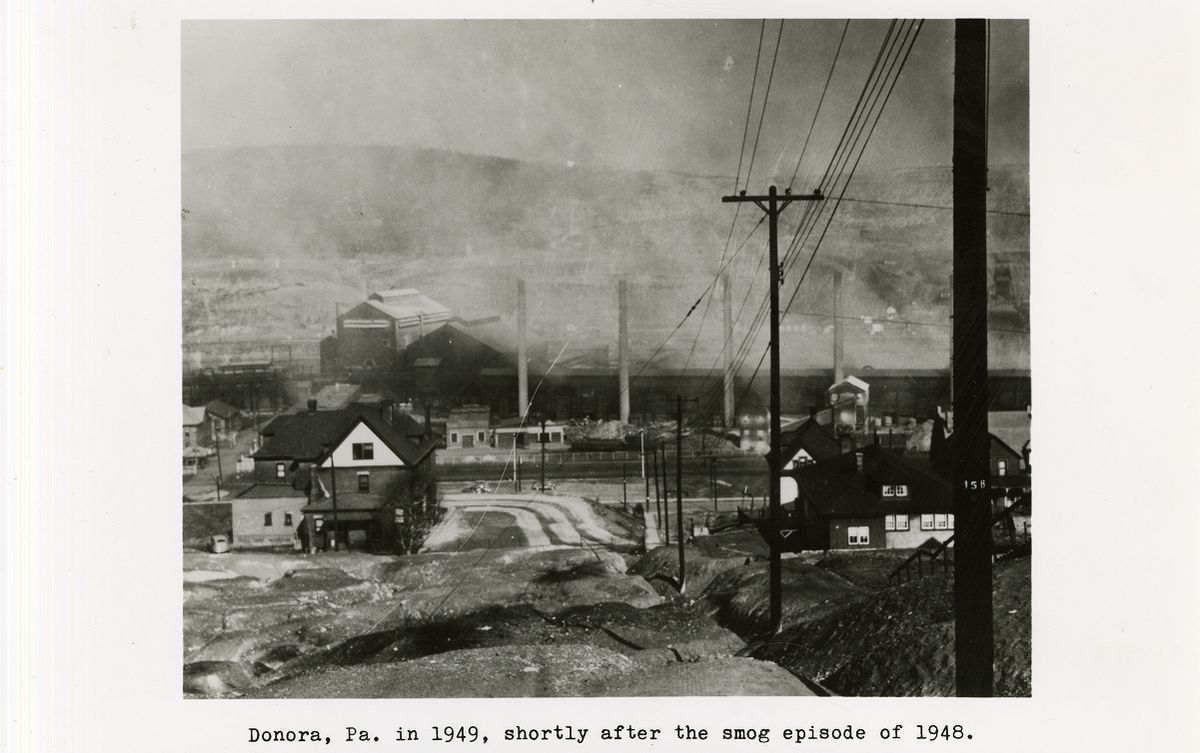
Image context: the cover photograph comes from the National Library of Medicine's Images from the History of Medicine collection. It is not a dramatic rescue scene. Its value is quieter: a factory landscape is still visible, but only through haze, which is exactly the historical problem Donora forced into the open.[6]
Before the emergency, the valley had already accepted bad air
Donora was not surprised by industrial smoke in 1948. EPA's historical account describes steel and zinc smelters as long-standing sources of dirty air in the town, and the local museum frames the smog as the event that made a wider clean-air movement unavoidable.[2][5] That matters because the disaster did not arrive in a clean environment and suddenly introduce pollution. It arrived in a place where pollution had already become part of ordinary civic weather.
The reconstruction has to start there. Donora's location along the Monongahela River put homes, works, roads, and hillsides into a tight physical relationship. Industrial emissions did not need to travel far before they entered domestic space. The Public Health Service report, as indexed by EPA's HERO database, identified atmospheric sampling for particulates, trace metals, sulfur dioxide, total sulfur, carbon dioxide, carbon monoxide, and nitrogen oxides at nearby zinc and steel factories.[1] That source does not support a single-poison story. It supports a combined-exposure story.
This is the first boundary in the evidence. Donora was not a case where one named chemical can explain every injury by itself. The Public Health Service authors concluded that no single substance was responsible, and that illness could have been caused by a combination of sulfur dioxide, oxidation products, and particulates.[1] The historical lesson begins with that complexity. People were not simply poisoned by "smoke" as a vague nuisance. They were breathing an industrial mixture under weather conditions that prevented escape.
October 27-31 turned emissions into a room
The crucial change was atmospheric. EPA's air-research history says a warm air pocket passed above Donora, trapping cooler air below and sealing pollutants near the streets.[2] That is the inversion mechanism in plain language: the valley did not merely have emissions; it lost vertical relief. Smoke that might normally have dispersed stayed close enough to be breathed repeatedly.
The Public Health Service report places the episode from October 27 to 31, 1948.[1] Those dates matter because the disaster was not a single blast or fire. It was duration. Each additional day turned a tolerable nuisance into cumulative exposure. The town did not need one spectacular rupture. It needed a cap in the sky and a set of sources underneath it.
That is why the phrase "fog" can mislead. Residents were experiencing fog in the visual sense, but the historical object was smog: fog made chemically and medically consequential by trapped industrial emissions. EPA describes Donora's streets as hidden under gray smog and notes that nearly half of the town's residents had severe respiratory or cardiovascular problems during the five-day episode.[2] The later PubMed abstract for the seventieth-anniversary reassessment gives a conservative estimate of 20 deaths and about 5,900 affected people, 43 percent of Donora's population.[3] The slight difference in phrasing across sources is useful: official numbers are not decorations but attempts to make a crisis countable.
The emergency entered through breath, age, and phone calls
One reason Donora became historically important is that the harm pattern was legible in bodies before it was legible in policy. The Public Health Service study administered questionnaires to 4,613 residents and conducted medical interviews with 558 individuals.[1] That household canvass turned private symptoms into public-health data. It also showed that illness was not randomly distributed.
The report found irritation of the respiratory tract and exposed mucous membranes, with cough as the most prominent single symptom.[1] Incidence and severity increased with age; more than 60 percent of those aged 65 years or older were affected.[1] The people who died were between 52 and 84, and most fatal cases had preexisting cardiorespiratory disease.[1] That does not make the deaths less environmental. It shows how environmental disaster often selects through vulnerability already present in a community.
This distinction is essential. A weaker interpretation would say that Donora mainly killed the already frail, as if the air were only a background stress. The evidence points the other way. The inversion made the background active. Existing heart and lung disease became lethal under conditions created by industrial emissions and atmospheric stability.[1][2] The disaster exposed a public-health rule still familiar today: pollution risk is not evenly distributed, and an acute episode can convert chronic vulnerability into immediate mortality.
Investigation changed the scale of responsibility
After the fog lifted, Donora did not become important only because the deaths were mourned. It became important because the episode was investigated at scale. The 2018 American Journal of Public Health reassessment calls it the first large-scale epidemiological investigation of an environmental health disaster in the United States.[3] That phrase is doing real work. Donora helped move dirty air from complaint to study design.
The Public Health Service report's method shows the change. Questionnaires, medical interviews, autopsies, factory sampling, symptom categories, age patterns, and contaminant measurements made the episode harder to dismiss as anecdote.[1] The report still had limits. It did not assign every illness to one substance, and later scholars continued to ask about long-term effects, including cardiovascular disease and cancer patterns in the region after 1948.[3] But uncertainty did not erase the main finding. A severe pollution episode had produced measurable illness and death across a town.
The local memory of Donora also kept the case from disappearing into technical literature. The Donora Historical Society and Smog Museum uses the slogan "Clean Air Started Here," and its institutional narrative connects the disaster to the 1955 federal air-pollution research law, the 1963 Clean Air Act, the creation of EPA in 1970, and the 1970 Clean Air Act Amendments that established national air-quality standards.[5] That slogan is civic memory, not a full policy chain by itself. But it captures something important: Donora became a place where a local death fog could be remembered as a national warning.
The policy afterlife was slower than the emergency
The federal policy chain did not arrive overnight. EPA's account of its own birth says the federal air program was founded in 1955 in reaction to several alarming problems, including Donora's inversion, Los Angeles smog, and London's 1952 lethal fog.[4] It also notes that early federal air work began as research without regulatory powers, that the 1963 Clean Air Act added enforcement authority over interstate air pollution, and that later amendments and the EPA reorganization gave federal clean-air policy more force.[4]
That delay matters. Donora's people experienced a five-day emergency; law took decades to build. The gap is not a reason to downplay the event. It explains why Donora belongs in history rather than only disaster memory. Its importance lies in the conversion of a local catastrophe into durable categories: air pollution as measurable exposure, susceptible populations as part of public-health analysis, industrial emissions as a matter of public authority, and environmental protection as a federal responsibility rather than a private dispute between neighbors and mills.[1][3][4]
The strongest reconstruction therefore avoids two mistakes. One mistake is to treat Donora as only a freak weather event. The inversion was necessary, but it became deadly because it trapped industrial emissions in a valley where people lived.[1][2] The other mistake is to treat it as only a simple origin story for modern environmental law. Donora did not create clean-air policy by itself. It supplied evidence, memory, and political pressure to a longer sequence that also included Los Angeles, London, scientific research, state action, federal reorganization, and later national standards.[3][4][5]
What makes Donora still unsettling is how ordinary the opening conditions were. A working valley, known smoke, older residents with vulnerable lungs and hearts, a few days of bad weather, and factories continuing to emit into a trapped air mass: none of these looked, by itself, like a national turning point. Together they made breathing a townwide emergency. That is why the photograph matters. The haze is not background. It is the historical actor the episode forced Americans to see.
Editor’s Pick Review
This article takes today’s merged standard/add-on editor-pick slot because it is the strongest 24-hour candidate across the full curation rubric: evidence density, narrative reconstruction, bilingual readability, and the tightened image-policy gate. The English piece makes an environmental-health disaster legible as a sequence of valley geography, industrial emissions, inversion weather, household illness data, and later clean-air policy memory, rather than reducing Donora to a flat origin story. Its archival cover photograph is immersive, topic-grounded, and documentary: the haze, factories, and townscape are the historical object under analysis, with no analytical diagram or symbolic pollution graphic doing the work. The Chinese edition preserves the same causal progression in clear historical prose, with stable public-health terminology and low translationese, so the piece holds up cleanly in both language lanes.
Sources
- U.S. Environmental Protection Agency HERO record for Schrenk, Heimann, Clayton, Gafafer, and Wexler, Air pollution in Donora, Pennsylvania. Epidemiology of the unusual smog episode of October 1948. Preliminary Report (U.S. Public Health Service, 1949).
- U.S. Environmental Protection Agency, "History of Air Pollution" - Donora inversion, local exposure, and later air-research framing.
- Jacobs, Burgess, and Abbott, "The Donora Smog Revisited: 70 Years After the Event That Inspired the Clean Air Act," American Journal of Public Health (2018), PubMed record.
- U.S. Environmental Protection Agency archive, "The Birth of EPA" - federal air-program origins, Donora's role in the historical framing, and Clean Air Act development.
- Donora Historical Society and Smog Museum, "1948 Smog" - local institutional memory, museum framing, and clean-air legacy chronology.
- National Library of Medicine Digital Collections, "Donora, Pa., shortly after the smog episode of 1948" - source page for the archival photoprint used as the cover image.