The Library Cave at Dunhuang is easy to remember as a treasure story: a sealed chamber, a monk, a hidden cache, then scholars and museums. That sequence is true enough to be useful, but too neat to carry the weight of the place. Cave 17 at the Mogao Caves matters because it turned preservation into a problem of movement. The archive survived because it was sealed. It became famous because it was opened. It became contested because it was dispersed. It remains usable because fragments of that dispersal are now being described, digitized, conserved, and argued over across institutions.[2][6]
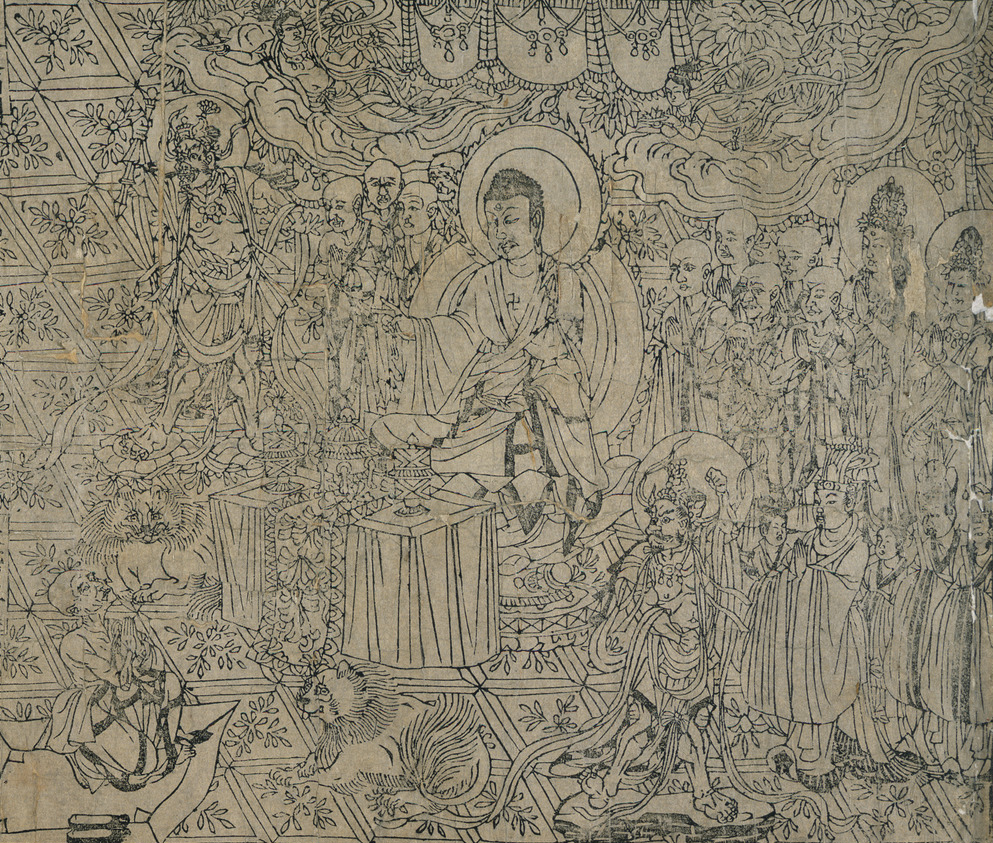
The most vivid object in that story is the British Library's copy of the Diamond Sutra, printed in 868 and catalogued as Or.8210/P.2. The International Dunhuang Programme describes it as a woodblock print in ink on paper, nearly five metres long, found at Dunhuang Mogao and connected to Stein's 1906-1908 expedition.[3] Its fame as the world's earliest dated printed book can make it sound like an isolated marvel. In the memory of Cave 17, it works better as an index: one portable object that makes visible a much larger archive of manuscripts, printed texts, paintings, textiles, and devotional things.
Image context: the cover image is a real digitized archival image of the Diamond Sutra frontispiece and text. It belongs here because the article is not treating Dunhuang as an abstract Silk Road symbol. It is reading the Library Cave through the physical and institutional afterlife of paper: sealed, sold, catalogued, conserved, digitized, and remembered.[1][3]
A sealed room joined site memory to paper memory
UNESCO's description of Mogao begins with the landscape: caves cut into cliffs southeast of the Dunhuang oasis, first constructed in 366 AD, with hundreds of preserved caves, tens of thousands of square metres of murals, and more than two thousand painted sculptures.[4] That scale matters. Cave 17 was never a free-standing archive in a neutral container. It belonged to a living Buddhist cave-temple complex shaped over centuries by pilgrimage, patronage, painting, translation, trade, and worship.[4]
The International Dunhuang Programme places the Library Cave's contents from the 4th to 11th centuries and describes more than 50,000 manuscripts, paintings, printed documents, textiles, and other objects sealed there.[2] The cave's memory therefore begins with compression. Religious texts, local documents, multilingual materials, art, and worn paper objects were gathered into one small chamber. What later museums separated by accession number once sat in stacks and bundles, under desert conditions that let paper endure with unusual force.[2]
This is the first thing commemoration must keep intact. The Library Cave was not simply a discovery of beautiful things. It was a discovery of a documentary ecology. The cave held evidence for Buddhism, Chinese and Central Asian history, daily practice, language contact, scribal habits, printing, donation, repair, travel, and institutional life. Its meaning depends on density. A single scroll matters, but the single scroll matters most because it points back to the room that held so many kinds of memory together.[2][4]
Wang Yuanlu made custodianship visible
The next memory problem is Wang Yuanlu. IDP's account identifies him as a former soldier and Daoist monk who moved to the Mogao area around 1899, took responsibility for restoration, and in 1900 found a sealed door in the corridor of Cave 16 leading to the chamber now called Cave 17.[2] He became the only person with access to the materials and tried to draw official attention, hoping to raise money for cave restoration.[2]
That detail complicates the story. Wang can be remembered as discoverer, custodian, seller, restorer, and intermediary. Those roles do not cancel one another. They describe the awkward position of a local guardian inside a weak late Qing heritage regime, facing decayed buildings, uncertain official support, foreign scholarly appetite, and objects whose value was not yet stabilized by modern heritage institutions.[2]
The ethical pressure of Cave 17 begins there. It is too simple to make Wang a villain who broke an archive or a hero who saved it. The stronger reading is that the cave exposed a mismatch between local care and global collecting. Wang had a site to maintain. Foreign explorers had money, institutions, transport networks, and learned desire. The paper archive moved through that imbalance.[2][6]
Dispersal became the archive's modern shape
Aurel Stein reached Dunhuang in 1907 during his second Central Asian expedition. IDP says Wang granted him limited access, and Stein obtained thousands of manuscripts, paintings, and textiles.[2] Paul Pelliot arrived in 1908 and purchased further manuscripts, paintings, sculptures, and textiles that later entered French collections.[2] In 1910, the Qing government ordered remaining items moved to Beijing, while other materials went on to Japan, Russia, and England through later expeditions and sales.[2]
Within about ten years, the Library Cave was no longer a local room. It had become a global archive without a single shelf. That dispersal is the core of its commemoration. A manuscript in London, Paris, Beijing, St Petersburg, Kyoto, or another collection is not merely an isolated holding. It is a piece of a cave that can no longer be physically reassembled.[2][6]
The International Dunhuang Programme grew from that condition. Its history page says the 1993 Sussex conference gathered institutions holding major Dunhuang collections, and that the programme was formally established in 1994 at the British Library.[6] IDP frames the twentieth-century dispersal of the Library Cave as a direct motivation for international collaboration, digitisation, preservation, and shared access.[6] That is a modern answer to an older rupture: if the archive cannot be returned to one room, its descriptions and images can at least be made to speak across collection borders.
Digital reunification has limits. It does not undo acquisition history. It does not restore the original order of the bundles as Wang first saw them. It cannot replace the handling knowledge of conservators or the place-based experience of Mogao. Yet it changes what memory can do. A dispersed archive becomes searchable. A scholar can connect object records that sit under different institutional authorities. A reader can see the Diamond Sutra as a book-history landmark and as one witness from Cave 17 rather than as a detached museum trophy.[3][6]
The Diamond Sutra turns fame back toward the cave
The Diamond Sutra is famous for its date. IDP's collection record gives 868 and identifies the object as a printed copy of the Vajracchedikaprajnaparamitasutra, translated by Kumarajiva, in Chinese script.[3] IDP's conservation blog calls it the world's earliest dated printed book and notes that it was found with tens of thousands of other scrolls in a hidden cave at Mogao.[5]
That fame needs careful handling. The scroll should not be treated only as a "first." Its printed status is historically important, but its commemorative value is larger. It shows how Buddhist devotion, woodblock printing, patronage, and the circulation of texts had already produced a sophisticated paper world long before modern printing stories usually begin in Europe.[3][5] It also shows how one object can become overburdened with symbolic work. The Diamond Sutra now has to stand for printing history, Buddhist transmission, Dunhuang, British Library collecting, Stein's expedition, and the larger problem of removed archives.
The better memorial use of the scroll is to let it point outward. Its frontispiece draws the eye, but its institutional path asks the harder questions: who made it in 868, who stored it before the early eleventh century, why Cave 17 was sealed, what Wang saw in 1900, why Stein could acquire it in 1907, how conservators stabilized it, and how a digital record now lets it be encountered without pretending the object has no modern collection history.[2][3][5][6]
Conservation keeps the site from becoming only an origin story
The remaining danger is that Dunhuang becomes only a memory of what left. Mogao itself still exists as a vulnerable site. UNESCO emphasizes the caves' murals, sculptures, setting, and continuing heritage value.[4] The Getty Conservation Institute describes long collaboration with the Dunhuang Academy beginning in 1989, with work on wall-painting conservation, environmental issues, visitor management, documentation, lighting, and monitoring.[7]
This site work matters for commemoration. The Library Cave's papers are dispersed, but Mogao is not reducible to a lost archive. Its walls, caves, painted surfaces, conservation regimes, visitor limits, and research infrastructure are part of the same historical afterlife. If Cave 17 teaches that paper can travel, Mogao teaches that place still makes claims. A digital image can reconnect records. It cannot replace the fragile physical environment that made the archive possible.[4][7]
Remembering the Library Cave well therefore means holding three things together. First, the sealed chamber preserved a dense medieval archive. Second, the opening of that chamber created a modern dispersal whose ethics remain visible in every catalogue record. Third, preservation now works through both site care and distributed access. Dunhuang's memory is not housed in one place anymore. It survives as a relationship among cave, scroll, museum, database, conservation lab, and reader.
That is why Cave 17 remains more than an archaeological episode from 1900. It is a test case in how cultural memory moves after discovery. The Library Cave did not only give the world rare objects. It gave the world a permanent question: how should one remember an archive that survived by being sealed, became known by being broken open, and now depends on many institutions to keep its scattered pieces legible?
Sources
- Wikimedia Commons, "Diamond Sutra of 868 AD - The Diamond Sutra (868), frontispiece and text - BL Or. 8210-P.2 (cropped).jpg" - source page for the digitized British Library image used as the article cover.
- International Dunhuang Programme, "Discovering Cave 17" - account of Wang Yuanlu, the 1900 discovery, Stein and Pelliot, and the dispersal of Library Cave materials.
- International Dunhuang Programme, "Or.8210/P.2" - collection record for the 868 printed Diamond Sutra, including material, dimensions, find site, and provenance.
- UNESCO World Heritage Centre, "Mogao Caves" - site description, chronology, cave count, murals, sculptures, and historical significance.
- International Dunhuang Programme, "The Diamond Sutra" - conservation and collection note describing the 868 scroll and its discovery with other Mogao Library Cave materials.
- International Dunhuang Programme, "History of the IDP" - history of the programme, its 1993-1994 origins, and its response to the dispersal of Library Cave collections.
- Getty Conservation Institute, "Wall Paintings Conservation at Mogao Grottoes" - project history for conservation collaboration with the Dunhuang Academy from 1989 onward.