Hammurabi's stele is often introduced as if it were a modern statute book that happened to be written in cuneiform. That memory is useful, but it starts too late. The Louvre's own overview warns that the text engraved around 1750 BC is not a legal code in the modern sense; it is a collection of 282 royal legal judgments arranged around property, family, trade, labor, violence, and social order.[3] Read closely, the monument is less a handbook for citizens than a public staging of kingship: a ruler, a god, a carved surface, a sequence of cases, and a long final curse all work together.
The object itself makes that argument before the words begin. The Louvre collection record identifies it as a broken stela, 225 cm high, 79 cm wide, and 47 cm thick, with a relief at the top showing the seated Shamash and the standing Hammurabi, then an inscription below in Old Babylonian cuneiform.[2] The record places its origin in Mesopotamia, its discovery at Susa in 1901-1902, and its current display in the Louvre's Richelieu wing.[2] Even the stone's material name is a useful caution: the Louvre lists basalt, while recent heritage-science work notes that the basalt-versus-diorite attribution has remained scientifically unresolved and calls for noninvasive analysis.[2][7] The safest reading begins with the monument's social work rather than with a romantic label for the stone.
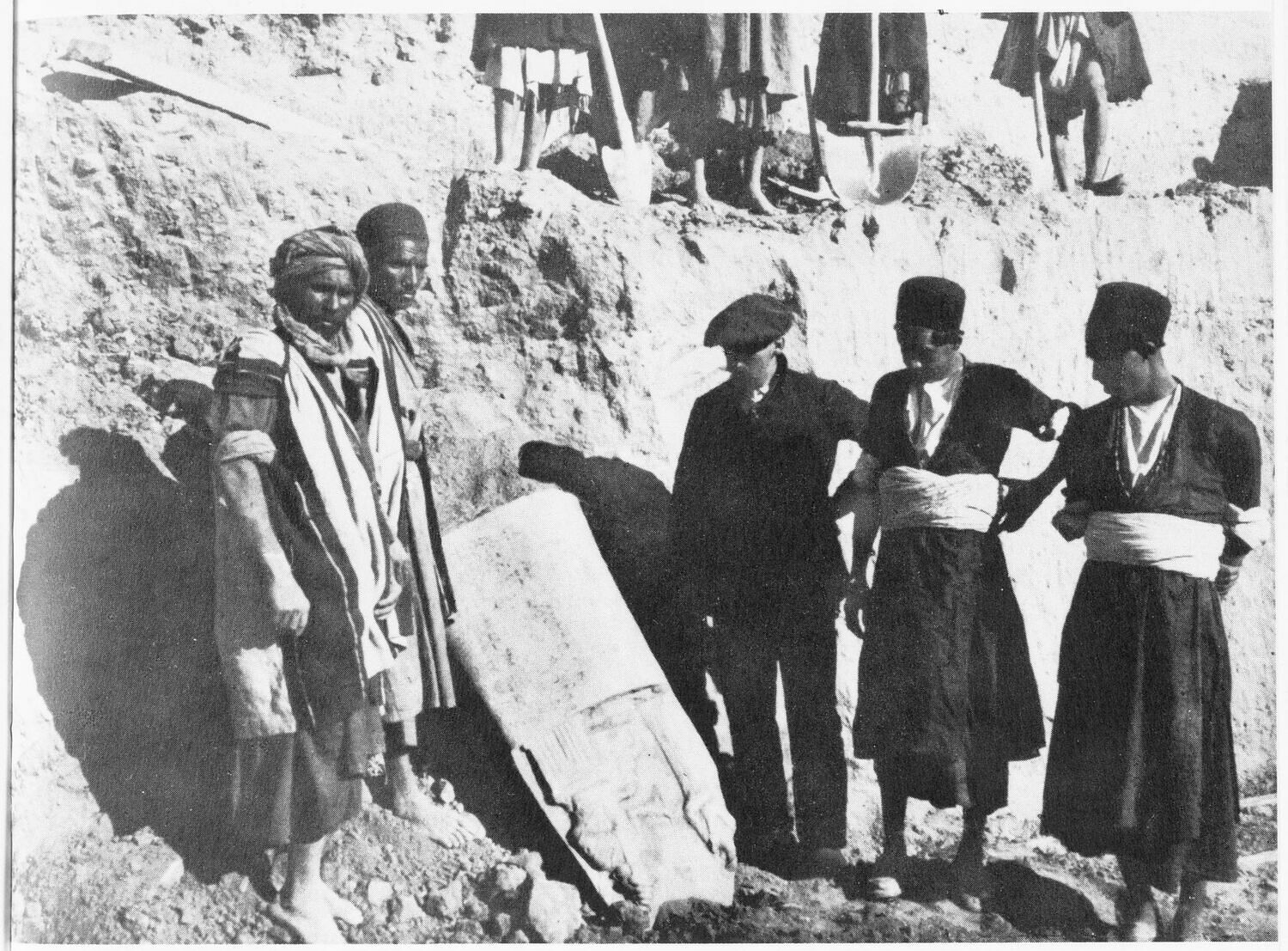
Image context: the archival discovery photograph matters because this essay reads the stele as a public object with a career. It was carved for Babylonian royal display, carried to Susa in antiquity, excavated by a French mission in 1901-1902, photographed, catalogued, and reinstalled as a museum object.[1][2]
The prologue turns law into royal light
The prologue does not begin with ordinary disputes. It begins with gods, cities, temples, and the king's assigned role. In the eHammurabi edition's modern translation, Anu and Enlil ordain Hammurabi to demonstrate justice, destroy wickedness, prevent the strong from exploiting the weak, and rise like Shamash over humanity.[4] The Avalon text similarly opens by making Hammurabi the ruler called to bring righteousness, protect the weak, and enlighten the land.[5] This opening matters because it tells the reader what kind of text follows. The judgments are not presented as clever administrative reforms. They are presented as the visible consequence of divine commission.
That does not make them empty propaganda. It makes them political theology. The relief at the top of the stele already shows Hammurabi facing Shamash, the god associated with justice.[2][3] The prologue then translates that image into language. The king is not just a conqueror with a legal office. He is a shepherd, provider, restorer of temples, benefactor of cities, and brightener of the land.[4][5] Before the cases begin, the reader has been taught that justice descends through a relationship among gods, king, city, and public inscription.
This also explains the long list of places in the prologue. Modern readers may want the code to hurry toward rules, but the text lingers over Nippur, Sippar, Larsa, Uruk, Isin, Kish, Lagash, Borsippa, and other religious and political centers.[5] The geography is not padding. It makes Hammurabi's justice spatial. His authority is not a theory floating above Babylon. It is mapped through temples, cult centers, canals, cities, and conquered districts. The law collection enters only after that map has been drawn.
The cases teach procedure as much as punishment
The first laws are famously severe, but their severity is only part of the point. The opening sequence in the Avalon translation concerns accusation, proof, ordeal, witnesses, and judges.[5] A false accuser in a capital matter can die. A judge who changes a written decision after fault is discovered must pay heavily and lose the bench.[5] These early clauses do not simply threaten bodies. They ask what turns a claim into a decision.
That order is revealing. A modern summary often jumps to "an eye for an eye," but the stele begins by worrying about evidentiary failure. Who bears risk when an accusation cannot be proved? What happens when witnesses fail to appear? What penalty disciplines a judge whose written judgment collapses? The law collection is harsh, but it is also anxious about process. It recognizes that public order can be injured by robbery, by false testimony, by corrupt judging, and by undocumented exchange.[5]
The same procedural concern appears in commercial and property sections. The Avalon translation repeatedly invokes witnesses, contracts, receipts, tablets, oaths, and time limits.[5] A buyer who cannot produce the seller and witnesses may become legally exposed. An agent who lacks a receipt cannot treat money as his own. A debtor whose harvest is destroyed by storm can wash the debt tablet and suspend grain payment for that year.[5] These examples show why the Louvre's description of the text as case judgments is useful.[3] The stele does not only state values. It models recurring situations in which proof, record, risk, and status determine the outcome.
The hierarchy is visible, not hidden
A close reading must also keep the stele's social world in view. The text does not imagine equal citizens before one general rule. It differentiates temples, palace property, free persons, dependents, slaves, soldiers, merchants, cultivators, wives, children, and professional builders or physicians.[5] Penalties can shift according to the rank of the injured person and the status of the actor. That hierarchy is part of the legal architecture, not an accidental blemish on it.
This is where the monument resists two opposite simplifications. It is not a timeless charter of equal rights. It is also not a random list of cruelty. Many clauses try to stabilize obligations inside a stratified economy: military land tenure, agricultural leases, irrigation damage, merchant-agency relationships, marriage payments, inheritance, adoption, wages, hire, and building liability.[5] The stele's justice is distributive in an older, harder sense. It allocates responsibility across social stations that the text takes as given.
That point changes how the famous talion passages should be read. Physical retaliation clauses are present, and they are severe. Yet the larger document is full of compensation, substitution, oath, contract, and status distinctions.[5] The eye-catching punishments do not exhaust the system. Hammurabi's stele makes justice visible by sorting social life into cases. Some cases end in death or bodily penalty. Others end in repayment, return of property, annulment of contract, a fixed wage, or a public loss of office.[5]
The epilogue tells us what the monument wanted
The final section is especially revealing because it stops sounding like a practical digest and starts defending the stele as an object. In eHammurabi's epilogue translation, the king boasts that his words are unmatched, asks that justice shine over the land by Shamash's command, and warns that no one should remove his engraved image.[6] The concern is not merely whether a judge consults a clause. The concern is whether the monument remains in place, readable, honored, and feared.
The curses intensify that object logic. The epilogue calls down divine punishment on any future ruler who alters the words, erases the name, changes the image, or disregards the judgments.[6] A modern law book can be updated by amendment. Hammurabi's stele imagines alteration as sacrilege and political attack. The text's authority depends on continuity of inscription: the king's name, the god's sanction, the carved image, and the sequence of judgments must survive together.
That ending also helps explain the stele's afterlife. The object discovered at Susa was already displaced from its likely Babylonian context.[1][2] Its survival as an excavated monument is partly accidental, but the form was designed for durability. Stone display, divine scene, prologue, cases, epilogue, and curses all push against forgetting. The monument wanted future viewers to encounter Hammurabi as the king through whom justice became visible.
What a close reading changes
Read this way, Hammurabi's stele is neither a simple first law code nor a museum trophy with a famous label. It is a royal technology of public order. The prologue tells viewers where authority comes from. The cases show how disputes become legible through proof, status, contract, oath, and penalty. The epilogue protects the monument by making textual alteration a religious and political offense.[4][5][6]
The common modern phrase "Code of Hammurabi" is not wrong, but it can flatten the object. The Louvre's more careful framing points toward a better center of gravity: a monumental collection of jurisprudence, carved around 1750 BC, discovered at Susa in 1901-1902, and built around 282 judgments rather than modern legislative abstraction.[2][3] Its history matters because the stele did not only preserve rules. It made justice into a scene: king before god, cases below relief, curses after judgments, and stone carrying royal memory through displacement.
That is why the object still holds attention. It lets us see law before law becomes a separable institution. Justice appears here as image, voice, hierarchy, record, divine command, and royal self-defense. The stele made Babylonian authority visible in the form of cases, and the cases made Hammurabi visible as the ruler who claimed to keep the strong from crushing the weak.[4][5]
Sources
- Wikimedia Commons, "File:Code of Hammurabi 104.jpg" - source page for the archival Louvre excavation photograph used as the article image.
- Louvre collections, "Code de Hammurabi" - official collection record for SB 8, including dimensions, material listing, iconography, inscription language, discovery at Susa, and current display location.
- Musee du Louvre, "The Code of Hammurabi" - official overview describing the stele, the relief of Hammurabi before Shamash, the circa 1750 BC inscription, and the 282 legal judgments.
- eHammurabi, "Prologue" - cuneiform, transliteration, normalization, and modern translation of the law code's prologue, including the divine commission language discussed here.
- Yale Law School Avalon Project, "The Code of Hammurabi" - L. W. King translation of the prologue and legal clauses used for close reading of accusation, witnesses, contracts, property, debt, and status.
- eHammurabi, "Epilogue" - cuneiform, transliteration, normalization, and translation of the epilogue, including the king's self-presentation, monument-protection language, and curses.
- Gabriel Pinilla, Stephan Rohrs, Horst J. Schulze and Philippe Walter, "Diorite or basalt: controversy concerning the world-famous Code of Hammurabi stele in the Louvre," npj Heritage Science (2026) - recent discussion of the unresolved material attribution and proposed noninvasive testing pathway.