The Ludlow Massacre is often remembered through its most unbearable image: women and children dead after a tent colony burned on April 20, 1914.[2][3][5] That memory is necessary, but it can make the event look like a sudden eruption of cruelty. The stronger historical question is how a coal strike produced a settlement where family shelter, union organization, armed confrontation, and state authority were forced onto one exposed patch of Colorado ground.
The mechanism begins with housing. Colorado Fuel and Iron was not just an employer in the southern coalfields. The National Park Service describes the company as employing about 7,000 workers and controlling nearly 70,000 acres of land, while the University of Denver's Ludlow atlas shows why that mattered locally: when the strike began, many miners and families were evicted from company housing and moved into tent cities built by the United Mine Workers of America.[2][4] In a company town system, a labor dispute could become a housing crisis almost immediately.
Company housing made the strike spatial
The United Mine Workers called the Colorado strike in September 1913 after operators rejected demands that included the eight-hour workday, enforcement of mine-safety rules, and the right to choose housing and doctors.[2][4] Those demands show that the strike was never only about a wage rate. It was about the employer's reach into the body, the home, the doctor, and the day.
Eviction made that reach concrete. Britannica says about 10,000 miners were on strike and that those evicted from company towns built tent colonies, the largest at Ludlow housing about 1,200 strikers.[3] The University of Denver atlas gives the colony a sharper social form: about 500 tents, more than 24 languages, streets, public areas, and a deliberate effort by union leaders to make a temporary camp function as an organized community.[4]
That is the first causal link. The company town gave operators leverage over shelter; eviction was meant to weaken the strike by making survival harder. The union tent colony answered by turning displacement into infrastructure. It let families remain near the coalfield, kept strikers in contact with organizers, and made the strike visible as a public settlement rather than a scattered set of unemployed men.
The tent colony preserved pressure
Ludlow mattered because a tent city is both fragile and stubborn. It is fragile because canvas, stove pipes, food supplies, water, children, and medicine are exposed to weather and violence. It is stubborn because it keeps people together. DU's atlas emphasizes that the colony was temporary, yet arranged with streets and shared spaces; the layout itself helped create community during the strike.[4] The camp was therefore not a passive refuge. It was a device for preserving collective pressure.
That pressure changed the conflict's shape. The NPS account says miners armed themselves as confrontations with private security escalated.[2] Britannica adds that the Colorado National Guard, deployed to reduce violence, favored the operators by escorting strikebreakers and overlooking violent actions by detectives.[3] Once armed strikers, company guards, and state troops all treated the colony as a strategic site, the camp's domestic and military meanings fused.
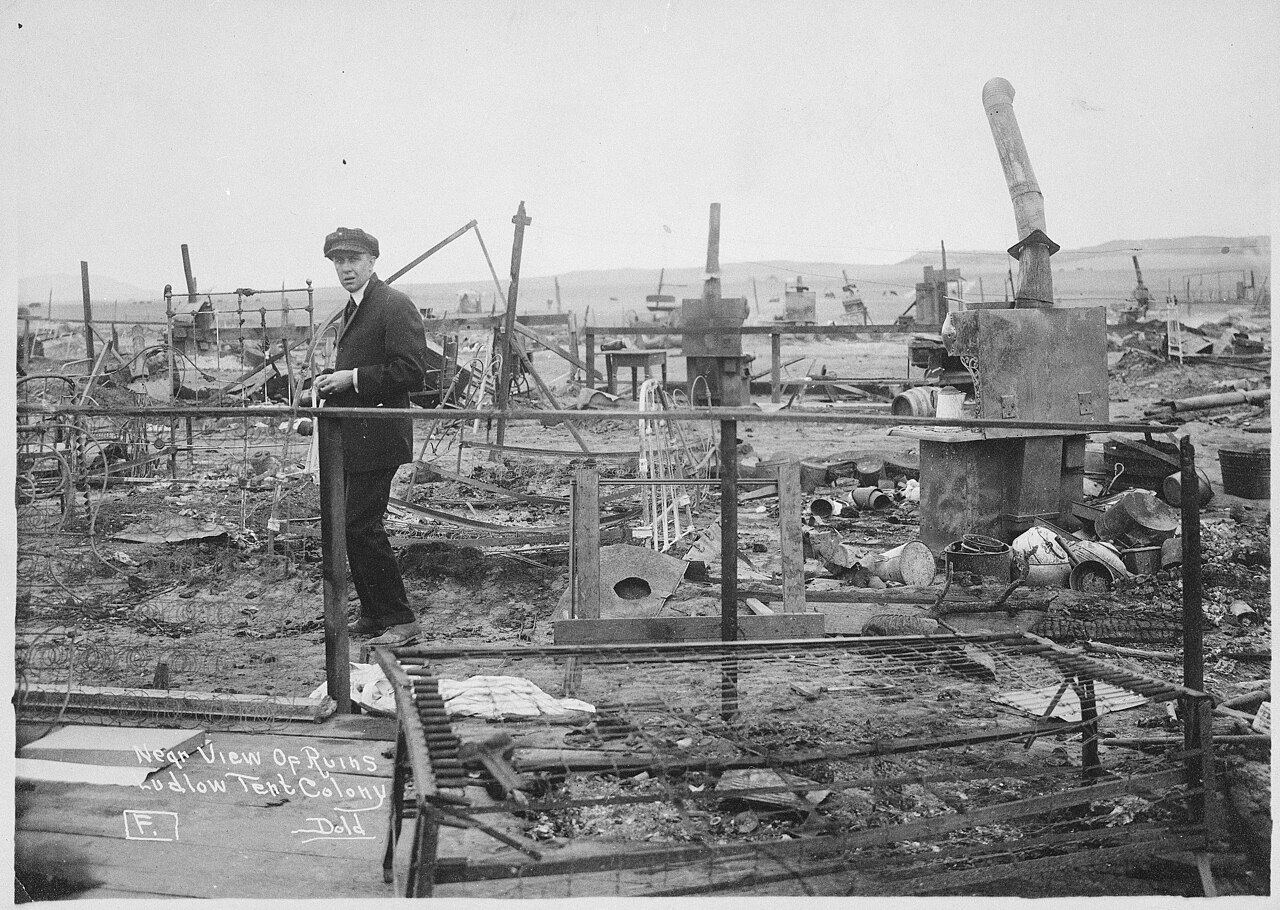
This is why the photograph of ruins is more than atrocity evidence.[1] It shows the strike's physical grammar. Stove pipes mark cooking and warmth. Scattered metal marks household improvisation. Open ground marks exposure. A labor conflict that might have remained inside payroll ledgers and mine entrances had become a landscape of family survival under armed observation.
State force converted conflict into legitimacy crisis
The crucial escalation came in April 1914. Britannica describes a reduced National Guard presence, heightened violence, and a machine gun placed on a bluff overlooking Ludlow before the daylong battle.[3] The NPS summary states that National Guardsmen aligned with Colorado Fuel and Iron attacked the tent colony on the morning of April 20, killing 21 people, including 11 children.[2] Britannica gives a slightly different total, 25 dead, including 11 children, a reminder that casualty accounting itself sits inside contested aftermath.[3]
The number matters, but the mechanism matters as much. If a private security force attacked a camp, the story would be one of corporate violence. At Ludlow, the presence of the National Guard made the state part of the violence. When troops and company interests appeared aligned, the public question changed from "can this strike be contained?" to "whose order is the state enforcing?"
The underground pits made that question even sharper. DU's ruins gallery says strikers dug pits beneath tents for protection from gunfire and identifies the "Death Pit" as the place where most of those hiding in one tent cellar suffocated when the tent above burned.[5] A pit is defensive architecture at its smallest scale. It was not built to win a battle. It was built to let families endure gunfire. When such a shelter became a death chamber, Ludlow's meaning exceeded ordinary strike violence.
The aftermath widened the battlefield
Ludlow did not end when the tents burned. NPS says the massacre ignited 10 days of continuous warfare in Colorado until President Woodrow Wilson ordered federal troops to disarm both sides and restore order.[2] Britannica likewise notes armed retaliation after the massacre, federal troop intervention, and the strike's end on December 10, 1914.[3] The battlefield widened because the colony had become a symbol of state-backed corporate power rather than one local camp.
The institutional aftermath also shows the event's double edge. Britannica says Congress held hearings but took no concrete action, trials of more than 400 miners dragged on until 1920 with no convictions, and Rockefeller later instituted company-sponsored unions as an alternative to the UMWA.[3] NPS frames the later congressional report, produced in 1915, as important in promoting child-labor laws and enforcing the eight-hour workday.[2] Put together, the sources show both limits and consequences: Ludlow did not deliver immediate union victory, yet it made the costs of industrial paternalism harder to keep private.
What the mechanism explains
Ludlow's lasting force comes from the way three systems locked together. Company housing made a strike into eviction. Tent colonies made eviction into organized presence. State force made organized presence into a national legitimacy problem. The massacre was not an accidental overlay on the strike. It was the point where the strike's built environment, family life, and coercive politics converged.
That reading also keeps the victims from being reduced to symbols. The children and adults at Ludlow died inside a settlement created by specific decisions: company control over housing, operator refusal of union demands, family eviction, union camp-building, armed escalation, militia deployment, and the decision to treat the tent colony as a target.[2][3][4][5] The burned camp remains historically powerful because it shows that labor violence was not only fought at the mine mouth. It entered the home, then revealed that the home had been inside the labor system all along.
Sources
- Wikimedia Commons, "File:Ludlow tent colony fire (11191749246).jpg" - National Archives photograph source page for the burned Ludlow tent colony image used in this article.
- National Park Service, "War in the Coalfields: The 'Ludlow Massacre' and its Impact on the Eight-hour workday" - official preservation article on CF&I scale, UMWA demands, eviction, April 20 deaths, federal troops, congressional investigation, and landmark status.
- Encyclopaedia Britannica, "Ludlow Massacre" - synthesis of the strike chronology, tent colony scale, National Guard role, casualty count, retaliation, federal intervention, trials, and Rockefeller's company-union response.
- University of Denver, Colorado Coalfield War Archaeological Project Digital Atlas, "History 1913-1914 Ludlow Colony" - archaeological and spatial context for the tent colony's size, languages, layout, and role as union headquarters.
- University of Denver, Colorado Coalfield War Archaeological Project, "The Ruins of Ludlow" - photo-gallery context on the burned colony, machine-gun and rifle fire, militia looting, and the protective pits beneath tents.