Operation Mincemeat is easy to remember as a macabre stunt: British intelligence floated a corpse toward Spain with false invasion papers, and Germany believed the wrong target. That summary is true enough to be memorable, but it hides the more interesting historical mechanism. The deception did not work because the premise was theatrical. It worked because British planners made the lie administratively ordinary.[1][2]
The invented officer, "Major William Martin," had to pass through several skeptical systems. Spanish officials had to find him plausible. German intelligence had to want the papers badly enough to copy them. British officers had to appear anxious to recover the briefcase without overacting. Axis commanders then had to fit the forged information into assumptions they already considered likely. Mincemeat succeeded only when all those layers reinforced one another.[1][2]
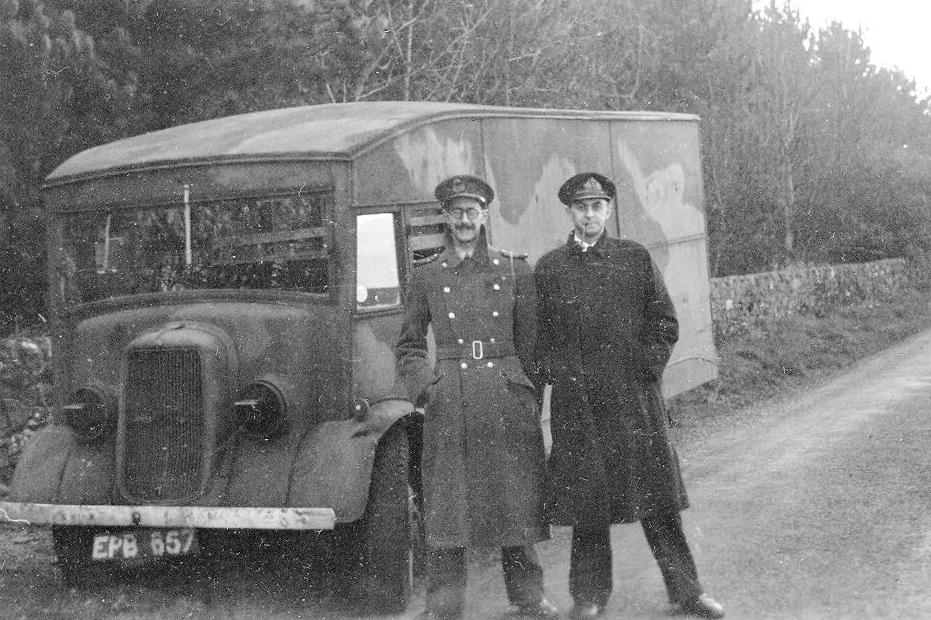
The cover image shows Charles Cholmondeley and Ewen Montagu, two of the central planners, beside the vehicle used to transport Glyndwr Michael's body for the operation.[4] It is a useful corrective to the legend. This was not deception as pure imagination. It was deception as handling: body storage, clothing, identity papers, personal effects, locked containers, submarine movement, diplomatic messages, and post-event document inspection.[1][2][4]
The timeline that made the lie testable
The first anchor is January 1943, when the planners needed a body whose condition could plausibly support a sea-death story.[1][2] Britannica identifies the body as that of Glyndwr Michael, a homeless Welshman who had died in London after eating rat poison, later transformed into the fictitious Royal Marine officer William Martin.[1] The ethical discomfort is part of the history, not an optional footnote. A real dead man was overwritten by a usable military identity.
The second anchor is 29-30 April 1943. Britannica places the release of the body near Huelva on April 29 and its discovery the next morning, after HMS Seraph had carried it to the Spanish coast.[1] The geography mattered. Spain's formal neutrality made the event deniable, while its internal sympathies and intelligence traffic made leakage plausible.[1][2]
The third anchor is the May-July 1943 window. The National WWII Museum reconstructs the paper chase after the briefcase was retained, passed around, returned to British hands, and examined for signs of tampering. By 14 May 1943, Hitler was already treating Greece and Sardinia as serious reinforcement priorities, and by 10 July 1943, Operation Husky opened against Sicily.[2][3]
The corpse was only the carrier
Mincemeat's common retelling gives the corpse too much agency. A body without paperwork would have been tragic, suspicious, or useless. The crucial move was to make the body a courier. The false officer carried documents suggesting Greece and Sardinia as Allied targets, with Sicily framed as a diversion. That reversal turned true information into something the Germans could explain away.[1][2]
This was the first mechanism: misdirection through over-specific paperwork. A vague rumor about Greece would not have been enough. The planted letters had to look like working correspondence between senior officers, not propaganda. They needed names, ranks, routes, timing, and bureaucratic texture. The more ordinary the documents felt, the less they resembled a message designed to be found.[1][2]
The second mechanism was identity depth. Britannica describes the supporting personal material: a fiancee's photograph, an engagement-ring receipt, a theatre ticket stub, keys, cigarettes, matches, and other items that gave Major Martin a life beyond the mission documents.[1] These details did not prove the invasion plan. They made the carrier feel real enough that the invasion plan could be read without first collapsing the identity.
That is why "pocket litter" was not decoration. It acted like a friction layer. If an investigator asked why this man had a briefcase, the answer was not simply "because the plot requires it." He had a name, a rank, a romantic life, bills, recent movements, and enough everyday mess to resemble a person moving through wartime London. The deception depended on boredom. A too-perfect officer would have looked composed by an author. A mildly cluttered one looked administered by life.[1][2]
Spain was the relay, not the audience
The planners were not trying to convince Spain as the final target. Spain was the relay. Britannica notes that the Spanish passed the documents to German contacts while Britain pressed for the return of the supposedly secret briefcase.[1] The National WWII Museum's account adds the later British discovery that the letters had been removed from their envelopes using small rods, a detail that matters because it converted suspicion into evidence that the trap had been sprung.[2]
This was the third mechanism: controlled loss. British intelligence needed to lose the documents just enough. If the briefcase disappeared forever, the plan could not be monitored. If it returned too cleanly, the Germans might never have seen it. If British officials appeared indifferent, the papers would not feel important. The London-to-Haselden messages described by the National WWII Museum were part of that theater of urgency, especially because the British knew some channels were insecure.[2]
The operation therefore sat in an awkward middle zone between secrecy and performance. The documents had to be secret enough to tempt theft, but exposed enough to be stolen. The British had to want them back, but not so efficiently that the deception died on the beach. The Spanish and German handlers had to feel that they had intercepted something, not merely received it.
German belief did the final work
No deception operation can force an enemy to believe. It can only shape what the enemy thinks it has discovered. Mincemeat's final mechanism was confirmation under pressure. The Allies were obviously going to move from North Africa into the Mediterranean. Sicily was the practical route, but precisely because it was obvious, Axis planners were alert to the possibility that the obvious target might be a feint.[2][3]
The false letters exploited that tension. They did not ask Germany to believe something random. They offered a coherent alternative: Greece and Sardinia were the real targets, Sicily was the cover. Once that frame entered the system, later evidence could be sorted around it. The National WWII Museum reports that Hitler ordered reinforcements toward Greece and the Balkans, and its Operation Husky account notes that German resources were shifted away from the true main target.[2][3]
The July invasion did not become easy. Operation Husky still required more than 3,000 ships, over 150,000 troops in the first days, major air cover, and hard fighting across Sicily.[3] Mincemeat did not win Sicily by itself. Its achievement was narrower and more believable: it helped keep the enemy's attention and reserves misweighted at a decisive opening moment.[2][3]
Why the mechanism still matters
Operation Mincemeat is often called ingenious, but the word can make the operation feel like a single flash of cleverness. The stronger lesson is procedural. Mincemeat joined four operations into one: it created a plausible person, attached that person to plausible documents, moved him through a plausible leakage channel, and let the enemy's own expectations complete the inference.[1][2][3]
That also explains the moral unease. Glyndwr Michael's body was used to make a fictional officer legible to empires at war. Britannica notes that the false William Martin was buried with full military honors in Huelva and that Michael's identity was not publicly disclosed until 1997, when his name was added to the grave by the Commonwealth War Graves Commission.[1] Remembering that detail keeps the story from becoming only a caper. The deception's brilliance came from making one man's erased life useful to military bureaucracy.
The core mechanism, then, was not "a corpse fooled Hitler." It was that a corpse, paperwork, pocket litter, Spanish leakage, British recovery theater, and Axis expectation formed a chain in which each link made the next one easier to believe. The fake life worked because it looked less like a plot than like a file.
Sources
- Encyclopaedia Britannica, "Operation Mincemeat" - overview of the Trout Memo, Glyndwr Michael's body, the William Martin identity, pocket litter, Huelva release, Spanish-German leakage, and Sicily aftermath.
- Walter Wolf III, The National WWII Museum, "Secret Agents, Secret Armies: Operation Mincemeat" - reconstruction of the Trout Memo origins, Spanish briefcase chain, tampering evidence, May 1943 German reaction, and postwar identity disclosure.
- The National WWII Museum, "Operation Husky: The Allied Invasion of Sicily" - context on the July 10, 1943 Sicily landings, scale of the operation, and the effect of Mincemeat on German dispositions.
- Wikimedia Commons, "File:Charles Cholmondeley and Ewen Montagu.jpg" - source page for the 1943 archival photograph used as the article image.