
In a Hyde Park apartment, an interracial group of young jazz enthusiasts appears to be winding down a club meeting. Then a casual claim—that rock and roll is a form of jazz—opens an argument the room cannot contain. The debate moves from musical definition to racial power, from syncopation to segregation, and finally from the history of jazz to the future of the United States. The setting is fictional, but the pressure behind it was not. The Cry of Jazz, directed by the Chicago composer Edward O. Bland, was filmed in 1958 and released in 1959, as civil-rights activism accelerated and urban renewal was remaking the Black South Side.[2][5]
This is not a documentary that simply records a performance. It is a 34-minute, black-and-white “thesis film” built to make an argument. Scripted debate, direct address, neighborhood observation, church and barroom scenes, montage, and performances by the young Sun Ra and his Arkestra all become parts of the proof. Bland's central analogy is at once lucid and combustible: jazz balances repeated harmonic and rhythmic limits with melodic improvisation, just as Black life in the United States has made freedom within conditions imposed by white supremacy.[3][4]
That analogy explains why the film still feels urgent—and why it must be watched critically. Bland insists that jazz cannot be detached from the history of the people who created it. He also lets a model of musical form harden into a total theory of racial identity. The result is neither a neutral period document nor a set of propositions a viewer must accept whole. It is evidence of Black independent filmmakers using cinema, before the institutional gains of the later 1960s, to seize authority over the interpretation of Black art.[3][5]
Viewing note: the film uses a racial term common in its 1959 setting and advances essentialist claims about Black and white identity. This article preserves the historical title and identifies the argument without endorsing its categories.
Four filmmakers, one argument
Bland was a composer and arranger, not an established director. He made the film with Nelam Hill, Eugene Titus, and Mark Kennedy, whose surnames supplied the initials for KHTB Productions. According to the University of Chicago's account, the four financed the project largely from their salaries, worked with a volunteer cast and crew, and used an apartment near 51st Street and Greenwood Avenue for the fictional Parkwood Jazz Club. Their debates grew out of a real frustration: white jazz enthusiasts could celebrate the music while treating its Blackness as incidental, available to be admired and then edited out.[5]
Hyde Park made that dispute unusually concrete. In the late 1950s, the neighborhood presented itself as a site of liberal interracial exchange while redevelopment decisions narrowed where Black Chicagoans could live, work, and socialize. The club scene therefore does more than stage abstract positions. It places Black speakers in a supposedly shared intellectual room and asks whether their white companions will recognize them as authorities rather than merely fellow consumers. When politeness collapses, the failure belongs partly to the interracial ideal the apartment miniaturizes.[5]
The film's form also records its makers' refusal to wait for permission. Race films made for segregated audiences were declining, the better-funded Black independent cinema associated with later decades had not yet emerged, and commercial screens offered few routes for a work this argumentative. KHTB's answer was small-scale production with maximal rhetorical ambition. Bland organized images against music, made an amateur dramatic frame carry a lecture, and turned Sun Ra's ensemble into both performers and historical demonstrators.[3][5]
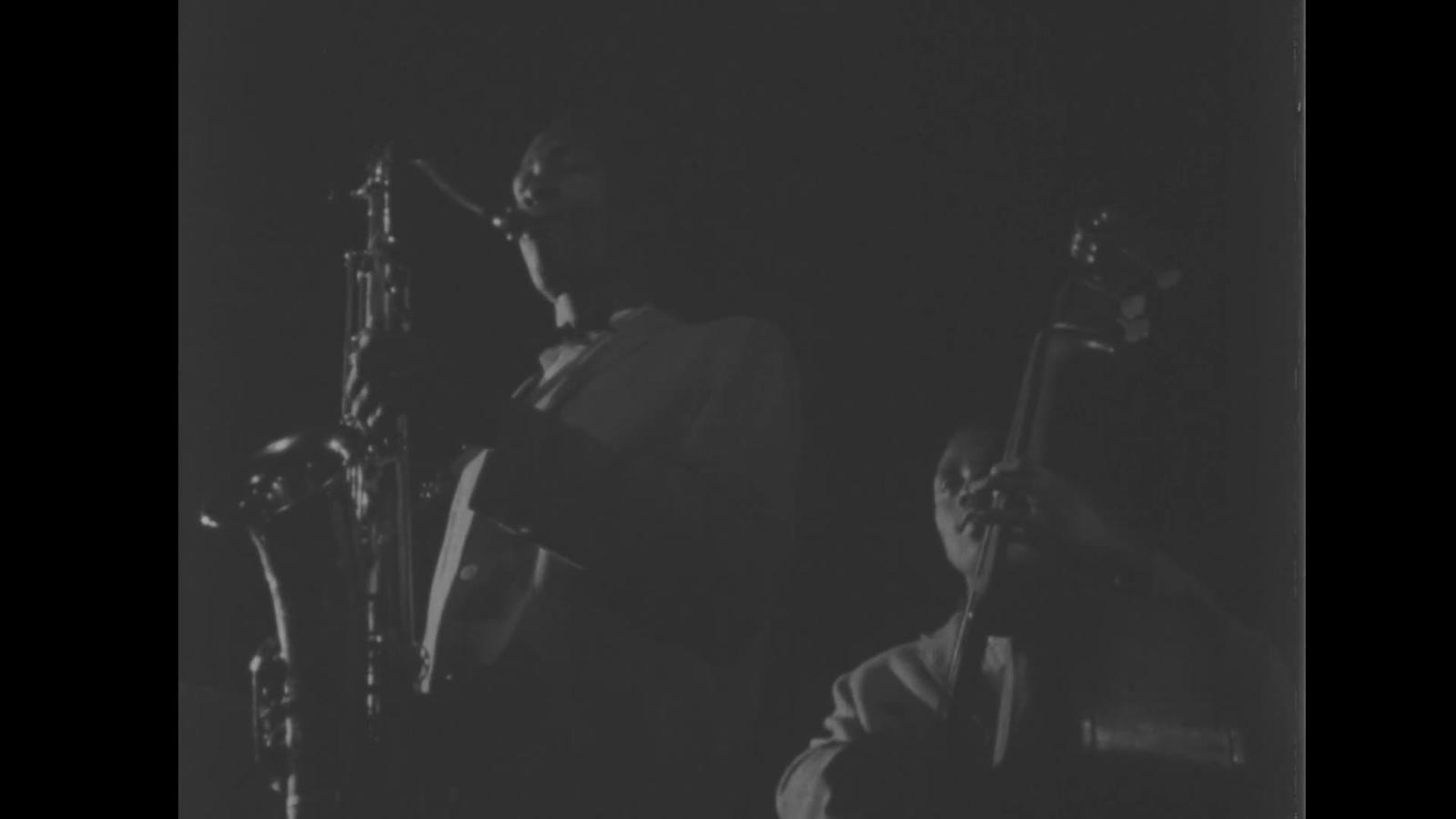
The Library of Congress catalog describes the surviving object as a 34-minute sound film in black-and-white, held in both a 16 mm viewing print and a digital file. The Library's official upload below presents that archival copy; the film was later selected for the National Film Registry.[1][2] The cover image is a frame from the same photographic record, not a modern reconstruction.
First watch: authority moves around the room
In the opening minutes, the camera does not immediately tell us whom to trust. People stand, sit, interrupt, and divide into smaller conversational clusters. The loose blocking resembles the aftermath of a real meeting. Yet once Alex begins defining jazz, the room reorganizes around him. White objections become prompts; Black speakers supply the conceptual vocabulary. The shift is visible before the argument is complete: social space becomes a contest over who may name the music.
The dramatic scenes are often stiff, but the stiffness has a function. These are not psychologically rounded characters moving toward private revelations. They are positions under pressure. Film scholar Chuck Kleinhans describes the work as a didactic exposition assembled from dramatic dialogue, direct address, documentary illustration, music, and essayistic construction. Bland borrows a familiar instructional grammar and changes who possesses the authority.[3]
That reversal is easy to mistake for simple didacticism. Watch the listeners instead. Their glances, folded arms, half-smiles, and interruptions show recognition arriving unevenly. The white members are welcome while jazz remains a shared enthusiasm; they become defensive when appreciation requires an account of power. The film thus distinguishes access from authorship. Being in the room, buying the record, or loving the sound does not by itself confer the right to erase the history embedded in the form.
Second watch: an argument made through cutting
From roughly 4:00 onward, Bland begins leaving the apartment for Black Chicago. A church congregation moves to gospel; a couple dances beside a jukebox; children, workers, streets, and crowded interiors enter the film's vocabulary. Around these passages, the soundtrack and editing make the argument that the scripted dialogue can only state. Sacred and secular movement answer each other across a cut. Repetition becomes social continuity, not merely a technical feature measured in bars.[1][3]
The most important point is that these images are not generic “atmosphere.” They are used as evidence. Bland cuts from the verbal claim that jazz expresses Black life to bodies keeping time in spaces organized by worship, labor, leisure, and restricted opportunity. Cinema allows him to place unlike settings in relation without pretending they are identical. The viewer is asked to perceive a shared rhythmic knowledge crossing the boundaries between church and club.
There is also a danger in that confidence. A montage can reveal a pattern, but it can make the pattern look complete. The camera selects a congregation and a dance floor, then the edit recruits both into one thesis. Individual lives become illustrations of a collective experience they did not get to define on screen. The film fights a history that universalized white experience by asserting the specificity of Black experience; at moments, it answers one flattening system with another.
Third watch: Sun Ra makes the lecture audible
Across the film's long middle, approximately 8:00–22:00, Sun Ra and his Arkestra play successive jazz idioms while Alex explains the relation between constraint and improvisation. The performances matter because they prevent “jazz” from remaining a single, timeless noun. Ensemble, rhythm, and solo line change before the viewer. History becomes audible as transformation.[1][3]
This is early footage of an artist whose later Afrofuturist image can dominate retrospective accounts. Here, Sun Ra's musicians are not decorative proof that the filmmakers had access to a future icon. They are working through the film's musical argument. Bassist Ronnie Boykins, among the players visible in the surviving print, anchors passages in which freedom is never imagined as the absence of structure. Improvisation means movement against and through what repeats.[3]
Bland maps that formal tension onto American history: recurring harmony and meter figure the limits imposed on Black life, while the improvised line figures invention within them. William Sites's study helps clarify the severity of this move. The film does not simply say that social experience influences style. It joins musical form, racial identity, capitalist dehumanization, and the possibility of cultural emancipation inside one theory.[4]
The analogy has real explanatory force. It rejects the fantasy that art floats free of the conditions under which people make it, and it refuses to treat Black innovation as raw material awaiting universal refinement. But analogy is not identity. Musical restraint is chosen, repeated, and made productive inside a performance; racial domination is imposed through law, violence, property, labor, and custom. If the two are made equivalent, the elegance of the musical model can soften the coercion of the history—or make suffering appear necessary for artistic creation.
“Jazz is dead” as a historical hinge
Near the final third, Alex announces that jazz is dead. The claim is deliberately shocking, especially in a film that has spent so much energy establishing jazz as a singular Black achievement. Bland's reasoning is formal and historical: if jazz's creative freedom depends on the fixed limits that oppose it, the form cannot supply an emancipated future. Sites reads this less as a prediction about record sales than as Bland's demand for a break—a modernist Black art no longer bounded by the inherited structure the film calls jazz.[4]
The pronouncement was already unstable in 1959. Ornette Coleman, John Coltrane, Nina Simone, the musicians who would form Chicago's Association for the Advancement of Creative Musicians, and Sun Ra himself were opening futures the film's verdict could not contain. Kleinhans notes the irony: the Arkestra footage that illustrates Bland's supposedly terminal history later helped renew interest in the film, while jazz continued changing around and beyond its categories.[3]
At about 28:00, the film turns from exposition toward rupture. Discordant music intensifies; flames and images of destruction replace the earlier demonstrations. This is not a calm forecast. Editing converts a theoretical limit into sensory crisis. The future cannot be reached by extending the present line; the screen imagines a break. The sequence is a reminder that the film's famous racial declarations emerge from an aesthetic argument about time as much as from the confrontation in the apartment.[1][4]
The insight and the trap
Contemporary reactions exposed exactly this tension. The film's attack on white appropriation and liberal complacency attracted admirers, but its categorical claims about Black and white humanity provoked fierce opposition. The University of Chicago Film Studies Center summarizes a divided afterlife: Ralph Ellison rejected the film, while Amiri Baraka found it illuminating; a New York screening became heated enough to draw police intervention.[6] Those responses cannot be reduced to courageous radicals versus timid moderates. They mark a real disagreement over whether historical oppression creates a uniquely authoritative Black perspective—and whether saying so requires fixed racial essences.
The film is strongest when it treats form as historical evidence. It asks who created a cultural language, under what constraints, and who gets to explain what that language means. It is weakest when the analogy closes: when Blackness, whiteness, jazz, freedom, and restraint become stable blocks with one relation for all time. The very montage that makes a buried social connection visible can make change difficult to imagine.
That contradiction is why The Cry of Jazz deserves an archival spotlight rather than ceremonial praise. It preserves early Sun Ra performances and South Side environments, but its deepest record is an act of intellectual self-authorization. Four novice filmmakers made a work that expected viewers to argue back. They did not ask merely for Black inclusion in existing cultural history; they claimed the power to define the form, diagnose its limits, and declare the next history necessary.
More than six decades later, the apartment still poses the right first question: can a culture be loved while the experience that formed it is ignored? The film's answer—that form carries history—remains indispensable. Its warning arrives less intentionally: once form is made to carry all of history, people can disappear inside the theory. Watching critically means keeping both truths in view.
Sources
- Library of Congress, The Cry of Jazz — official YouTube presentation of the complete archival film.
- Library of Congress Online Catalog, The Cry of Jazz, LCCN 2022602507 — production date, format, holdings, digital-copy record, and National Film Registry status.
- Chuck Kleinhans, “The Cry of Jazz and the expressive politics of music and race: interview with Ed Bland,” Jump Cut 54 (2012) — close analysis, production history, Bland interview, reception, and later significance.
- William Sites, “Beyond the ‘Futureless Future’: Edward O. Bland, Afro-Modernism and The Cry of Jazz,” American Studies 60, no. 1 (2021) — analysis of musical form, racial identity, and Bland's modernism.
- Hannah Edgar, “The controversial 1959 film that could only have been made in Hyde Park,” University of Chicago Magazine — KHTB Productions, financing, neighborhood context, and production history.
- University of Chicago Film Studies Center, “Art & Music: The Cry of Jazz and Chicago Blues” — synopsis, performance context, and contemporary reception.