By the time a history book calls a people extinct, several different endings may have been compressed into one word. A population can be devastated. A government can be destroyed. A language can stop being transmitted. A legal category can disappear from a census. Descendants can be absorbed into other communities. None of those processes is trivial, but neither are they interchangeable.
The Taíno extinction debate begins with a catastrophe that no serious interpretation denies. After Spanish colonization began in 1492, warfare, forced labor, hunger, displacement, and epidemic disease tore through the Indigenous societies of the Greater Antilles. A National Museum of the American Indian guide estimates that by 1540 about 90 percent of the Native population had died.[1] Political orders and ceremonial life were violently disrupted; survivors entered a colonial world increasingly organized around Spanish rule and enslaved African labor.
The dispute is over the last step in the familiar sentence: enormous mortality became extinction. Did that word describe the destruction of autonomous Taíno societies, or did it claim that their people left no continuing history? Archaeology, colonial classification, family memory, a 1919 photograph, and ancient DNA do not all answer the same question. Put together, however, they make literal disappearance untenable. They also show why ancestry alone cannot settle who is Taíno today.
The extinction story counted different losses as one
The strongest case for the traditional extinction account starts at the scale of institutions. The Arawak-speaking communities whom Europeans encountered were not simply a bundle of genes or a list of surviving loanwords. They had settlements, leaders, kin relations, farming systems, ritual objects, exchange networks, and local political identities. Conquest did not leave that world intact under a new flag. It killed people on a massive scale and broke the institutions through which collective life had reproduced itself.[1]
If Taíno is defined narrowly as the sovereign societies of the late fifteenth century, then those societies did end. Later people of mixed Indigenous, African, and European descent did not live outside colonial history, and a surviving practice such as cassava cultivation cannot by itself prove an unbroken ethnic identity. Cultural elements travel between neighbors, change uses, and acquire new meanings. Descent, practice, and political peoplehood overlap, but they are not synonyms.
This reading also explains why many historians once found a terminal date plausible. Spanish records were strongest where the state wanted labor, tribute, conversion, or control. As Indigenous people fled, intermarried, joined new settlements, or were assigned a different racial and legal label, they became harder to see under the category that earlier officials had used. A shrinking entry in an imperial ledger appeared to confirm the social destruction visible everywhere else.
Yet that last inference contains the problem. A category can reach zero because people died. It can also reach zero because officials started counting survivors as something else.
The ledger was not a neutral census
Lynne Guitar, Pedro Ferbel-Azcarate, and Jorge Estevez locate the emergence of the Hispaniolan extinction narrative in the first half of the sixteenth century. They argue that it served several interests: reformers could dramatize the murderous failure of the encomienda labor system, the Crown could obscure incomplete control over resisting communities, and colonists could rationalize replacing Indigenous labor with enslaved Africans.[3] That is an interpretation of the archive, not proof that mortality figures were invented. Its force lies in showing that every colonial count had a purpose.
Classification also changed the object being counted. Intermarriage did not biologically erase a parent or grandparent, but colonial and later national categories often treated mixture as an exit from Indigeneity. A person recoded as Spanish, Black, mixed, peasant, or simply rural could disappear statistically while remaining in the same family and landscape. On this view, the extinction story was partly produced by a rule of recognition: only an unmixed, separately governed population counted as surviving.
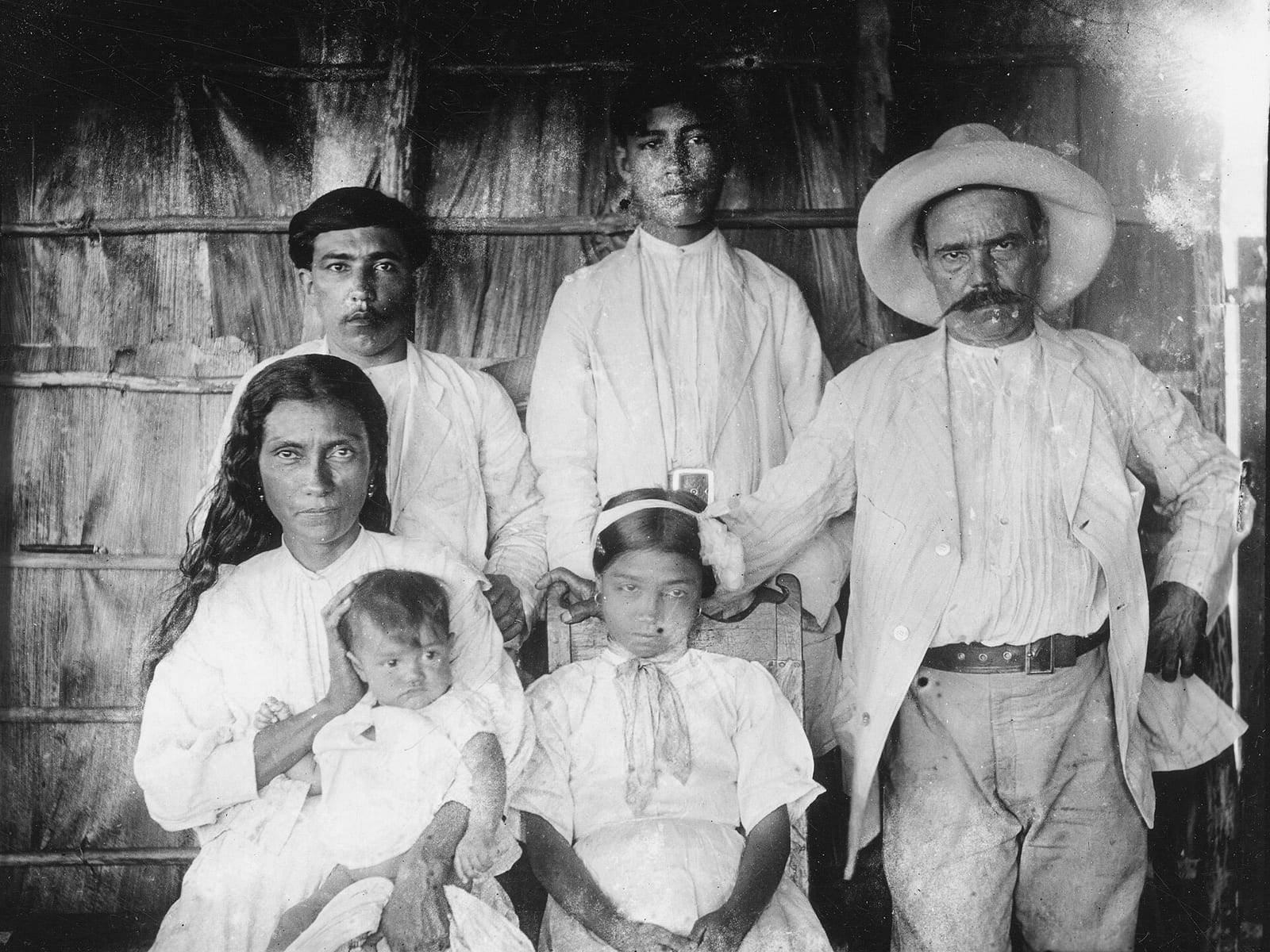
The cover photograph makes that rule visible without resolving every question. In 1919, Smithsonian ethnologist Mark Raymond Harrington photographed the Barrientos family beside a wooden house in Baracoa, eastern Cuba. The museum's description identifies the family as founded by an Indigenous woman and a Spanish former soldier.[7] The picture does not establish an uninterrupted Taíno polity, certify every sitter's identity, or supply a five-century genealogy. It establishes something smaller and stubborn: an institutional collector documented Indigenous descent in a Cuban family nearly four centuries after the supposed ending.
Three archives reopen the history
The first counter-archive is archaeological. Kathleen Deagan's work at En Bas Saline in Haiti examined a Taíno town occupied both before and after European contact. Six years of excavation led her to challenge models of immediate social disintegration: at the household scale, the study found relatively few major changes in traditional social practice during the post-contact occupation and marked resistance to incorporating European material culture.[2] One site cannot stand for the whole Caribbean, and its evidence does not bridge every later century. It does show that conquest and cultural disappearance did not occur in a single synchronized instant.
The second is documentary and ethnographic. Guitar and her coauthors assemble evidence for survival on Hispaniola from historical, linguistic, ethnographic, and archaeological work, while the National Museum of the American Indian points to healing, farming, weaving, pottery, food, and family traditions maintained and altered by survivors.[1][3] This evidence is uneven. A shared technique does not carry a name tag, and oral histories require the same scrutiny as written records. But uneven evidence is not no evidence. The archive becomes more legible once historians stop requiring survivors to remain socially untouched in order to count.
The third archive is genetic, and it answers the narrowest question most decisively. In 2018, Hannes Schroeder and colleagues published a high-coverage genome from a woman who lived in the Bahamas about a thousand years ago. Comparing her genome with 104 present-day Puerto Rican genomes, the team found that Indigenous ancestry components in the modern sample were closely related to the ancient individual. That result demonstrates a line of population continuity across European colonization; it does not identify every Indigenous Caribbean ancestor as culturally Taíno.[4]
A larger study published in 2021 added genome-wide data from 174 ancient people across the Bahamas, Hispaniola, Puerto Rico, Curaçao, and Venezuela. Its models estimated average precontact Indigenous ancestry in present-day populations at about 4 percent in Cuba, 6 percent in the Dominican Republic, and 14 percent in Puerto Rico.[5] Those are population estimates, not identity scores. They differ across islands and individuals, and they record survival through a profoundly unequal history of European settlement and the transatlantic slave trade.
Genomics therefore defeats one proposition and cannot decide another. It defeats the claim that Indigenous Caribbean ancestry vanished completely. It cannot appoint citizens of a contemporary nation, validate a family tradition by percentage, or turn biological descent into political recognition.
The revival debate is not only about proof
From the late 1970s onward, Taíno-identifying groups became increasingly visible in Puerto Rico, the continental United States, and elsewhere in the Caribbean. The movement challenged schoolbook extinction and built communities around heritage, ceremony, language research, environmental work, and public recognition.[1] Its growth changed the historiographical question. Historians were no longer discussing only what happened in the sixteenth century; they were also deciding whose account of survival carried authority in the present.
Critics have raised a serious boundary. Gabriel Haslip-Viera's edited collection describes how Taíno imagery became a symbol of Puerto Rican identity by the end of the nineteenth century and argues that state-sponsored celebration of an Indigenous past could marginalize Black history. In that reading, a romantic three-part national story—Indigenous origin, Spanish culture, African contribution—can honor a safely ancient Taíno while softening the centrality of slavery, anti-Blackness, and living Afro-Caribbean culture.[6]
That critique does not restore literal extinction. It warns that a claim can be historically corrective in one direction and evasive in another. Indigenous survival should not be used to bleach Caribbean history, and mixed descent should not be arranged as a competition in which one ancestry makes another less real. The Barrientos photograph itself refuses that sorting: its historical meaning lies in family formation across a colonial boundary, not in recovering a supposedly pure type.[7]
The revivalist interpretation has an equally strong reply. Requiring a colonized people to show unchanged language, isolated reproduction, continuous state recognition, and perfectly preserved archives sets a standard that conquest was designed to make impossible. Communities can persist through mixture, concealment, relabeling, and later public reorganization. A movement that becomes visible in the twentieth century need not have been invented from nothing in the twentieth century.
Where the evidence leaves the argument
The extinction thesis is strongest when it names destruction: catastrophic death after 1492, the defeat of political autonomy, and the rupture of language and institutions. It is weakest when it turns those losses into a claim that no people, descent, practice, or memory crossed the colonial centuries.
The continuity thesis is strongest when it stays layered. Archaeology documents post-contact persistence at a townsite. Historical and ethnographic work follows families and practices that colonial categories obscured. The 1919 photograph records one such family in the archive. Ancient genomes establish that Indigenous Caribbean ancestry survives in present-day populations. Contemporary communities explain what that inheritance means to them.[2][3][4][5][7]
It is weakest when those layers are made to certify one another automatically. DNA is not a citizenship card. A cassava griddle is not a genealogy. A family story is not beyond verification. Nor is the absence of a colonial label proof of absence.
More community-led archival research could connect named families across parish, land, labor, and census records. More archaeology could test how practices changed at sites occupied deep into the colonial period. Genomic research designed with descendant communities could refine population history without treating human remains or living participants as raw evidence detached from consent. Such work would sharpen the routes of continuity; it would not return the Caribbean to a pre-1492 world.
The most defensible conclusion is therefore asymmetric. Taíno societies suffered a historical catastrophe, but total extinction is too final for the evidence. People survived by changing, and colonial systems often recorded change as disappearance. The task is not to replace a story of extinction with a fantasy of untouched continuity. It is to write the harder history in between: death, survival, mixture, erasure, memory, and resurgence all occupying the same Caribbean past.
Sources
- National Museum of the American Indian, Taíno: Native Heritage and Identity in the Caribbean gallery guide — institutional overview of precontact societies, colonial devastation, surviving practices, and the contemporary heritage movement.
- Kathleen Deagan, “Reconsidering Taíno Social Dynamics after Spanish Conquest: Gender and Class in Culture Contact Studies,” American Antiquity 69, no. 4 (2004) — household-scale archaeology from the pre- and post-contact townsite at En Bas Saline, Haiti.
- Lynne Guitar, Pedro Ferbel-Azcarate, and Jorge Estevez, “Taíno Survival on Hispaniola, Focusing on the Dominican Republic,” in Indigenous Resurgence in the Contemporary Caribbean (2006) — historiographical argument and multidisciplinary survival evidence.
- Hannes Schroeder et al., “Origins and Genetic Legacies of the Caribbean Taino,” Proceedings of the National Academy of Sciences 115, no. 10 (2018) — ancient Lucayan genome and comparison with present-day Puerto Rican Indigenous ancestry.
- Daniel M. Fernandes et al., “A Genetic History of the Pre-contact Caribbean,” Nature 590 (2021) — genome-wide study of 174 newly reported ancient individuals and estimates of Indigenous ancestry in present-day Caribbean populations.
- Gabriel Haslip-Viera, ed., Taíno Revival: Critical Perspectives on Puerto Rican Identity and Cultural Politics. Markus Wiener Publishers — publisher record summarizing debates over revival, nationalism, racial mixture, and the marginalization of Black history.
- Wikimedia Commons, “1919 The Barrientos family” — source page for Mark Raymond Harrington's archival family photograph from Baracoa, Cuba, with Smithsonian provenance and image metadata.