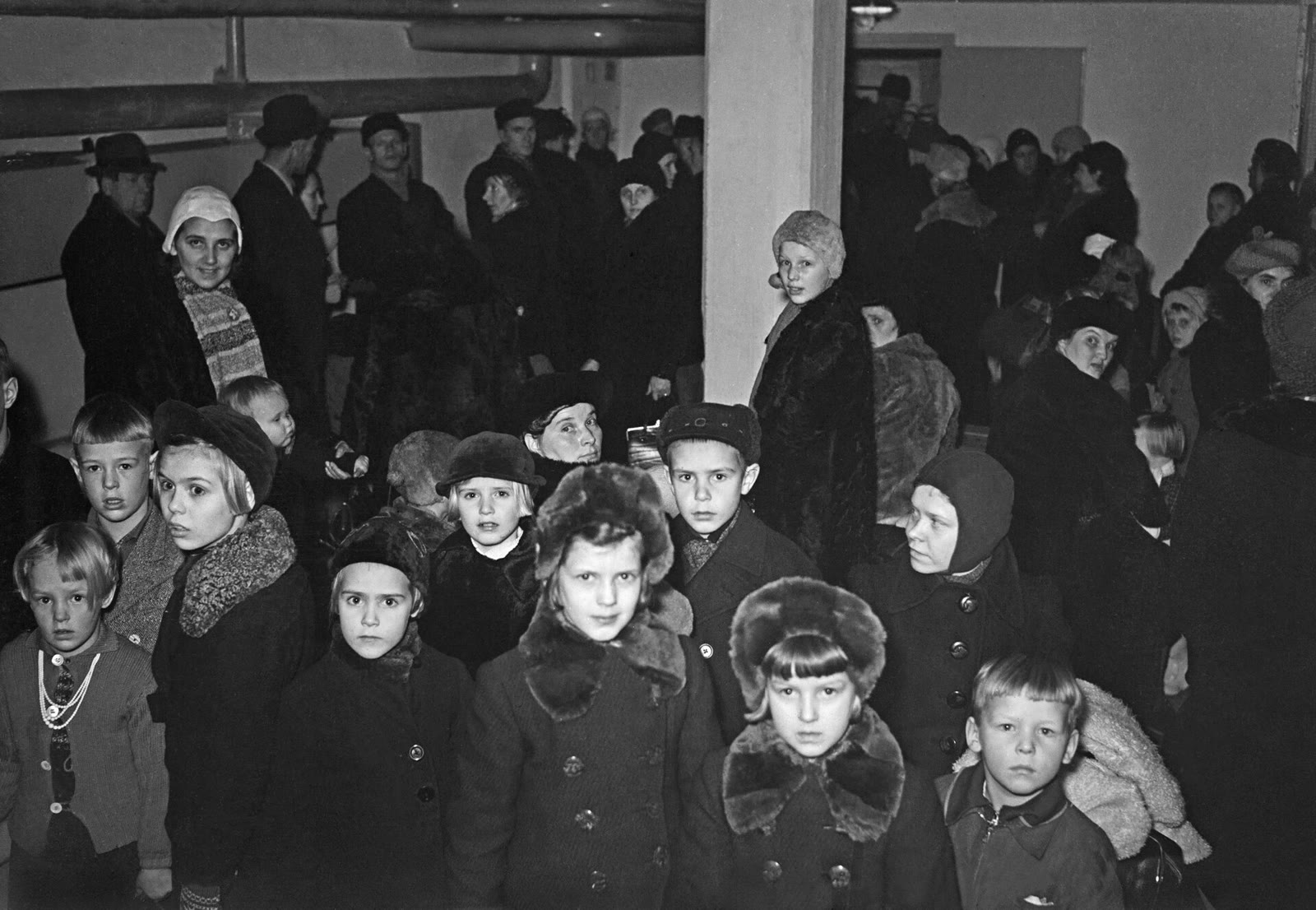
In archival photographs, the departures can look almost interchangeable: children in winter coats, adults massed behind them, a station somewhere beyond the frame. In Britain on 1 September 1939, school groups began leaving cities expected to be bombed. In Helsinki on 30 December 1939, children gathered for travel to neutral Sweden as Finland fought the first month of the Winter War.[1][8]
The resemblance is real. Both movements depended on labels, timetables, volunteer labor, private homes, and parents accepting an indefinite separation. But the administrative logic beneath the platform scene was different. Britain tried to move a child's school world out of danger. Finland's largest transports to Sweden moved the child into a new family world across a national and linguistic border.
That distinction did not make one humane and the other cruel. It tells us what each evacuation system tried to keep intact—and what each made newly fragile.
Britain made the school portable
Britain planned first by geography. The 1939 Government Evacuation Scheme divided the country into areas to be emptied, areas to receive people, and places expected to remain neutral.[3] Its priority list put schoolchildren first, to travel in organized units under their teachers. Preschool children formed a different category because they were to go with their mothers or another caregiver.[1]
The school was therefore more than a convenient place to count children. It supplied the assembly point, the adult escorts, the peer group, and at least the possibility of continuing lessons after arrival. A child might sleep in a stranger's house, but the state aimed to send teacher and classmates along as pieces of familiar civic life.
London's first operation shows how thoroughly that premise shaped the machinery. The evacuation order reached County Hall at 11:07 a.m. on 31 August 1939. The next morning, parties moved through 1,589 assembly points, 168 departure stations, 11 rail exchange stations, and 271 receiving stations. The London County Council's later study reported more than 600,000 people moved without casualty; nationally, about 1.5 million evacuees reached reception areas over three days.[1][2]
Those numbers can make the event sound like frictionless transport. It was not. Only about half the people for whom London had planned actually used the official provision. Later movements stalled when receiving authorities could not or would not find enough billets for children seeking to rejoin their own school parties.[2] The difficulty is revealing: administrators treated keeping a school together as valuable even when that requirement complicated placement.
The 1939 operation was voluntary. Parents could refuse, and they could reverse the decision. When the expected bombing did not arrive during the first months of the “Phoney War,” many children went home; a Royal Voluntary Service archival summary says that roughly four in five of the first wave had returned by January 1940. Evacuation resumed as invasion and air attack became immediate threats in 1940. A limited compulsory order followed in the winter of 1940–41, although the same summary records only about 400 children moved under it during 1941.[3] The main system's dependence on family consent preserved parental authority, but it also allowed perceived calm to pull children back toward the danger from which policy had removed them.
Finland moved care across the border
Finland's child transports began from a different map of danger. Soviet forces invaded on 30 November 1939. The photograph above was made exactly one month later as children left for Sweden.[8] The first Winter War transfers were followed by much larger movements during the Continuation War. Swedish archival records place the overall number of Finnish children sent abroad during the war years and their aftermath at roughly 70,000, most of them to Sweden.[4]
Here the key administrative unit was less often an intact class than an individual child selected from a family under strain. Finnish guidance issued in 1941 prioritized circumstances such as displacement from territory ceded to the Soviet Union, a father wounded or killed in war, or a home destroyed by bombing. A major research cohort describes approximately 49,000 children aged one to ten sent to Swedish foster families between 1941 and 1945; that narrower figure and the Swedish archive's broader total count different parts of the movement.[4][6]
The routes themselves announced the larger transfer. Children crossed by ship and air and, when those routes became dangerous, by rail through Haparanda. Most entered the homes of people they had never met.[4] Sweden drew on an established foster-care tradition, but the Finnish arrivals more than doubled the country's foster-home population during the period. Linköping University's research overview places this mobilization of authorities and willing households against Sweden's neutrality policy; it was organized generosity, not a borderless or politically empty rescue.[5]
Britain also used host households, and Finland also used institutions such as children's homes and hospitals. The contrast is one of dominant design, not two sealed categories. Yet a Finnish child placed alone or with a sibling in a Swedish-speaking family depended on that household for much more of the replacement world: language, daily discipline, affection, schooling, and the meaning of home itself.
A billet and a foster home performed different work
Both governments solved a public emergency by asking private households to absorb it. That act could open warmth, security, food, and relationships. It could also expose children to humiliation, neglect, or homesickness. The Royal Voluntary Service summary records parents' worry about sending children to strangers and describes unhappy children and mothers during the first months in reception areas.[3]
Still, the British billet was meant to sit beside the evacuated school. The Finnish foster home more often became the child's central institution. That is an inference from the two systems' structures, not a claim that every child lived the model perfectly. It helps explain why the same visible act—handing a child to strangers—could produce different problems when the emergency ended.
In Britain, proximity and voluntariness made return relatively easy, sometimes dangerously so. Children could be collected during the lull, and many later evacuation stays ended with travel back within the same national public system. Even then, officials planned a staged reverse movement beginning in 1944; for under-fives returning from residential war nurseries, they also proposed talks to help parents and children adjust to ordinary home life again.[3]
For many Finnish children, homecoming reversed a deeper transfer. They left Swedish caregivers to whom they had become attached, returned to parents marked by war, and sometimes had to recover Finnish after living through formative years in Swedish. A study of postwar advice and children's literature calls this a double rupture: first from biological parents, then from foster parents. Its evidence includes a 1947 novel used to help families think through reunion and a 1948 aftercare committee created for children returning from Sweden.[7]
Not everyone returned. The Swedish National Archives estimates that about 7,000 children remained in Sweden. A study of postwar reunification says that up to 15,000 did not return to Finland, a broader total that also includes children sent elsewhere in Scandinavia.[4][7] The figures establish a range, not a single settled count; both make clear that temporary evacuation became permanent separation for a substantial minority.
Safety had a social architecture
It is tempting to score the schemes by the dangers children escaped or by the pain separation caused. The historical record resists that tidy verdict. A large sibling-comparison study of Finnish evacuees found no overall increase in adult psychiatric hospitalization across men and women combined, but it did identify different patterns by sex, including a higher risk of hospitalization for mood disorder among evacuated women. Hospital records do not measure every kind of loss or resilience, and the authors do not turn the result into a universal judgment on evacuation.[6]
The more useful comparison is architectural. Britain tried to conserve school continuity while accepting discontinuity in household life. Finland and Sweden tried to conserve physical safety and material care through a new household, while accepting a much larger break in family and nation and, for many children, language. Britain's model could be undone quickly by parents because danger seemed distant. Finland's could become difficult to undo because safety had grown intimate.
A railway label identified where a child should go. It could not specify which relationships should survive the journey. That was the hidden policy choice: not simply whether to evacuate, but whether the portable unit of childhood would be the class, the family, or the child alone.
Sources
- The National Archives, “Government evacuation scheme” — Ministry of Health memorandum, 1939, catalogue reference ED 138/48, with transcript and operational context.
- The National Archives, “The evacuation of September 1939” — London County Council's 1940 study, catalogue reference ED 138/49.
- Royal Voluntary Service Archive & Heritage Collection, Summary of Government Evacuation Scheme, 1938–1944 (1973) — reception, the Phoney War return, later evacuation waves, and postwar readjustment.
- Riksarkivet, “Finska krigsbarn” — Swedish archival overview of the Finnish child transports, routes, foster families, and children who remained in Sweden.
- Linköping University, “New homes in Sweden” — research overview of Finnish child evacuation, foster-home mobilization, Swedish authorities, and neutrality politics.
- Torsten Santavirta, Nina Santavirta, Theresa S. Betancourt, and Stephen E. Gilman, “Long term mental health outcomes of Finnish children evacuated to Swedish families during the second world war and their non-evacuated siblings: cohort study.” BMJ 350 (2015) — University of Helsinki research record.
- Antti Malinen, Tuomas Laine-Frigren, and Mervi Kaarninen, “Rebuilding emotional ties for child evacuees returning from abroad.” History of Education 51, no. 4 (2022) — Tampere University research record and open-access manuscript.
- Hugo Sundström, “Finnish Children to Sweden,” 30 December 1939 — archival press photograph from the Finnish Heritage Agency's JOKA Press Photo Archive, reproduced via Wikimedia Commons.