The Cod Wars are easy to turn into a comic miniature: tiny Iceland, no standing army, facing down British trawlers and Royal Navy frigates over fish. That version is memorable, but it hides the mechanism. Iceland did not beat Britain by winning a naval contest in the conventional sense. It won by making the old fishing order increasingly expensive to enforce, increasingly awkward inside NATO, and increasingly out of step with where international maritime law was already going.[1][3][4]
The dispute unfolded in steps rather than one leap. Iceland moved its fishery limit to 4 nautical miles in 1952, then to 12 in 1958, 50 in 1972, and 200 in 1975.[1][3] Each extension produced protest from distant-water fishing states, especially Britain, because British vessels had long worked the rich grounds around Iceland.[1][3] But each round also shifted the baseline. What looked extreme at first could look normal a few years later once fish stocks, coastal-state claims, and Law of the Sea negotiations moved in the same direction.[2][3][4]
The first mechanism was dependence
Iceland's bargaining power began with vulnerability. Fish was not a marginal sector that Reykjavik could trade away for diplomatic calm. Government and FAO accounts both frame Iceland's twentieth-century fisheries policy as a long campaign to secure control over the waters on which the national economy depended.[1][3] In the third round, contemporary and later analyses often describe fish and fish products as the center of Iceland's export economy, which meant that losing access near home was not simply a commercial setback. It threatened the country's core earning system.[4]
That asymmetry mattered because Britain cared deeply about its distant-water fleet, especially ports such as Hull and Grimsby, but the dispute was not existential for Britain as a state.[4][5] This did not make British resistance weak. It made British escalation politically awkward. Sending frigates could protect trawlers for a time, but it also made a large NATO power look as if it were using warships to preserve access to another small member's coastal fish.[4] Iceland could absorb more diplomatic strain because the issue sounded like survival at home.
The second mechanism was enforcement cost
The image of the Cod Wars as "war" can mislead because the decisive weapon was not a missile, shell, or blockade. It was enforcement friction. Britain could contest Iceland's claims legally and deploy naval protection, but British trawlers still had to fish in a moving, hostile, closely watched work zone.[2][4][5]
The Icelandic Coast Guard's most important tactical move was the trawlwire cutter. FAO's reconstruction notes that the successive fishery extensions forced the Coast Guard into repeated confrontations, including hazardous maneuvers and collisions with trawlers and frigates.[3] Later operational accounts explain why the cutter mattered: an Icelandic patrol vessel could cross behind a trawler and cut the wires connecting the vessel to its gear.[4][5] The loss was not symbolic. A trawler without gear lost time, catch, and money. It had to withdraw or refit before the day's work could resume.[4][5]
That changed the contest from "can Britain protect a fleet?" to "can Britain make fishing predictable enough to be worth continuing?" The Royal Navy could be present and still fail to remove the operating cost. A frigate could deter boarding, but it could not easily make every trawl safe from a small patrol craft operating near its own coast. Iceland did not need command of the sea. It needed enough denial capacity to make normal commercial fishing abnormal.[4]
The third mechanism was legal drift
In 1974, the International Court of Justice gave Britain an important legal result in the 50-mile dispute. The Court held that Iceland's unilateral 50-mile exclusive fishery regulations were not opposable to the United Kingdom and that Iceland could not simply exclude British vessels from the disputed zone; it also said the parties had duties to negotiate in good faith.[2] On paper, that looked like a British win.
But the judgment did not freeze the politics. It also acknowledged the need to account for conservation and Iceland's special dependence on fisheries.[2] More importantly, the wider legal environment was moving. FAO places Iceland's fishery-limit campaign inside the broader process that led to the 1982 United Nations Convention on the Law of the Sea, where the 200-mile exclusive economic zone became the standard legal architecture for coastal-state resource control.[3] By the time Iceland declared a 200-mile zone in 1975, it was not merely inventing a rule from nowhere. It was pushing early, aggressively, and unilaterally toward a rule that more states were beginning to treat as the future.[3][4]
This is why the Cod Wars are better understood as a transition fight than as a simple bilateral quarrel. Britain was resisting not only Iceland's immediate patrol line, but the precedent that other coastal states might follow.[2][3] Iceland, meanwhile, could frame the same move as anti-imperial, conservationist, and economically necessary. The legal center of gravity was slipping away from the older distant-water assumption that open access near another country's coast was normal.[1][3][4]
The fourth mechanism was alliance leverage
The final pressure point was NATO. Iceland's location in the North Atlantic made it strategically valuable during the Cold War, especially because of the Keflavik base and the air-sea monitoring routes between Greenland, Iceland, and the United Kingdom.[4] That did not mean Iceland could dictate terms on every issue. It did mean that a fishery dispute between two NATO members could become an alliance problem if Reykjavik threatened to close the base, weaken cooperation, or rupture diplomatic relations.[4]
The third Cod War pushed that leverage hardest. Britain sent naval protection back into the contested waters after the 200-mile declaration. Iceland escalated diplomatically, and in February 1976 it broke relations with Britain.[4] Guardian archive coverage from January 1976 catches the tense middle of the dispute: British skippers were angry, the Navy had been withdrawn at points, Icelandic gunboats were watching the trawlers, and British negotiators were already discussing sharply reduced catch figures inside the 200-mile zone.[5]
That is the alliance mechanism in miniature. Britain could keep insisting on fishing access, but each day of confrontation raised costs beyond fisheries. NATO did not want a small member's North Atlantic cooperation endangered over cod. Iceland could not sink the Royal Navy; it could make the Royal Navy's presence politically counterproductive.[4][5]
Why concession became cheaper than patrol
By June 1976, Britain accepted Iceland's 200-mile limit, ending the Cod Wars.[1][3][4] The settlement did not mean every Icelandic claim had always been legally unanswerable or every British grievance had been invented. It meant the balance of cost had changed.
Four mechanisms had converged. Iceland's dependence made compromise politically hard at home. Trawlwire cutting and close patrols made British fishing inside the contested zone costly and unstable. International law was moving toward coastal-state resource jurisdiction rather than away from it. NATO gave Iceland a strategic lever far larger than its patrol fleet.[1][2][3][4][5]
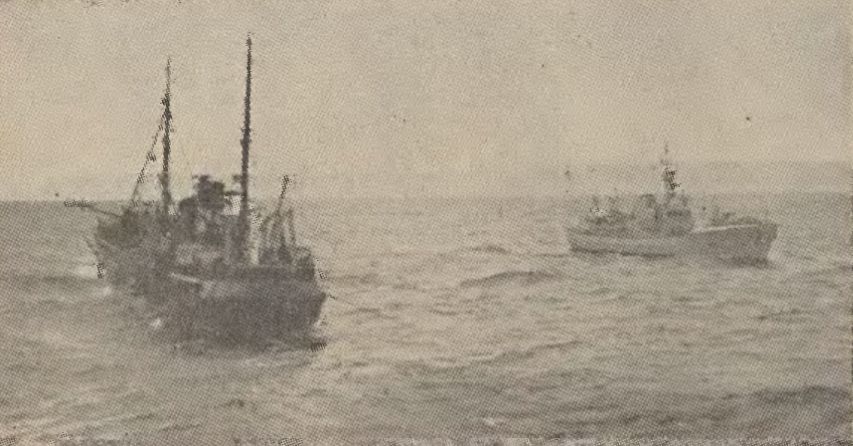
The 1958 photograph used here is useful because it resists the legend. Coventry City and Albert do not look like actors in a grand sea battle. They look like working vessels in close quarters, which is exactly where the dispute was decided.[6] The Cod Wars turned sovereignty into a practical question: who could make a line on the water matter every day, in bad weather, near nets, under cameras, and inside alliance politics?
The answer was not that Iceland had more force. It had a better fit between national need, law in motion, patrol tactics, and diplomatic leverage. Britain could win arguments, escort trawlers, and complain about unilateralism. Iceland made the old arrangement harder to operate than the new one was to accept.
Sources
- Government of Iceland, "History of fisheries" (official overview of Icelandic fisheries development, postwar foreign fishing, and fishery-limit extensions).
- International Court of Justice, Fisheries Jurisdiction (United Kingdom v. Iceland), case page and 1974 merits summary on the 50-nautical-mile dispute.
- FAO, Case Study of the Icelandic Integrated System for Monitoring, Control and Surveillance, Fisheries and Aquaculture Circular No. 1053 (2011), especially the history of Icelandic fishery-limit extensions.
- Lieutenant Commander Michael Junge, "The Cod Wars and Lessons for Maritime Counterinsurgency," U.S. Naval Institute Proceedings (February 2023), on asymmetry, NATO leverage, trawlwire cutters, and naval limits.
- Richard Norton-Taylor and Patrick Keatley, "Cod war tensions with Iceland - archive, 1976," The Guardian (archive article republished January 29, 2020).
- Wikimedia Commons, "File:CoventryAlbertWestfj.png" (1958 public-domain photograph of British trawler Coventry City and Icelandic patrol vessel Albert during the first Cod War; image source for cover).