Executive Order 10924 is easy to misremember as a ceremonial birth certificate. President John F. Kennedy signs; the Peace Corps appears; youthful idealism goes abroad. The document is more interesting than that. Read closely, it shows a president building a temporary machine that could start before Congress finished deciding whether it should exist permanently.[1][2]
That is why the order matters as administrative history, not just Kennedy memory. It did not create an independent agency with a complete statutory base. It placed a Peace Corps inside the Department of State, headed by a director, financed through funds already available under the Mutual Security Act, and tied to existing economic-assistance programs.[1] The genius and the risk sat in that modesty. The program could move quickly because it was legally narrow.
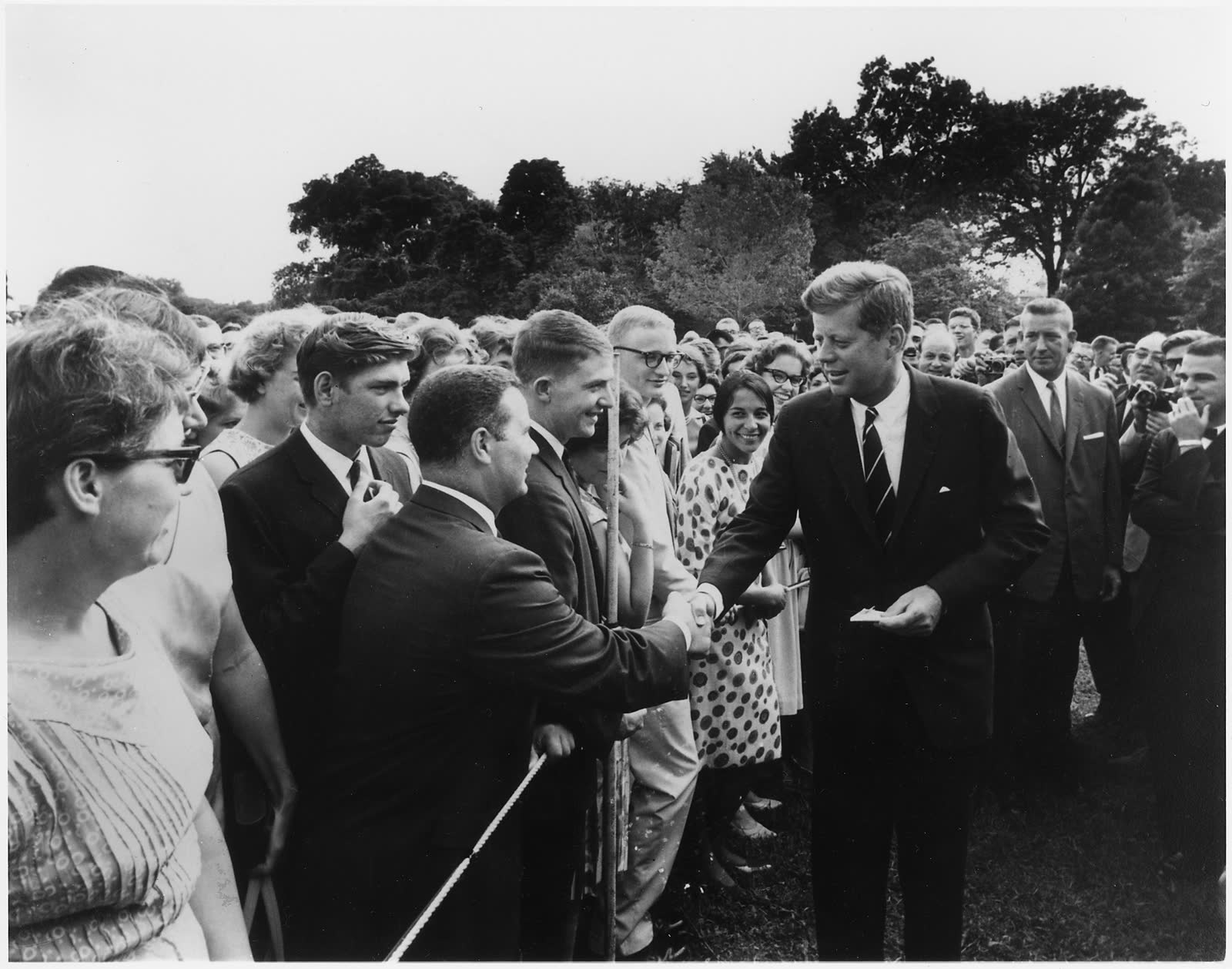
Image context: the cover uses a real National Archives/JFK Library photograph of Kennedy greeting Peace Corps volunteers on the White House South Lawn.[6] It is not a signing-ceremony image, and that makes it useful. The article is about the short distance between temporary paper authority in March 1961 and visible people in the field later that year. The photograph shows the pilot becoming human infrastructure.
The first sentence is a workaround
The order begins with authority, not aspiration. Kennedy grounded the action in the Mutual Security Act of 1954 and in the presidency.[1] That opening does a great deal of work. It tells the reader that the Peace Corps is being launched through the foreign-aid machinery already available to the executive branch, not through a brand-new act passed in advance by Congress.
The National Archives' contextual note makes the sequence plain: Kennedy signed the order on March 1, 1961, and Congress formally authorized the Peace Corps on September 22 of the same year.[1] The State Department's Foreign Relations of the United States editorial note uses the same hinge more explicitly, describing the March order as creating a temporary pilot basis and the September act as the later legal authority under which the Peace Corps began operating.[3]
That six-and-a-half-month gap is the whole story. Kennedy was not merely announcing a preference. He was using existing law to create an operating test. In his public statement the same day, he said he had signed an order for a temporary pilot and was also sending Congress a message proposing a permanent corps.[2] The two moves belonged together: begin now, legislate next.
This was not accidental haste. The State Department note records Kennedy's argument that the temporary corps would generate information and experience for designing the permanent organization, while making it possible to begin training in summer 1961 and place volunteers overseas by late fall.[3] The order therefore treated action as evidence. It made the pilot program a political and administrative experiment whose results would arrive before Congress had finished building the permanent frame.
Section 1 keeps the agency contained
Section 1 is short. It instructs the Secretary of State to establish an agency in the Department of State, known as the Peace Corps, and says it will be headed by a director.[1] The restraint is the point. The document does not imagine the Peace Corps first as a free-standing moral emblem. It locates it inside an existing cabinet department.
That placement mattered because the Peace Corps was both close to and anxious about foreign policy. Kennedy's signing statement insisted that the program was not designed as diplomacy, propaganda, or ideological conflict.[2] Yet the order embedded it in the department responsible for foreign relations. The tension was structural from the beginning: the corps was supposed to serve host-country needs and human development, but it was born from Cold War-era foreign-aid authority and State Department delegation.[1][2][3]
The containment also solved a startup problem. A new independent agency would need statutory detail, appropriations, personnel rules, and congressional patience. A State Department agency could borrow administrative gravity while the idea proved itself. That is why the early Peace Corps should be read as a pilot inside a host institution, not as a finished institution that merely waited for volunteers.
Section 2 defines service as trained labor, not charity abroad
Section 2 gives the Peace Corps responsibility for training and overseas service by American men and women in new assistance programs and in connection with existing U.S., U.N., and international programs.[1] The keyword is training. The order was not authorizing travel, goodwill tours, or volunteer sentiment as such. It was authorizing a pipeline: recruit, train, place, and connect service to practical development work.
Kennedy's signing statement sharpened that boundary. He framed the corps as a pool of trained Americans who could help foreign countries meet urgent needs for skilled manpower, and he emphasized that Americans would be sent only where wanted by host countries and where they had real jobs to do.[2] That claim did two things at once. It promised usefulness abroad, and it guarded against the suspicion that the program was simply a soft-power export wrapped in idealism.
The State Department note shows the same practical language in the March 1 message to Congress. Kennedy argued that Peace Corps members would supplement technical advisers by providing skills needed at a working level, under host-government development plans.[3] The pilot therefore rested on a distinction between advice and labor. Technical advisers could recommend projects; volunteers were supposed to help make those projects usable on the ground.
That is a more demanding idea than the public slogan suggests. It made recruitment only the first problem. The harder problem was matching skills, language, training, local demand, safety, and diplomatic compatibility. The order could not solve all of that. It created the legal channel through which Shriver and the new staff could try.
Section 3 reveals how speed was purchased
Section 3 is the least romantic part of the order and one of the most revealing. It directed the Secretary of State to finance the Peace Corps using funds available for functions under the Mutual Security Act.[1] In other words, the pilot did not wait for a clean new funding stream.
The State Department note records Kennedy's explanation to Congress: the initial expenses would come from appropriations already available for the foreign-aid program.[3] That decision bought speed. It also made the pilot politically legible as part of an existing foreign-assistance architecture rather than a sudden independent spending claim.
The tradeoff was that temporary financing could not give the program durable autonomy. The National Archives note says permanence and eventual autonomy required congressional approval and funding.[1] The September Peace Corps Act supplied that next layer. The Statutes at Large text of Public Law 87-293 made the program's peace-and-friendship purpose statutory rather than provisional.[4]
The March order and the September act should therefore be read as a two-step founding. The order created movement. The act created legal staying power. Without the order, the Peace Corps might have remained a proposal waiting on process. Without the act, it would have remained dependent on borrowed authority and vulnerable to the limits of a temporary workaround.[1][3][4]
The pilot forced a permanent answer
By May 30, Kennedy had transmitted proposed legislation to congressional leaders, and the State Department note records concrete targets: 500 to 1,000 volunteers abroad by the end of 1961 and 2,700 abroad or in training by June 1962.[3] Those numbers were not decorative. They turned the Peace Corps from an idea into a capacity question. How many people could be selected? How fast could they be trained? Which countries would request them? What would Congress authorize once the pilot was already underway?
The National Archives account says that by September, because of the executive order and Sargent Shriver's leadership, volunteers were already in the field.[1] That sequence changed the politics of authorization. Congress was no longer voting on a pure abstraction. It was voting on whether to make permanent a program whose recruitment, training, country negotiations, and public image had already begun.
There is a lesson here about state-building. Institutions often look inevitable after they acquire anniversaries, alumni, buildings, and official histories. Executive Order 10924 shows the uncertain first version. The Peace Corps started as a bounded administrative improvisation: a director, a department home, delegated foreign-aid functions, available funds, and a temporary claim that operating experience would inform permanent design.[1][3]
The enrolled-act record preserved by the National Archives describes the September statute as establishing a Peace Corps to help interested countries and areas meet needs for skilled manpower.[5] That durable statutory language can make the outcome feel inevitable. The original order did not guarantee it. It created a disciplined opening.
That is the strongest close reading of the document. Executive Order 10924 made the Peace Corps real by refusing to pretend it was already complete. It began inside State, under borrowed authority, with borrowed money, and with a public argument that training, host-country demand, and working-level service could justify permanence. The Peace Corps became an institution because the pilot was designed to make delay costly: by the time Congress acted, the idea already had people, plans, and motion.
Sources
- National Archives, "Executive Order 10924: Establishment of the Peace Corps. (1961)" - document image, transcript, citation, and contextual note on the March 1 order and September 22 authorization.
- The American Presidency Project, "Statement by the President Upon Signing Order Establishing the Peace Corps" (March 1, 1961) - Kennedy's public explanation of the temporary pilot and proposed permanent Peace Corps.
- Office of the Historian, Foreign Relations of the United States, 1961-1963, Volume XXV, Document 70 - editorial note on Executive Order 10924, delegation, congressional message, targets, and transition to the Peace Corps Act.
- GovInfo, "Public Law 87-293 - Peace Corps Act" (September 22, 1961), Statutes at Large PDF - statutory text authorizing the Peace Corps.
- DocsTeach/National Archives, "Act of September 22, 1961 (Peace Corps Act), Public Law 87-293, 75 STAT 612" - enrolled-act record and archival citation.
- Wikimedia Commons, "File:President greets Peace Corps Volunteers. White House, South Lawn. - NARA - 194180.jpg" - archival Abbie Rowe photograph from the John F. Kennedy Library/National Archives holdings used as the article image.