The Antiquities Act of 1906 is often remembered by its afterlife: Grand Canyon, Chaco Canyon, Muir Woods, Acadia, and the long American argument over how much land a president can reserve without waiting for a new act of Congress. But the statute itself is small, almost compressed. Its power comes from a few carefully placed nouns: "objects," "lands," "permits," "museums," and the famous limiting phrase "smallest area compatible." Read closely, the law did not begin as a national-park shortcut. It began as a way to stop looting, keep evidence public, and let the executive move fast when a protected object would otherwise be damaged before Congress finished debating it.[1][2]
The timeline matters. In the late nineteenth century, archaeologists, museum collectors, tourists, traders, and federal land managers were all encountering - and often removing - objects from ancestral sites across the public domain. National Park Service historian Ronald Lee traced the legislative campaign to organized preservation efforts beginning around 1899, when scientific societies began pushing for federal protection of "objects of archaeological interest" on federal lands.[3] Congress passed the act on June 8, 1906. Theodore Roosevelt signed it that day. On September 24, 1906, he issued Proclamation 658, setting aside Devils Tower in Wyoming as the first national monument.[4]
That sequence - June statute, September proclamation - shows why the act's language was operational rather than ornamental. It did not create an agency, a park service, or a long planning process. The National Park Service would not exist until 1916. In 1906, the tool was a legal switch: if the object was federally owned or controlled, and if it was historic, prehistoric, or scientific, the president could proclaim it a national monument and reserve the land needed to care for it.[1][2]
The object comes before the landscape
The central clause authorizes the president to declare "historic landmarks, historic and prehistoric structures, and other objects of historic or scientific interest" to be national monuments.[1] The phrasing is broader than an archaeology bill alone would have been, but narrower than a general scenic-preservation statute. The protected thing has to be named as an object of interest before the surrounding land comes in.
This is why Devils Tower was such a revealing first test. Roosevelt's proclamation did not argue for a recreational park, a scenic drive, or a regional landscape. It called the tower a "lofty and isolated rock" and then made the statutory move: it was an "object of historic and great scientific interest."[4] The proclamation's logic is almost syllogistic. The act protects qualifying objects. Devils Tower is such an object. Therefore the president may reserve the land needed to protect it.
The object-first structure did two things at once. It helped the act pass as a preservation measure with a recognizable target: ruins, structures, landmarks, specimens, evidence. But it also left room for natural features to enter through scientific interest. NPS's later account notes that the act became the first general federal law protecting cultural and natural resources of historic or scientific interest on federal lands.[2] That was not an accident of later presidents stretching a tiny loophole beyond recognition. The early legislative drafts had already connected prehistoric works with "natural formation[s] of scientific or scenic value," and Lee identified that connection as an early bridge between historic and natural-area preservation.[3]
"Smallest area compatible" is a limit, not a measuring tape
The act's most litigated-sounding phrase is its land rule: reserved parcels must be confined to the "smallest area compatible" with proper care and management of the protected objects.[1] The phrase matters because it is both a constraint and a grant of judgment. It does not say "smallest possible acreage." It asks what area is compatible with care and management.
Roosevelt's Devils Tower proclamation makes that distinction visible. The proclamation does not protect only the tower's stone column. It gives township-and-section descriptions for surrounding federal land, then warns unauthorized persons not to injure or destroy any feature of the tower or settle on the reserved lands.[4] In other words, the protected object required a management envelope. The law's limit was not a surveyor's circle drawn at the base of the rock. It was a practical boundary around the object, access, injury prevention, and federal control.
That boundary language explains the act's durability. The "smallest area" phrase reassured Congress that a president was not being handed unlimited park-making power. The "compatible" phrase made the protection usable. A cliff dwelling, fossil bed, battlefield feature, cave mouth, giant tree grove, or volcanic formation can be ruined by actions beyond the exact footprint of the visible object. The legal question built into the act is therefore not whether there is surrounding land, but whether the surrounding land is necessary to care for the thing identified.[1][4]
The permit system reveals the original emergency
The monument clause became famous, but the act is also a permit law. It required permission from federal land managers for archaeological investigation and removal of objects; it created penalties for unauthorized excavation and removal; and it required excavated materials to be permanently preserved in public museums.[2] Those provisions tell us what Congress thought the immediate emergency was: not merely scenery lost to development, but evidence removed from context and transferred into private hands.
That point changes the way the monument power should be read. The act was not only a scenic-preservation statute wearing archaeological clothing. It was a custody regime. Objects on federal land were not to be treated as free raw material for collectors. If scientific institutions excavated, they needed permission. If material came out of the ground, it was supposed to remain in public educational custody.[2]
The presidential proclamation power sits inside that same custody logic. A site could not always wait for a bespoke statute, especially when looting or casual damage was already underway. The act's speed was part of its preservation design. By June 1906, Congress had supplied a general rule; by September, Roosevelt could apply it to a specific object without starting over.[1][4]
A short law with a long institutional shadow
The act's institutional afterlife was larger than its text. NPS notes that presidents have used Antiquities Act authority nearly 300 times since 1906, and that major park units including Grand Canyon and Acadia began, at least in part, as monuments.[2] Lee's later proclamation history counted 87 national monuments created under the act between 1906 and 1970, with Devils Tower listed first among the scientific areas.[5]
That growth should not make the original text look accidental. The statute's architecture invited expansion because it solved four separate problems in one compact instrument. It defined protectable things broadly enough to include archaeological, historical, and scientific objects. It attached land only through a management-necessity test. It disciplined excavation through permits and public curation. And it let the president move by proclamation when delay itself could be destructive.[1][2]
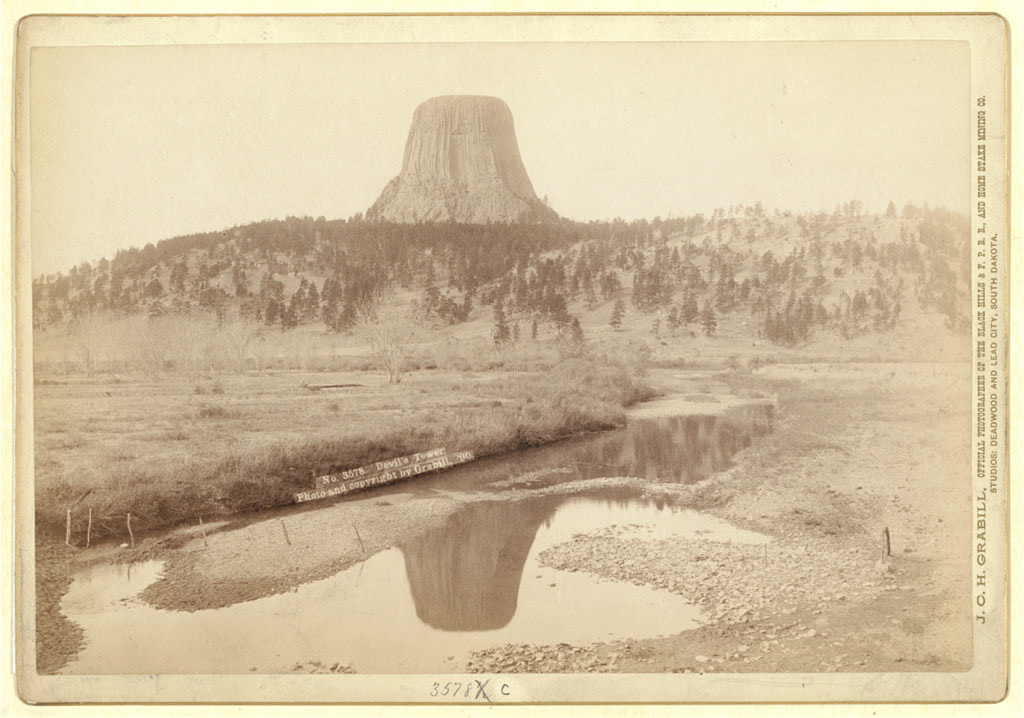
Devils Tower is therefore more than a first entry in a monuments table. It is the act's opening demonstration. The 1890 Grabill photograph shows the tower as a physical singularity: isolated, legible, and visually easy to name.[6] Roosevelt's 1906 proclamation converted that singularity into a legal object, then gave it enough surrounding land to be managed. The key historical move was not simply that a president protected a beautiful place. It was that the federal government learned to protect a bounded object quickly, publicly, and with a vocabulary that could later reach ruins, canyons, forests, caves, and coastlines.
The later controversies over monument size and presidential discretion are real. They are also arguments made possible by the original compromise. "Smallest area compatible" kept the act from being a blank check, while "objects of historic or scientific interest" kept it from being a narrow anti-looting ordinance. The genius of the 1906 law was that it was neither only one. It was a preservation machine built from object, boundary, custody, and speed.
Sources
- GovInfo, 16 U.S.C. 431: National monuments; reservation of lands; relinquishment of private claims (recodified text of Antiquities Act section 2; June 8, 1906, ch. 3060, 34 Stat. 225).
- National Park Service, "Antiquities Act of 1906" (overview of purpose, protection tools, amendments, and significance; last updated February 10, 2025).
- Ronald F. Lee, National Park Service, "The Antiquities Act, 1900-06" (legislative history and early preservation campaign).
- Theodore Roosevelt, "Proclamation 658: Setting aside Devils Tower National Monument, Wyoming" (September 24, 1906; 34 Stat. 3236), Wikisource transcription.
- Ronald F. Lee, National Park Service, "The Proclamation of National Monuments Under the Antiquities Act, 1906-1970" (tables and interpretation of early monument proclamations).
- Library of Congress Prints & Photographs Division, John C. H. Grabill, "Devil's Tower" (1890 photographic print; no known restrictions on reproduction; image source for cover).