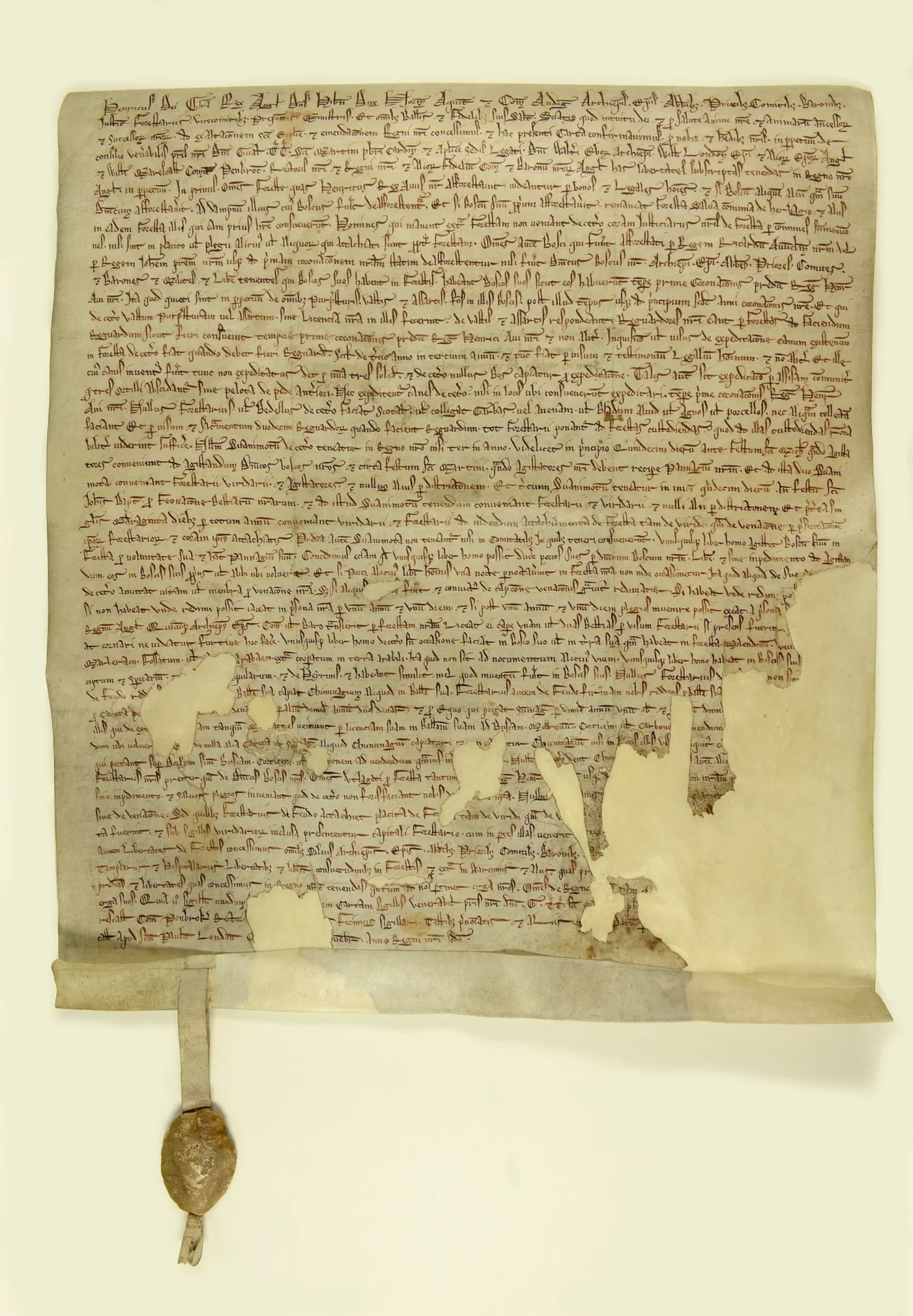
A pig could spend a night in the king’s forest without costing its owner his property. That small assurance sits in clause 9 of the Charter of the Forest, issued in Henry III’s name in November 1217. A document addressed to bishops, barons, justices, and royal officers had found room for an animal that might not complete its journey before dark.[1]
The detail makes the charter worth reading slowly. Its concessions concern the practical conditions of making a living: reaching grazing, carrying fuel, using a wood. They also have edges. A protected passage for pigs did not give their keeper permission to take the king’s deer. How much freedom could a document create while leaving the royal forest in place?
A forest could contain a village
In medieval England, a royal forest was an area subject to special hunting law. It could include heath, moorland, settlements, and land belonging to people other than the king. Trees alone did not define its boundary. A person could possess woodland yet face another authority over what happened there.[2]
The charter emerged from a struggle over that authority. King John’s death in October 1216 left his young son Henry with a disputed kingdom. The regency government, led by William Marshal and the papal legate Guala, used renewed grants of liberties to help secure the throne. In 1217 the Forest Charter accompanied another issue of Magna Carta as part of the peace settlement.[2]
That setting matters. The text records concessions made by a government trying to restore allegiance. Its opening speaks in the king’s voice; its closing explains that, because Henry had no seal of his own, Guala and Marshal supplied theirs. The authority promising restraint remained royal.[1]
The right to arrive with your pigs
Clause 9 begins with the free man’s own wood, then addresses movement through the king’s woods, and finally allows the overnight stay. The sequence follows a practical problem: having somewhere to feed livestock is useful only if the animals can reach it.[1]
In Richard Thomson’s 1829 translation, the clause permits passage “freely and without impediment.” Here freedom attaches to a particular activity across a particular space. The overnight provision gives that permission some tolerance for an imperfect journey. Read this way, it prevents the right of passage from depending on a journey completed without delay.[1]
This is an interpretation of the clause’s design, not evidence of a particular drover’s experience. The charter supplies no story about a named pig keeper successfully invoking it. What it does supply is a situation specific enough to recognize: animals passing through royal woodland, with a night’s delay protected against forfeiture.
The possessives deserve attention too. The clause distinguishes the subject’s wood from the king’s. It makes those holdings easier to use together without dissolving ownership. A reader who turns the passage into an unrestricted invitation to forage anywhere loses the distinctions that make the concession intelligible.
The deer stayed royal
The next clause changes the consequences of taking royal game. Clause 10 rules out loss of life or limb, but retains a heavy financial penalty for someone able to pay. Someone unable to pay faces a year and a day in prison, followed by release if sureties can be found; otherwise the offender must leave England.[1]
Removing death and mutilation was a substantial restraint on punishment. Yet poverty could still turn an offence into imprisonment and expulsion. The offender’s resources affect the outcome. It therefore supports a narrower claim than a general celebration of equal liberty: one category of physical punishment was prohibited while severe, unequal consequences remained.
Clause 11 makes rank visible. An archbishop, bishop, earl, or baron passing through the forest may take one or two beasts. A forester should witness the taking; in the officer’s absence, a horn should announce it.[1]
That sound is a revealing detail. The privileged hunter must make the act public so it will not appear furtive. The charter knows the difference between permitted taking and theft, and social position helps determine which description applies. Its neighbouring clauses protect a pig keeper’s passage and a lord’s hunting privilege within the same landscape.
A living carried on someone’s back
Clause 14 turns to chiminage, a transport toll. It restricts who may collect it and from which traffic, then exempts people carrying wood, bark, or charcoal on their backs for sale. Earning a livelihood from that load does not cancel the exemption.[1]
The distinction allows us to see economic activity at a different scale from the mounted hunter. Someone with saleable fuel but no laden horse or cart appears in the text as a person whose work merits specific protection. The clause does not abolish tolls. It draws a boundary around a modest way of earning.
Taken together, these provisions suggest how to read the charter’s generosity. Ask what activity is protected, on whose land, for which person, against which demand. Those questions recover the force of each concession without turning a society organized by status and property into a modern public park.
What the parchment can prove
Durham’s surviving charter carries Guala’s seal; Marshal’s is missing. The archive catalogue identifies the document as DCD 1.2.Reg.4 and records damage to its dating clause. It separately identifies the Forest Charter reissued on 11 February 1225.[4]
Even the familiar date of 6 November 1217 requires care. Historian David Carpenter explains that later copies support it, but the damaged Durham original appears to contain a different initial letter. His proposed explanation distinguishes authorization from the day a clerk wrote an individual copy; he presents that reconciliation as a possibility. November 1217 is secure ground for this reading, while the exact day involves an unresolved documentary puzzle.[3]
There is a larger limit as well. A grant tells us what authority promised, not how consistently every officer complied. Establishing the charter’s daily effects would require evidence from disputes and enforcement alongside its words. The 1225 reissue confirms that the concessions had a continuing political life; it cannot, by itself, demonstrate that every protected journey went unchallenged.[4]
The pig’s overnight stay remains a useful measure of what the document attempted. Royal hunting rights survived, and rank still mattered. Within those constraints, a precise sentence made an ordinary delay something an official was no longer entitled to turn into a loss of property. The charter’s significance lives in that precision.
Sources
- Henry III, Charter of the Forest (1217), in Richard Thomson, An Historical Essay on the Magna Charta of King John (1829), pp. 329–336, especially clauses IX–XI and XIV — scanned English translation, PDF pp. 367–374.
- Durham Cathedral, “Magna Carta and the Charter of the Forest” — the meaning of royal forest, the regency settlement, surviving charters, and the photograph used here.
- David Carpenter, “Magna Carta 1217,” The Magna Carta Project — comparison of surviving originals and later copies, including the Forest Charter’s disputed dating clause.
- Durham University, Calendar of the Durham Cathedral Archive: Royal Documents, entries DCD 1.2.Reg.4 and DCD 1.2.Reg.5 — identification, seals, damaged date, and the 1225 reissue.