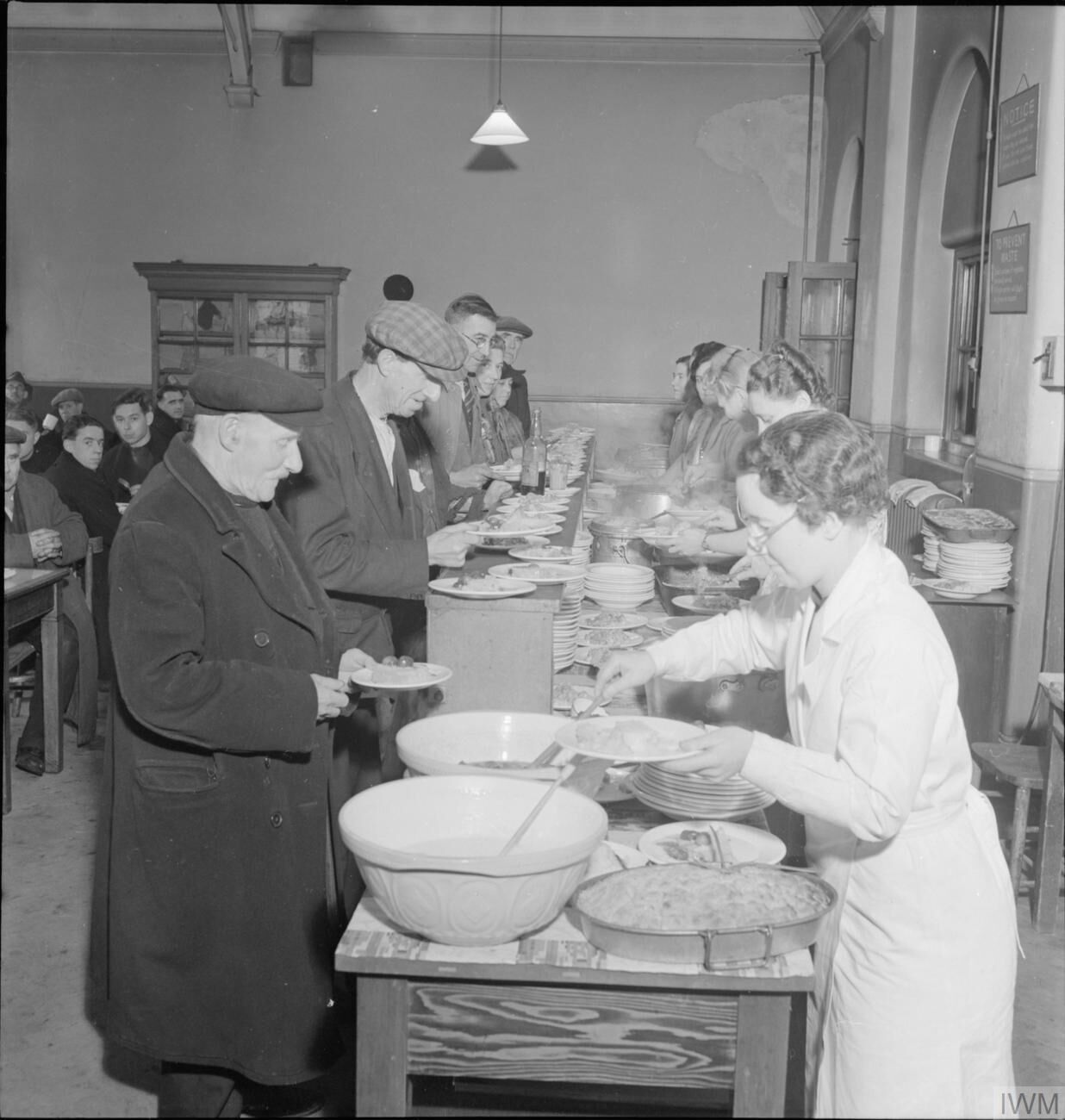
At Woolmore Street in London, a man holds his plate towards a serving counter. Behind it, women portion out lunch; behind him, other diners wait their turn. The official caption identifies him as T. Hambly, a 77-year-old former merchant seaman. This Ministry of Information photograph from 1942 records an ordinary transaction in a British Restaurant: the customer brings the plate, and a shared kitchen supplies the meal.[1]
Its political significance lay partly in what the diner could leave in his pocket. Meals bought in catering establishments did not draw on the household ration in the same way as food bought for cooking at home. British Restaurants widened access to that advantage. To understand their place in wartime Britain, follow the meal from the ration book to the counter.[2]
A ration book could not cook lunch
Food rationing governed access to scarce ingredients, but a household still needed somewhere to prepare them. London's emergency meals service began in September 1940, feeding people displaced by bombing. It developed into a network of restaurants using premises including schools and church halls. The Ministry of Food's Wartime Meals Division lent local authorities money to establish them.[2]
The kitchen mattered as much as the food. A purchased meal transferred shopping, preparation and cooking from the individual household to an establishment equipped to do the work. For someone displaced from home, or working too far away to return for lunch, that transfer could make a hot meal possible.
By 3 February 1942, the Ministry's parliamentary secretary, Major Gwilym Lloyd George, described a purpose extending across social categories: providing a hot, nourishing daily meal for people whose normal arrangements had been disrupted by war. His answer placed British Restaurants within the wider system of canteens and commercial catering needed by workers eating away from home.[4]
The extra meal already existed
The objection was obvious. If someone ate lunch at a British Restaurant and retained their household allowance, were they receiving more than their fair share?
Lloyd George had answered that challenge in the Commons on 28 January 1942. Supplementing the household ration through a purchased meal was already possible for people able to afford restaurants and hotels. A purpose of British Restaurants, he said, was to extend that opportunity “to all classes.” The same exchange defended takeaway meals as an essential service for workers.[3]
Equal household allowances could coexist with unequal access to a purchased lunch. The public restaurant addressed that second problem through the price of entry.
The British Records Association's guide to wartime London records three-course British Restaurant meals at nine old pence. Standards varied, and ninepence should not be mistaken for a single price maintained everywhere throughout the war. It nevertheless conveys the scale of the offer: an ordinary paid lunch within reach of customers for whom hotel dining was irrelevant.[2]
“Off the ration” described the customer's access to the meal. It did not mean an unlimited national food supply. In February, Lloyd George defended the additional consumption by arguing that British Restaurants used too little rationed food to affect domestic allowances. That was the ministry's contemporary justification, rather than an independent measurement of every restaurant's effects.[4]
A national idea needed a local kitchen
Turning the policy into lunch required a council to act. On 28 May 1941, MP Ellis Smith pressed the ministry about authorities that had not established feeding centres. Lloyd George explained that divisional food officers had staff assigned to encourage and assist councils. Asked what could be done about reluctant authorities, he said that, as far as he knew, the ministry could only urge them forward.[5]
That answer exposes a practical limit. National encouragement could supply a programme and assistance; the meal depended on local premises, equipment and organisation. A person could have a good claim on the policy's intentions and still live beyond its useful reach.
Private caterers also had a place in the approval process. In January 1942, the ministry said it would consider existing provision sufficient when both capacity and prices were adequate, and investigate trade objections before approving a new restaurant.[3]
Location remained contentious. In a Commons debate on 13 May 1943, Ebenezer Walkden praised Birmingham for consulting employers and workers' representatives about sites. He contrasted this with a restaurant near his own home, which he said had no factory within two miles. His criticism concerned workers in small workplaces who lacked canteens and could not easily shop or travel home for meals.[6]
Walkden was making a case, not presenting a complete national survey. His example nevertheless identifies a failure that restaurant totals could conceal. The relevant distance was the one between a hungry worker and an affordable counter during the time available for lunch. Counting buildings alone could not establish that the service reached its intended customers.
When the emergency became a habit
On 28 November 1946, Food Minister John Strachey introduced the Civic Restaurants Bill by recalling the service's beginnings in the Blitz. He reported that more than 2,000 British Restaurants had served over 500,000 meals daily at the wartime peak in May 1943. More than 1,000 remained, serving over 400,000 meals a day. These were his figures in support of continuation; their striking feature is that meal numbers had fallen much less sharply than restaurant numbers.[7]
The bill sought to let willing local authorities continue public catering. Strachey also described an expectation that the restaurants should cover their costs over time. Affordable meals had become a service whose future required decisions about municipal powers and operating accounts, beyond the immediate need to feed bombed-out households.[7]
Return to Hambly's plate. The photograph cannot establish how well a national system worked, and an official wartime image deserves to be read with that limit in mind. What it does make visible is the point where the system had to deliver: a staffed counter, a waiting customer, food ready to serve. Fair shares depended on the arrangements that brought those things together, as well as the allowances printed in a ration book.
Sources
- Imperial War Museums photograph D 10680, “Woolmore Street British Restaurant 1942,” Ministry of Information Photo Division, via Wikimedia Commons — archival image and identification of T. Hambly.
- British Records Association, Sources for the History of London 1939–45, chapter 5, pp. 85–86, reproduced by the Institute of Historical Research — rationing, the Londoners' Meals Service, premises, loans and meal prices.
- House of Commons, “British Restaurants,” 28 January 1942, vol. 377, cols. 717–718 — access across classes, takeaway meals and the conditions for approving restaurants.
- House of Commons, written answer, “British Restaurants,” 3 February 1942, vol. 377, cols. 1061–1062W — the ministry's stated purpose and defence of meals outside the domestic ration.
- House of Commons, “British Restaurants,” 28 May 1941, vol. 371, cols. 1853–1854 — divisional assistance and questions about reluctant local authorities.
- House of Commons, “Ministry of Food,” 13 May 1943, especially Ebenezer Walkden at cols. 890–893 — small workplaces, siting decisions and unequal access to canteens.
- House of Commons, “Civic Restaurants Bill,” 28 November 1946, especially John Strachey's opening speech, cols. 1796–1802 — wartime and postwar meal totals, municipal continuation and financial conditions.