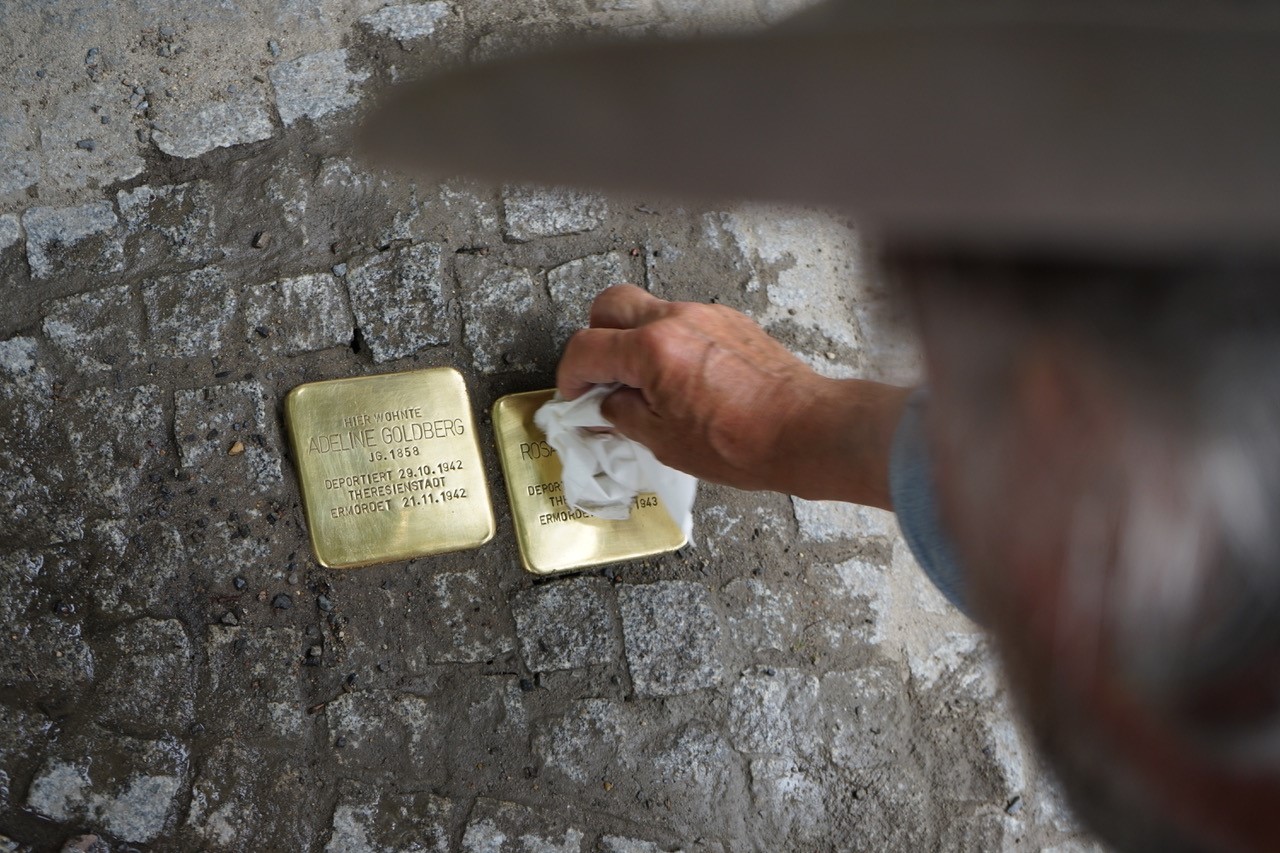
The first words are often “Here lived.” Before a Stolperstein records persecution, deportation or death, it establishes that someone belonged at this address. The brass surface is smaller than a handspan, set into the pavement outside a former home. Its scale asks for a small interruption: slow down, look down, read a name.[1]
That downward glance became the centre of a bitter disagreement in Munich. To supporters, the stones returned people to streets from which the Nazis had removed them. To opponents, putting their names beneath passing shoes risked another humiliation. Families and organisations representing victims stood on both sides.[5] How could the same position in a pavement promise recognition to one family and injury to another?
The address before the deportation
Gunter Demnig developed the Stolpersteine concept in 1992–1993. The project's own account describes individually handcrafted memorials, each restoring a person's name to the place where they had lived. The relationship between the stone and its surroundings is essential: an inscription beside a familiar doorway asks the present city to acknowledge an earlier resident.[1]
Choosing the address takes historical work. The installation instructions specify the last home freely chosen by the person, rather than a building into which the Nazis subsequently forced them. They ask researchers to reconstruct whole families, including those who escaped or survived, and to locate and inform relatives. Municipal permission is required; once installed, the stones become part of the public pavement and municipal property.[3]
These rules place the memorial before the final catastrophe. A deportation destination explains what happened to a person; a chosen address helps establish the life that persecution interrupted. Including survivors also keeps a family from being represented only by its murdered members. The household becomes visible as something the Nazis broke apart.
The ground was a practical choice as well as an artistic one. According to the project's FAQ, Demnig first considered walls but anticipated difficulty obtaining individual property owners' consent. Pavements offered a route through municipal approval. The same account stresses that Stolpersteine are memorials rather than gravestones: there are no remains beneath them.[2]
A legal boundary helped determine the form of remembrance. Moving a plaque a short distance from a wall to a pavement changed whose permission mattered—and what a passer-by could do to the name.
A removal could hurt as much as a placement
Munich's 2004 decision against Stolpersteine in public space had an immediate human consequence. Stones for the Jewish art dealers Siegfried and Paula Jordan were removed. Their son Peter experienced the removal as a renewed violation of his parents' memory. Deborah Cole's AFP report, republished by the Jewish Museum Munich in January 2015, places his response alongside the objection of Charlotte Knobloch, president of Munich's Jewish community: names exposed to dirt and footsteps did not, in her view, receive the dignity the murdered deserved.[4]
The report also records survivor Ernst Grube supporting the stones and challenging the authority given to Knobloch's position. Both had experienced persecution as children. Their disagreement makes it impossible to divide the dispute neatly between people with historical experience and people without it.[4]
Each side was protecting something concrete. Supporters wanted a recoverable place in the everyday city, accessible without arranging a museum visit. Opponents wanted the physical treatment of a name to express respect. The artist could explain his intention, but intention could not settle what a bereaved family should feel when a shoe passed over the brass.
On 29 July 2015, Munich's council reaffirmed the prohibition in public space. Contemporary AFP reporting carried by ntv described wall plaques and upright memorials outside former homes as the preferred alternatives.[5] The qualification matters: the public-space dispute was not evidence that Munich contained no Stolpersteine. The Jewish Museum's earlier report had already documented installations on private property.[4]
Raising the names changed the encounter
The city's first Erinnerungszeichen, or Memorial Signs, were installed in July 2018. Its official anniversary account dates that beginning and records further installations at former homes and businesses.[7] The alternative preserved the connection between a person and an address while changing how a reader met the inscription.
Munich's design uses wall plaques and slender upright steles. Names, biographical information and, where available, portraits appear in metal. The city's description explicitly places the information at eye level and says that relatives' wishes take priority: a sign will not be installed against them.[6]
A portrait adds something a short pavement inscription usually cannot: a face encountered alongside the record of persecution. Raising the text also removes the possibility of an ordinary footstep crossing it. Yet the sign still asks the reader to connect a present building with someone who once lived or worked there. The argument changed the memorial's physical form without abandoning the importance of the address.
This does not establish that one design produces deeper remembrance. The sources document intentions, objections and decisions; they do not measure what every passer-by notices or retains. A ground-level stone may interrupt a habitual walk. An upright plaque may make a name easier to encounter with dignity. Either can also become part of the background.
After the ceremony
The Stolpersteine project's FAQ describes brass that darkens and local sponsorships for cleaning it.[2] That ordinary maintenance is part of the memorial's continuing life. Somebody returns to the pavement and makes an inscription readable again.
The research matters just as much. The installation guidance welcomes documented corrections to biographical records and asks initiators to work with archives.[3] A lasting inscription still depends on people willing to check what it says. Metal can preserve an error as faithfully as a name.
Munich's dispute leaves a demanding account of commemoration. Recovering the person and choosing how to display the name are separate responsibilities. An address can reconnect a family with a lost home; the height, ownership and treatment of the inscription determine how that connection enters public life. Even after the stone is laid or the plaque mounted, the work of remembering remains with the people around it.
Sources
- Stiftung – Spuren – Gunter Demnig, “Stolpersteine” — the project's 1992–1993 conception, physical form, and individual commemoration.
- Stiftung – Spuren – Gunter Demnig, “Frequently Asked Questions” — the choice of pavement over walls, distinction from gravestones, objections, and cleaning.
- Stiftung – Spuren – Gunter Demnig, “Steps for Stolperstein Installation,” sections 1–3 — municipal permission, research, relatives, survivors, address selection, and corrections.
- Deborah Cole, AFP, “Stolpersteine – eine Außenansicht,” republished by the Jewish Museum Munich (January 2015) — the Jordan family, Charlotte Knobloch, Ernst Grube, and installations on private property.
- ntv/AFP, “Stadtrat bestätigt Verbot: München bleibt ohne Stolpersteine” (29 July 2015) — the council decision and proposed alternatives.
- City of Munich, “Erinnerungszeichen für Opfer des NS-Regimes in München” — the design, eye-level placement, portraits, and priority given to relatives' wishes.
- City of Munich, “Anniversary: 5 Years of Memorial Signs” (6 July 2023) — the first installations in July 2018 and subsequent remembrance at former residences and businesses.
- Stiftung – Spuren – Gunter Demnig, “Press materials,” photograph “Bild Gunter Demnig 2” — source of the photograph reproduced above.