The Burlingame-Seward Treaty is easy to remember as a short-lived pro-immigration agreement. That is true, but too small. Read closely, the treaty signed at Washington on July 28, 1868 was also a document about how a weakened empire tried to recover diplomatic room after the Opium War treaty system. It amended the 1858 Treaty of Tianjin, but its most interesting clauses do not simply add technical language. They try to restate the relationship between the United States and Qing China as one between states capable of reciprocity, restraint, and negotiated movement.[1][2]
That makes the treaty more historically uncomfortable, not less. By 1880, the Angell Treaty had modified the free-migration promise; by May 6, 1882, the Chinese Exclusion Act suspended the coming of Chinese laborers for ten years.[4][5] The reversal came so quickly that the 1868 text can look naive in hindsight. But the better reading is sharper. Burlingame did not fail because it lacked a principle. It failed because its principle of equal movement could be narrowed, racialized, and overwritten once domestic U.S. politics decided that Chinese laborers were an exception to the reciprocity the treaty had just announced.[2][4][5]
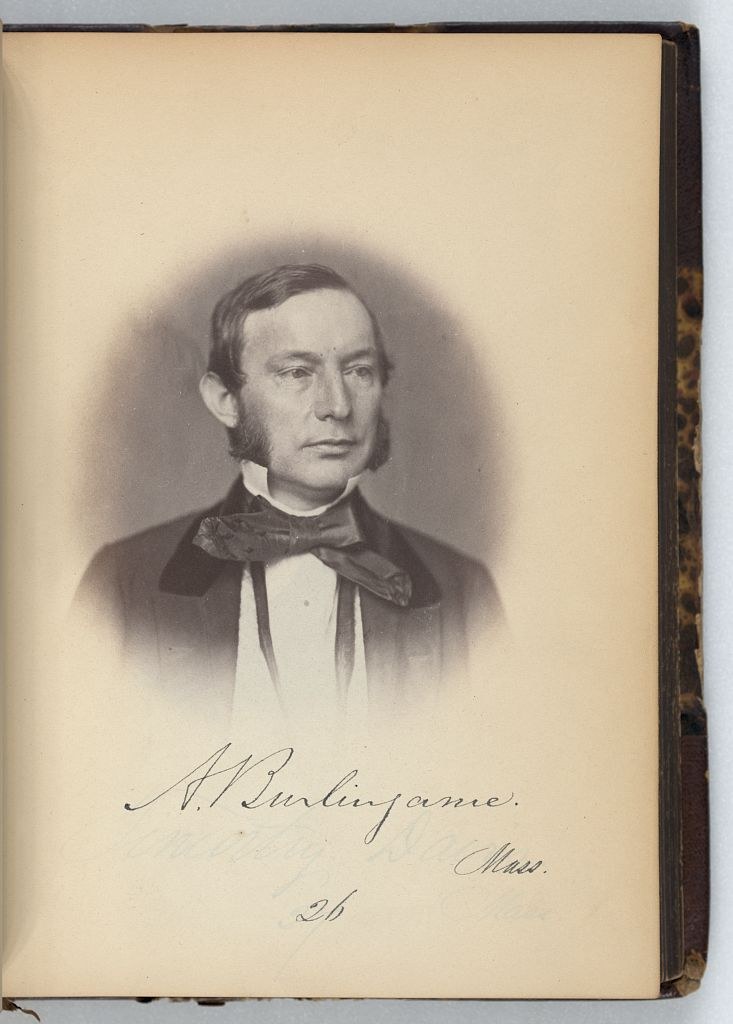
Image context: the cover uses an 1859 salted-paper photographic portrait of Anson Burlingame from the Library of Congress collection.[6] It fits the article because the treaty's unusual diplomatic grammar depended on Burlingame's role shift: he had served as U.S. minister to China, then traveled with Qing envoys as a representative for the Qing court. The image is a real archival photograph, not an interpretive engraving, so it keeps the essay's primary-source reading anchored in a physical nineteenth-century object.
The preamble makes the embassy visible
The treaty's first surprise appears before the articles. The named plenipotentiaries were William H. Seward for the United States and, for the emperor of China, Anson Burlingame, Chih-Kang, and Sun Chia-Ku.[1] That lineup matters. Burlingame had served as U.S. minister to China, then resigned and accompanied Chinese representatives on a diplomatic tour that included Washington, London, Paris, and Berlin.[2] In procedural terms, the Qing court was using a foreign diplomat's reputation to help speak in the language of Western diplomacy. In political terms, it was trying to make China appear as a treaty-making subject rather than merely a treaty-bearing object.
The State Department's retired historical overview frames the treaty as part of a Chinese effort to limit American interference in internal Chinese affairs while expanding on the 1858 settlement.[2] That description is useful because it keeps the document from becoming only an immigration story. Immigration is central, but the treaty's architecture begins with jurisdiction, consular standing, religious liberty, education, and internal improvements.[1] It is trying to show that China can grant, regulate, and negotiate without surrendering the whole field to foreign pressure.
The ratification timeline deepens the point. The text was signed in 1868, but ratifications were exchanged at Peking on November 23, 1869.[1] That gap places the document in a moment when Qing officials were still experimenting with outbound diplomacy while foreign powers were pressing for commercial access, missionary protection, and infrastructure concessions. The treaty is therefore a snapshot of a narrow opening: China was weak enough to need help, but not yet willing to concede that foreign powers could dictate the whole direction of reform.
Article III asks to be treated like other powers
Article III gives the emperor of China the right to appoint consuls at U.S. ports, with privileges comparable to those enjoyed by British and Russian consuls.[1] On the page, this looks administrative. In context, it is a status claim. China was not only being asked to receive foreign representatives. It was asserting a right to station its own representatives where Chinese subjects, merchants, and disputes would increasingly appear.
This is one reason the treaty's language of equality should not be dismissed as ceremony. A consul is not just a polite official. Consular presence lets a state make its people administratively visible abroad. It creates a channel for complaints, certificates, deaths, commercial conflicts, and negotiations over treatment. If the United States wanted protected access in China, Article III says China should be able to build a reciprocal diplomatic footprint in American port cities.[1][2]
That reciprocity had limits, and the article's comparison to Britain and Russia reveals them. China was measuring its American treatment against the privileges of stronger powers. The treaty did not erase hierarchy. It made hierarchy legible enough to contest.
Article V turns migration into a right, then guards against coercion
Article V is the treaty's famous center. It recognizes a right to change home and allegiance and describes mutual advantage in free migration between the two countries.[1] The phrase matters because it does more than permit labor supply. It places migration inside a moral vocabulary of consent and personhood.
The next sentence is just as important. The article condemns non-voluntary emigration and requires laws against taking people from one country to the other without free consent.[1] That boundary shows what the clause was trying to solve. The nineteenth-century Pacific world contained not only merchants and students, but also coercive labor recruitment, debt pressure, violence, and the afterlife of the so-called coolie trade. The treaty's answer was not to close movement. It was to distinguish voluntary migration from forced transport.
That distinction is the key to the later reversal. The 1882 Chinese Exclusion Act did not present itself as an anti-coercion measure. Its opening premise was that the coming of Chinese laborers endangered good order in certain U.S. localities.[5] The legal category shifted from consent to threat. A treaty that had treated movement as mutually advantageous was replaced by an act that treated a specific class of Chinese movers as a public danger.
The State Historical Society of Iowa's teaching page, drawing on the Library of Congress text, captures the 1868 treaty's basic promise: a friendly relationship and rights to move freely in each other's countries.[3] The close reading adds a qualification: the treaty made free movement honorable precisely by rejecting forced movement. Exclusion later collapsed that distinction. It did not ask whether migration was voluntary. It asked whether the migrant was a Chinese laborer.[5]
Article VI gives equality, then withholds citizenship
Article VI extends most-favored-nation privileges for travel and residence to Americans in China and Chinese subjects in the United States.[1] This is the treaty at its most reciprocal: if another nation's people receive better treatment, the other party's people should benefit too. The clause makes resident foreigners comparable across national lines.
Then comes the limiting sentence: the article does not confer naturalization.[1] That reservation is not incidental. It marks the difference between residence rights and membership. The treaty could imagine Chinese subjects traveling, residing, studying, worshiping, and receiving protection in the United States. It did not force the United States to accept them as future citizens.
That gap would matter enormously. The treaty gave Chinese migration a diplomatic shield, but it did not settle the domestic politics of belonging. Once anti-Chinese agitation intensified in the western states during the 1870s, U.S. politicians could claim they were not rejecting all treaty relations with China, only regulating the labor immigration that domestic constituencies had made politically explosive.[2][4][5] The treaty's own citizenship reservation left a boundary that later restrictionists could widen.
Still, Article VI should not be read backward as an invitation to exclusion. Its main work is protective: Chinese subjects in the United States should receive residence and travel privileges available to favored foreigners.[1] The 1882 act's certificate system, vessel penalties, and laborer suspension made that protective ideal much thinner in practice.[5]
Article VII makes education part of diplomacy
Article VII can look secondary beside immigration, but it may be the treaty's most optimistic clause. It gives citizens and subjects reciprocal access to public educational institutions and allows Americans to establish schools in treaty-permitted places in China, with reciprocal privileges for Chinese subjects in the United States.[1]
This provision matters because it treats diplomacy as a learning regime. The treaty does not imagine U.S.-China relations only through ports, tariffs, and labor. It imagines schools as instruments of contact. Chinese students in the United States and American schools in China become part of the same formal bargain.
There is an asymmetry beneath the symmetry. American missionary and educational institutions in China had a larger geopolitical infrastructure behind them. Chinese educational access in the United States depended on whether students could cross a society increasingly willing to separate admiration for Chinese "civilization" from hostility toward Chinese workers. That split would become a recurring pattern: elite exchange could be tolerated while labor migration was degraded.
Article VII therefore shows the treaty's aspiration and its weakness in one place. It could write equal educational access into international law. It could not force a receiving society to treat all Chinese presence as equally legitimate.
Article VIII is a non-intervention clause hiding in modernization language
Article VIII may be the most revealing article for China's purposes. The United States disclaims unnecessary dictation and intervention in China's domestic administration regarding railroads, telegraphs, and other internal improvements.[1] The emperor reserves the right to decide when and how such works should be introduced.[1]
This clause is not anti-modern. It is anti-coercive modernization. China is not refusing railroads or telegraphs as such. It is reserving the authority to decide their timing, terms, and political meaning. If China later asks for engineers, the United States may help designate them.[1] The order is crucial: Chinese decision first, foreign technical assistance second.
That language places the treaty inside a wider nineteenth-century struggle over who controlled reform. Western powers often framed infrastructure as progress, but infrastructure could also become leverage: rights of way, concessions, debt, military access, and administrative intrusion. Article VIII tries to separate technical modernization from foreign command. It says China may learn, hire, and build without conceding that outsiders own the reform clock.[1][2]
The reversal was legal, but not minor
The treaty did not survive U.S. domestic politics intact. The State Department overview notes that anti-Chinese sentiment grew especially in western states and that the 1880 treaty revision and 1882 Chinese Exclusion Act undid the free-immigration clauses.[2] The Angell Treaty of November 17, 1880 gave the United States the ability to regulate, limit, or suspend the coming of Chinese laborers when their immigration affected U.S. interests, while preserving language against absolute prohibition.[4] The 1882 act then suspended the coming of Chinese laborers for ten years and built enforcement around vessels, certificates, identification, and lawful re-entry categories.[5]
That sequence matters because it shows how treaty language can be reversed without being forgotten. The United States first had to renegotiate the diplomatic frame, then legislate exclusion through the narrower category of "Chinese laborers."[4][5] The shift was not from law to lawlessness. It was from one legal imagination to another: from voluntary movement and reciprocal residence to racialized labor restriction and documentary suspicion.
The close-reading conclusion is therefore not that Burlingame was a simple failure. It is that the treaty briefly made a different future legible. It joined Chinese sovereignty, voluntary migration, educational exchange, and limits on foreign intervention inside one agreement. Its later undoing reveals the pressure points: sovereignty was easier to honor when it served commerce; education was easier to praise than labor migration; and reciprocity was easy to narrow once racial politics defined one group as an exception.
That is why the Burlingame Treaty still reads with force. It is not merely a prelude to exclusion. It is the document that lets us see exclusion as a reversal. In 1868, the United States and Qing China put equal nations and mobile people into the same diplomatic sentence. By 1882, American law had taught itself how to cut the sentence in half.
Sources
- Governments of the United States and the Chinese Empire, "Burlingame-Seward Treaty (1868)," Wikisource transcription of the treaty text signed July 28, 1868, with ratification note.
- U.S. Department of State, Office of the Historian, "The Burlingame-Seward Treaty, 1868," historical overview of the treaty, mission, principles, and later reversal.
- State Historical Society of Iowa, "Burlingame Treaty, 1868," teaching page citing the Library of Congress treaty document and summarizing its free-movement provisions.
- U.S. Law and Race Initiative, University of Nebraska-Lincoln, "Angell Treaty (1880)," text and contextual note on the treaty that modified Burlingame's immigration provisions.
- National Archives, "Chinese Exclusion Act (1882)," milestone document page and transcript of the act suspending the immigration of Chinese laborers.
- Library of Congress, "Anson Burlingame, Representative from Massachusetts, Thirty-fifth Congress, half-length portrait" - 1859 salted-paper photographic portrait by Julian Vannerson, used as the article image.