The Alcatraz occupation is often remembered as a symbol: Native activists took "the Rock" and made the old prison speak back to the federal government. That is true, but it can make the event sound simpler than it was. The occupation lasted from November 20, 1969, to June 11, 1971, and it worked as history because a symbolic landing became a long logistical test. Boats, students, press attention, proposals, electricity, water, internal authority, outside supporters, and federal patience all became part of the same struggle.[1][2][3]
The sharper reconstruction begins with the island's vacancy. Alcatraz had stopped functioning as a federal penitentiary in 1963. It was close enough to San Francisco to be visible, famous enough to draw cameras, and abandoned enough to make federal control look wasteful. Native organizers understood the geography. If the government could hold unused land in the middle of the bay, Indians of All Tribes could ask why treaty promises, cultural institutions, and Native self-determination were treated as less practical than an empty prison.[1][2]
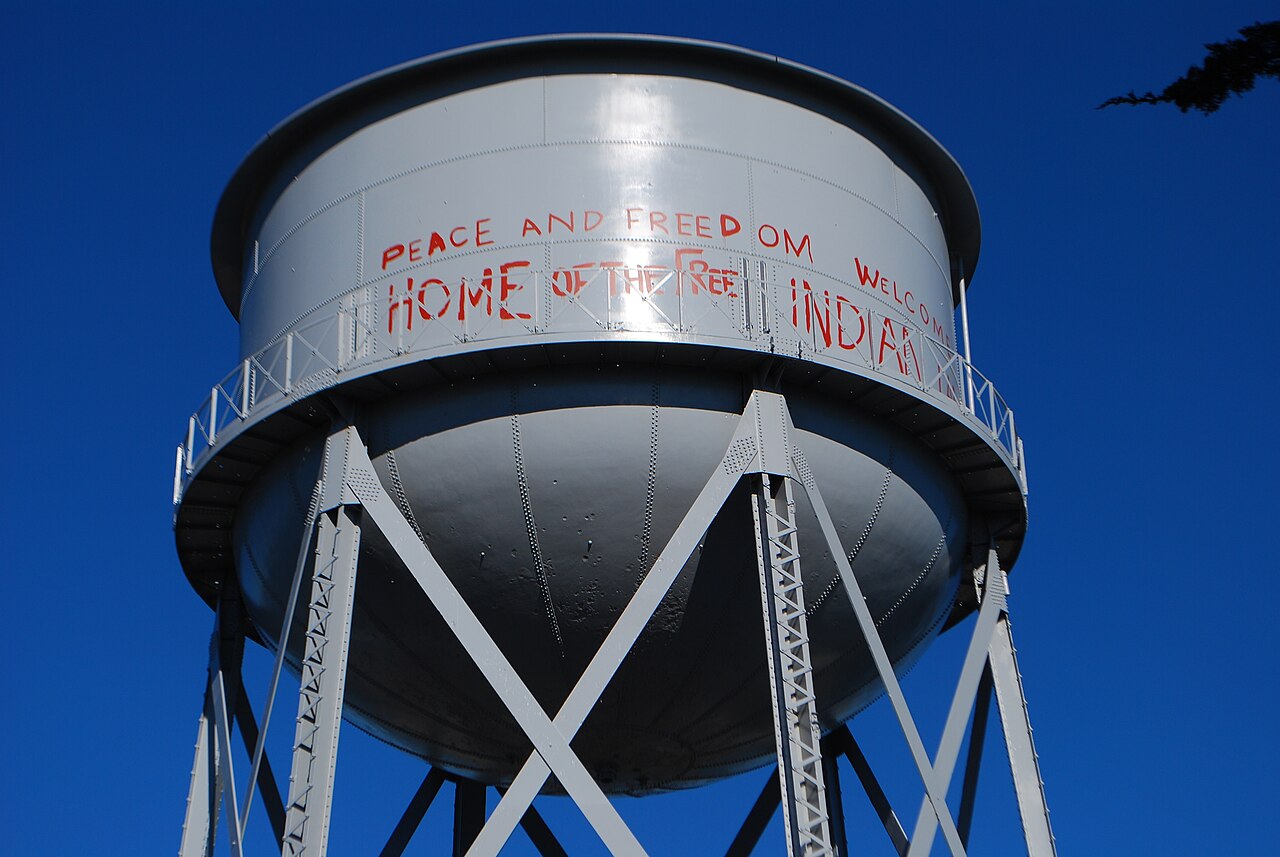
Image context: the cover photograph shows the Alcatraz water tower with occupation-linked "Indian Land" text still visible in 2013.[6] It is not an illustration or generated scene. The image matters because the occupation made its claim through surfaces as well as speeches: walls, dock signs, water towers, and prison buildings became a public text that visitors and cameras had to read.
The first landing made a legal joke serious
The occupation did not begin from nowhere on November 20. The National Park Service's historical account traces an earlier March 9, 1964 landing by five Sicangu Lakota people who declared Alcatraz Indian Land and cited the 1868 Fort Laramie Treaty. That action lasted only hours, but it left a usable precedent: abandoned federal land could be reimagined through treaty language rather than only through real-estate disposal.[1]
By November 9, 1969, Richard Oakes and supporters made a symbolic claim on the island from a chartered boat. The longer occupation followed eleven days later, when Native students landed before dawn and stayed.[1][2] The point was partly theatrical, but not unserious. The famous claim by "right of discovery" inverted the colonial language that had justified taking Indigenous land. It used parody as a legal mirror: if discovery had once made Native land available to outsiders, why could Native people not "discover" a closed federal prison?
That maneuver gave the occupation its first mechanism. It converted a demand into a scene. A policy memo can be ignored. A small group of people sleeping inside a former prison in San Francisco Bay is harder to keep abstract. The island gave the claim a stage, and the claim gave the island a new meaning.
Students made the occupation portable
The first durable force was generational. NPS accounts identify the November 20 landing as a student-led action, with leaders including Richard Oakes of Akwesasne Mohawk background and LaNada War Jack, then associated with Native student organizing in the Bay Area.[2] The "We Hold the Rock" essay emphasizes that the early occupation force was made up largely of young urban Native college students and notes the role of UCLA students in enlarging the group.[1]
That student base matters because the occupation was not only a tribal delegation, a single reservation protest, or a local San Francisco episode. It was intertribal by design. The name Indians of All Tribes was a political technology: it let people from different nations, campuses, and urban Native communities make a common claim without pretending they were one tribe.[1][3]
This made the action portable in two ways. First, it let supporters identify with the occupation even if Alcatraz was not their ancestral land. The island became a platform for treaty rights, cultural survival, education, and federal responsibility more broadly. Second, it gave the press a legible collective actor. Reporters could write about Indians of All Tribes, not only about a scattered set of personal grievances. That simplification carried risks, but it helped keep the occupation visible.
The demand was not just land
The occupation's demands are sometimes flattened into "give back Alcatraz." The record is more specific. NPS's site interpretation says the occupiers demanded recognition of treaties, a Native American cultural center, and the return of land.[2] The broader "We Hold the Rock" account describes plans for an Indian university, a cultural center, and a museum.[1] Another NPS interpretive stop summarizes the vision as including American Indian studies, job training, a spiritual center, an ecology center, and a museum.[2]
That package matters. Alcatraz was not being claimed only as territory. It was being claimed as infrastructure. The occupiers wanted a place where Native history, education, employment, ceremony, and public interpretation could be controlled by Native people. In that sense, the island was a test case for self-determination before self-determination had fully displaced the older federal policy world of termination and assimilation.
The abandoned-prison setting sharpened the contrast. A federal prison is a machine for custody. The occupiers tried to convert it into a machine for education and political repair. That reversal was the heart of the event: cells, docks, barracks, and administrative buildings were asked to serve a different theory of sovereignty.
Media attention was a supply line
The occupation needed food, water, transport, and heat, but it also needed attention. Without outside visibility, the island could be isolated and removed with little cost. With visibility, every federal response risked proving the occupiers' point: Native demands were still being handled as a management problem rather than as a political relationship.
The island's location helped. Alcatraz sat close to a major media city and already had national name recognition. Once occupied, it became a site that could be photographed from the water, entered by reporters, and discussed through recognizable images: prison blocks, graffiti, docks, a water tower, the bay skyline. The image archive and oral-history holdings preserved by Golden Gate National Recreation Area show how thoroughly the occupation became a recorded event, not only an internal movement memory.[4][5]
But attention was unstable. It could romanticize the occupation, narrow it to charismatic individuals, or lose interest when daily life became difficult. The occupiers therefore had to keep turning ordinary survival into political evidence. Every request for supplies, every discussion of building use, every message painted on the island restated the same argument: Native people were not asking to be represented symbolically inside someone else's institution. They were trying to run one.
Life on the island exposed the hard part
Long occupations are tests of governance. The first landing asked whether Native activists could claim Alcatraz. The next nineteen months asked whether they could hold it under pressure. Thousands of Native people and supporters joined or passed through, according to NPS interpretation, but the island's population changed over time.[2] That churn is not a footnote. It was the occupation's central difficulty.
The group had to manage food, housing, sanitation, safety, communications, visitors, decision-making, and relations with federal authorities. The former prison supplied symbolism, but not an easy living environment. The same isolation that made the claim dramatic made the occupation dependent on boats and outside support. When conditions worsened and numbers fell, the federal government could wait for the claim to become logistically vulnerable.
The archives matter here because they keep the occupation from becoming only a poster image. The Online Archive of California finding aid for the Alcatraz Indian Occupation Records describes materials from 1964-1971, with the bulk from 1969-1971, including organizational records, correspondence, printed matter, and other documentation tied to the occupation.[4] Those records reveal an event made of administration as well as defiance. An occupation survives not by symbolism alone but by forms, lists, letters, schedules, and arguments over what to do next.
The end did not erase the mechanism
Federal officers removed the remaining occupiers on June 11, 1971.[1][3] In a narrow tactical sense, the government retook the island. In historical terms, that did not make the occupation a failure. The action had already changed the visibility of Native politics, and NPS's own historical framing treats the occupation as a major event in contemporary Native American history and a launch point for sovereignty, power, and independence movements.[3]
The causal chain is important. Alcatraz did not single-handedly create Native self-determination policy. No serious reconstruction should make that claim. But it condensed a national argument into one place. It linked treaty language to urban Native youth, cultural-institution building to land claims, and media visibility to federal responsibility. The result was a model that later Native activism could borrow: occupy a site, make the legal contradiction visible, build an intertribal public, and force the state to answer in front of observers.
NPS's "We Hold the Rock" essay makes the policy afterlife explicit, arguing that the occupation helped end the older termination frame and supported the rise of self-determination as official policy, whether directly or indirectly.[1] The careful phrase is necessary. Policy change came through many pressures, including tribal governments, litigation, congressional work, and activism beyond Alcatraz. Still, the island gave the movement an unforgettable proof of concept. It showed that Native claims could seize the national stage without asking permission to enter it.
That is why Alcatraz remains more than a dramatic episode. The occupation's deepest achievement was not holding the prison forever. It was making the abandoned prison politically unusable in its old form. After Indians of All Tribes, Alcatraz could no longer be only a closed penitentiary awaiting federal repurposing. It had become evidence: of broken treaties, urban Native organizing, intertribal coalition, public pedagogy, and a demand that sovereignty be treated as a present-tense political fact.
Sources
- National Park Service, "We Hold the Rock" - Troy Johnson's historical essay on the 1964 landing, November 1969 occupations, Indians of All Tribes, demands, and policy afterlife.
- National Park Service, "The 1969 Occupation Begins" - interpretive stop on the November 20, 1969 landing, leaders, demands, and political messages on the island.
- National Park Service, "Native American Occupations of Alcatraz" - official Alcatraz Island page summarizing the 1964 and 1969-1971 occupations and their movement significance.
- Online Archive of California, "Alcatraz Indian Occupation Records, 1964-1971, bulk 1969-1971" - finding aid for organizational and archival records of the occupation.
- National Park Service, "The Voices of Occupation Alcatraz" - Golden Gate NRA oral-history and archival page preserving participant accounts and park archive references.
- Wikimedia Commons, "Indian occupation, Alcatraz (9974134026).jpg" - Kate Nevens's 2013 photograph of the Alcatraz water tower with occupation-linked Indian Land text, used as the article image.