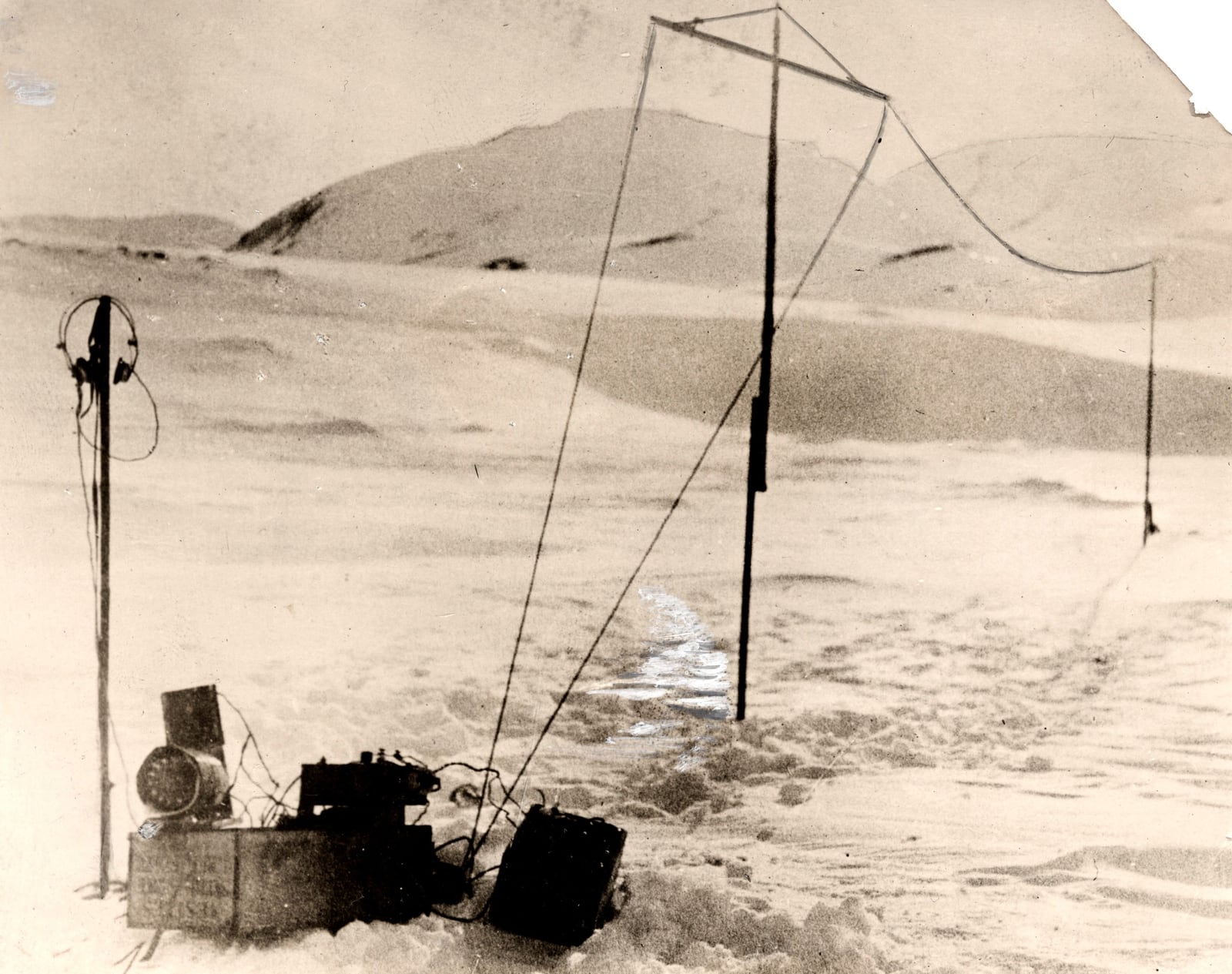
The most important message of the 1928 Italia disaster did not travel to its intended receiver. A small radio on drifting sea ice called the expedition's support ship near Svalbard. For nine days, no usable two-way link formed. Then the signal crossed roughly 1,900 kilometres and reached a young amateur operator in the Russian interior.[1][2]
That improbable jump gave a blind international search a living camp, coordinates and a radio link. It did not make the rescue orderly. Ships, aircraft, radio operators and sled parties moved on different clocks; some rescuers became castaways themselves. The last survivors would be reached only after 48 days on the ice, and the operation would cost more lives beyond those lost in the original crash.[3][4]
The familiar icon is the Red Tent. The deeper story is the chain around it: emergency equipment that fell out of a breaking aircraft, a frequency that overshot its intended listener, coordinates relayed across borders, aircraft that could find the camp but not empty it, and finally an icebreaker able to turn a radio position into physical rescue.
May 23–25: a scientific flight becomes two disappearances
The Italia left Ny-Ålesund before dawn on May 23, 1928, on the third flight of Umberto Nobile's polar expedition. This was not only a flag-planting venture. The airship carried physicists and instruments for work on geomagnetism, atmospheric electricity, cosmic rays and other polar phenomena. Nobile intended to make several exploratory flights and, if conditions allowed, put a small scientific party onto the ice.[1]
The airship reached the North Pole around midnight on May 24, but wind and fog prevented the planned landing. The crew turned south toward King’s Bay. During the long return, headwinds slowed the craft, ice formed on its surface, and the last position report placed it north of Svalbard. At about 10:35 a.m. on May 25, after a sudden loss of altitude whose exact cause remains unsettled, the control cabin struck the pack roughly 400 kilometres northeast of Ny-Ålesund.[1]
The impact split the disaster in two. Vincenzo Pomella died on the ice. Nine other men from the cabin survived, several injured. Relieved of the cabin's weight, the gas envelope rose again with six men still aboard and disappeared over the Arctic Ocean. Neither those men nor the main wreckage have been found.[1]
The people on the ice had not landed with a camp assembled to order. Survival depended on what the collision happened to scatter within reach: food, sleeping bags, navigational instruments, a tent and Giuseppe Biagi's portable high-frequency set, the Ondina 33. These were not random comforts. The tent and radio had been carried for the planned scientific descent, so equipment designed for a controlled field station became the core of an accidental one.[1]
The tent itself was ivory silk outside and blue-green inside, with a square footprint about 2.7 metres on each side. The survivors splashed it with red aniline used for altitude readings so an aircraft might distinguish it from the ice. The dye soon faded, but “Red Tent” fixed the camp in public memory.[3]
May 25–June 3: the signal travels over the rescuers
Biagi began transmitting distress calls while the support ship Città di Milano remained within the wider Svalbard region. The survivors used sextants, chronometers and an artificial horizon recovered from the wreckage to calculate a position near 81°14′ north, 25°25′ east. They could describe where they were. The harder problem was making that description arrive.[1]
The failure has two serious explanations, and the evidence does not require choosing only one. Nobile later argued that listeners had become too pessimistic about the crew's survival and that at least one fragment heard aboard the support ship on May 29 was mistaken for traffic from Mogadishu. In that interpretation, expectation and radio-room judgment helped turn a weak signal into noise.[1]
A modern reconstruction adds a physical mechanism. The Ondina transmitted around 9.1 and 9.4 MHz. Researchers modelling the 1928 ionosphere concluded that those frequencies could create a skip zone: too far for the weakening ground wave, but too near for a sky wave reflected back from the ionosphere. Disturbed solar and geomagnetic conditions made propagation more variable, sometimes adding absorption and sometimes permitting sporadic paths. The support ship could therefore sit in radio shadow while a receiver much farther away heard the call.[2]
These accounts are complementary rather than mutually exclusive. Propagation explains why the intended link was fragile; human assumptions explain why fragments did not immediately become a confirmed emergency. Complete receiver logs and comparable signal reports from every watch would sharpen the balance between them. The surviving record supports a layered failure, not a morality tale about one negligent operator or one defective radio.
On June 3, after nine days of calling, Russian amateur operator Nikolai Schmidt intercepted the coordinates and raised the alarm. Communication with King’s Bay followed within days.[1][4] The camp was no longer missing. Yet location did not equal access. Between the survivors and the coast lay moving pack ice that ordinary ships could not simply cross.
June 18–24: every successful contact creates another risk
The search widened across national lines. Italy, Sweden, Norway, Finland, France and the Soviet Union contributed people or equipment, but no single command could make aircraft, ships, weather and ice behave as one system. Three survivors—Finn Malmgren, Adalberto Mariano and Filippo Zappi—had already left the tent to seek help on foot. Their attempt created a second moving target. Malmgren died on the ice; Mariano and Zappi continued.[4]
Roald Amundsen entered the search carrying the history of an earlier partnership and quarrel. He and Nobile had crossed the Arctic in the airship Norge in 1926, then publicly disputed credit and authority. On June 18, 1928, Amundsen nevertheless left Tromsø aboard the French flying boat Latham 47 to help find Nobile's party. Radio contact ceased a few hours later. Searchers recovered wreckage, but Amundsen and the five others aboard were never found.[5]
The next breakthrough came from the air. Italian pilot Umberto Maddalena located the Red Tent on June 20, allowing aircraft to drop food, batteries and other supplies. Swedish pilot Einar Lundborg then landed a small ski-equipped aircraft at the camp on June 23 and took Nobile out, intending to return for the others. On the next landing attempt, the aircraft overturned. Lundborg, who had arrived as a rescuer, had to be rescued from the same ice.[4]
This reversal captures the operation's central difficulty. Aircraft could bridge distance quickly, but landing concentrated risk onto a rough, drifting surface. Supply drops could extend survival without ending exposure. A plane might remove one person and add another. The rescue needed both the speed of radio and aviation and the slower force of a vessel built to enter the pack.
July 12: the icebreaker closes the last distance
The Soviet icebreaker Krasin left Leningrad in mid-June under an expedition led by Rudolf Samoilovich. Unlike the whalers and support vessels already searching, it could force a route through heavy ice. Even then, the ship did not sail directly to a fixed camp. The floe had drifted; weather disrupted reconnaissance; the walking party had to be found separately.[6]
On July 12, Krasin first reached Mariano and Zappi. Later that day, it came alongside the floe and took aboard the five men still at the Red Tent: Alfredo Viglieri, František Běhounek, Giuseppe Biagi, Felice Trojani and the injured Natale Cecioni.[4][6][7] The rescue did not recover Malmgren, the six men carried away with the envelope, or the Latham crew. It ended the camp, not every search.
The chronology resists being compressed into the triumph of one hero or machine. The tent preserved bodies, but could not announce itself. The radio announced the camp, but first leapt over the receiver assigned to listen. Amateur reception supplied coordinates, but coordinates did not break ice. Aircraft made the camp visible and sustained it, but could not reliably evacuate everyone. The icebreaker completed the route only because every earlier layer had kept the survivors alive and progressively narrowed the search.
That is why the radio photograph matters.[8] It does not show the glamorous airship or the climactic bow of Krasin. It shows boxes, wire, poles and headphones set against snow: a fragile station built from the pieces that landed in the right place. Through that equipment, the Italia rescue found a living target when a message failed along its intended path and survived by finding another.
Sources
- Matteo Leone and Nadia Robotti, “The Polar Expedition of the Airship ‘Italia’ (1928): A Chapter in the History of Physics,” Physics in Perspective 27 (2025) — archival reconstruction of the expedition, crash, emergency equipment, position fixing and delayed radio contact.
- Bruno Zolesi et al., “The Shipwreck of the Airship ‘Dirigibile Italia’ in the 1928 Polar Venture: A Retrospective Analysis of the Ionospheric and Geomagnetic Conditions,” Space Weather 18 (2020) — open-access paper modelling the skip zone and disturbed propagation conditions.
- Museo Nazionale Scienza e Tecnologia Leonardo da Vinci, “Tenda Rossa” — museum object record for the tent's construction, dimensions, aniline colouring and recovery.
- Consiglio Nazionale delle Ricerche, “Ritorno al Polo Nord. La Tenda Rossa 2.0” — institutional chronology of Biagi's calls, the walking party, aerial rescue attempts and Krasin's arrival.
- Fram Museum, “Amundsen, Roald (1872–1928)” — museum biography covering the 1926 Norge partnership, the dispute with Nobile and Amundsen's final flight on June 18, 1928.
- Icebreaker Krasin Museum, “Feat in the Ice” — museum account of the ship's June departure, July 12 rescue and October return to Leningrad.
- Rai Cultura, “Il rompighiaccio Krasin raggiunge gli uomini della ‘tenda rossa’” — institutional anniversary record of the July 12 sequence.
- Wikimedia Commons, “Radioapparatuur van het verongelukte luchtschip Italia…” — source record for the anonymous 1928 archival photograph used as the article image.