The white dome of Brighton's Chattri and the nearby panels of soldiers' names belong to different moments of remembrance. The Prince of Wales unveiled the original monument on 1 February 1921; the Commonwealth War Graves Commission added a separate memorial in 2010. Almost ninety years divide the dedication from the names carved beside it.[1][5][6]
That interval gives the place its historical depth. A monument can survive while the work of remembering changes hands. At the Chattri, the story runs through hospital wards, complaints about upkeep, a threatened annual ceremony and the decision to identify individual men at the site of their cremation.
A hospital history beneath the marble
In 1914, Brighton's Royal Pavilion became a hospital for Indian soldiers wounded on the Western Front. Beds occupied rooms built for royal display. The authorities arranged separate kitchens, places of worship and funerals suited to the patients' religious requirements. Brighton & Hove Museums also identifies a political purpose: treatment in a royal palace could send a favourable account of British rule back to India.[2]
Practical care and imperial publicity were therefore intertwined. The hospital's grandeur could demonstrate generosity while making the wounded soldiers participants in a story about the empire that had brought them to Europe. A comfortable ward tells us something about treatment; it cannot establish how every patient understood his service.
The Chattri stands where 53 Hindu and Sikh soldiers who died in Brighton hospitals were cremated. Muslim soldiers who died in the town were buried at Woking. The museum's account places both groups within the memorial's broader history of remembrance.[2] The ground beneath the dome records particular funerals, while the act of commemoration reaches beyond them.
The dedication speaks in an imperial voice
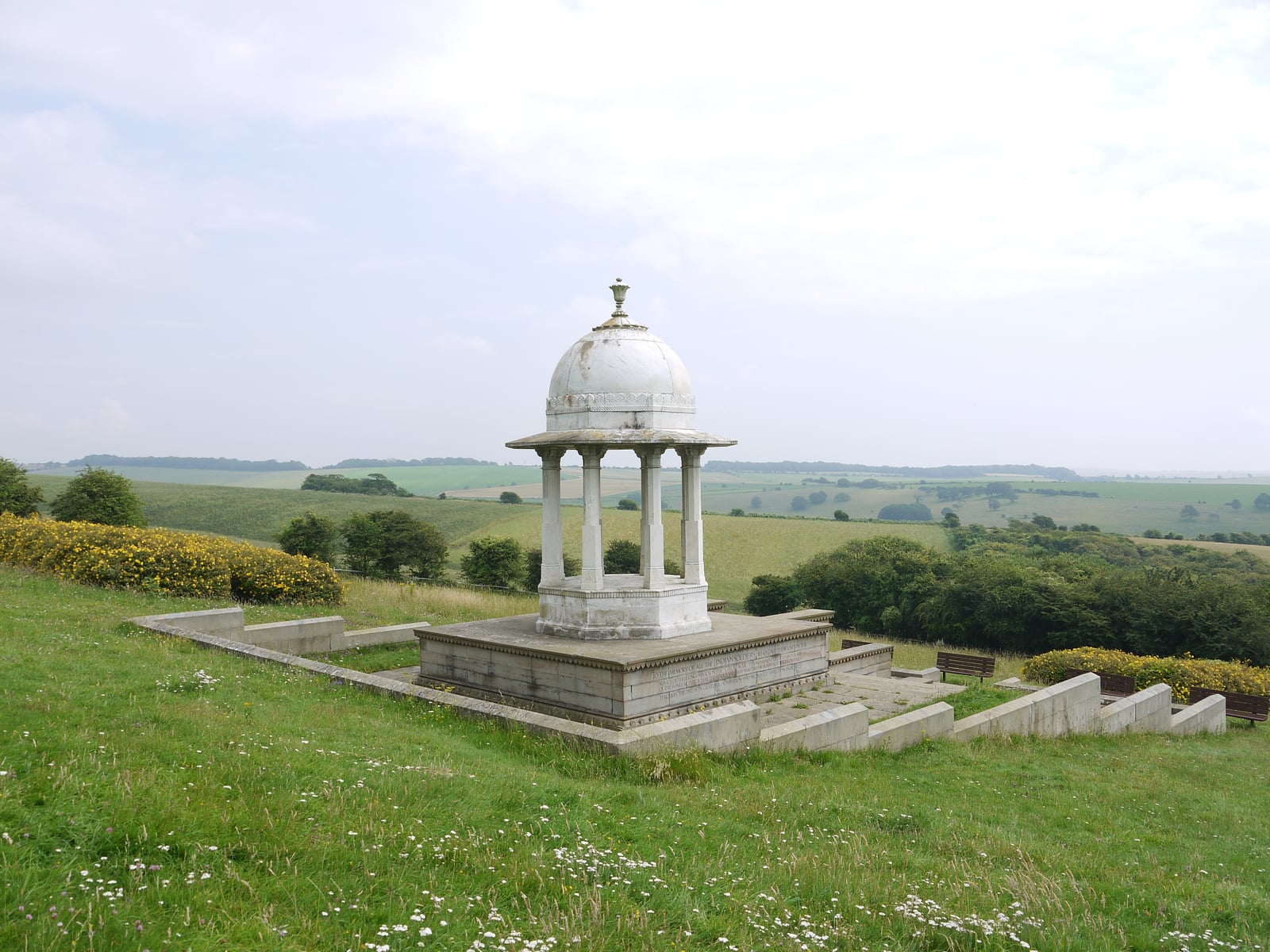
E. C. Henriques designed the monument under the supervision of Sir Samuel Swinton Jacob. White Sicilian marble forms an open pavilion: columns support a broad-eaved dome above a darker base. Historic England's description records the dedication to soldiers who died in the service of their “King-Emperor” and its promise of “grateful admiration and brotherly affection.” Those phrases belong to the monument unveiled in 1921.[1]
The wording brings affection and hierarchy into the same sentence. It honours Indian soldiers through their relationship to the sovereign. Reading that language now means recognising the political order that framed the tribute, while allowing that mourners could bring other loyalties and feelings to the place.
The memorial's later additions make that distinction visible. An inscription fixes the words chosen at one moment. It cannot permanently fix the reasons people gather around it.
Keeping the stone required ordinary work
Tom Donovan's history, published by the Chattri Memorial Group and drawn largely from India Office files, follows the less ceremonial aftermath. Brighton Corporation owned the monument and was responsible for its upkeep; the India Office had contributed to construction. A caretaker's cottage was completed in 1923. The caretaker and his wife were expected to supplement modest pay by selling tea, but too few visitors came.[3]
The arrangement proved fragile. After the caretaker died, his wife eventually left. By 1934, an applicant was told that the cottage had been dismantled. Meanwhile, complaints about neglect travelled between visitors, the India Office and the town. Donovan records a particularly sharp complaint from a walker in 1932, followed by official pressure for action.[3]
These details make maintenance part of the memorial's meaning. A dedication could announce lasting gratitude in a morning. Keeping that gratitude visible required wages, repairs and someone willing to accept responsibility. The surviving correspondence shows how easily a public promise became a recurring administrative argument.
A ceremony found new keepers
The British Legion revived its pilgrimage in 1951 and continued it until 1999, when ageing members, declining numbers and the practical demands of the event put its future in doubt.[3] Even the provision of tea mattered: remembrance depended on the social work surrounding the formal wreath laying.
Davinder Dhillon, a Sikh teacher in Brighton, took over stewardship of the annual service in 2000. He established the Chattri Memorial Group in 2005. His biography for a 2024 conference describes presentations and guided visits for schools and historical societies, extending the work beyond the ceremony itself.[4]
That succession changed who sustained the invitation to remember. Teaching and returning to the site could give a new generation reasons to approach an inherited monument. The dome remained recognisable; its public life depended on people making room for others around it.
Names beside the collective tribute
The CWGC's September 2010 announcement described a new memorial bearing 53 names, positioned a few metres from the Chattri. It also presented the unveiling as part of an educational effort to draw attention to Indian service in the two world wars.[5]
SikhMuseum's account records the unveiling on 26 September 2010 and describes five panels listing names, ranks and regiments. It also notes that John Otter, the former mayor who championed the Chattri, had proposed a tablet of names back in 1916.[6] Individual identification had a long history within the project, even though its physical expression at the site came much later.
The panels give a visitor a different way to read the place. A collective dedication can be taken in at a glance. A roll of names invites slower attention: one person, a rank, a regiment, then another. It supplies starting points for questions that the general tribute leaves open.
Read together, the two monuments preserve successive decisions about remembrance. The imperial dedication remains available for scrutiny. Beside it, the names draw attention to individual lives. Between those stones and the people who return to them, the Chattri's history continues to include both the promise made in 1921 and the work required to keep it meaningful.
Sources
- Historic England, “The Chattri,” list entry 1379911 — architecture, designers and the original dedication.
- Brighton & Hove Museums, “Indian Hospital Gallery” — hospital conditions, imperial publicity and funeral arrangements.
- Tom Donovan, history of the Chattri, Chattri Memorial Group (2005), drawing largely on India Office files: Part 2 — construction, unveiling and maintenance; Part 3 — the British Legion pilgrimage and postwar commemoration.
- British Association for Cemeteries in South Asia, “Indian Army — Conference at Brighton Dome, 15 September 2024” — Davinder Dhillon's stewardship, the memorial group and educational work.
- Commonwealth War Graves Commission, “War Graves Commission honours the fallen of India,” COI news release, 6 September 2010, reproduced by Wired-Gov — the new memorial, educational project and original unveiling date.
- SikhMuseum, “The Patcham Down Indian Forces Cremation Memorial” (2012) — Otter's proposed name tablet, the 2010 unveiling and the five inscribed panels.
- Harveyqs, “Chattri Brighton from the West,” photograph, 26 July 2021, Wikimedia Commons, CC BY-SA 4.0.